//

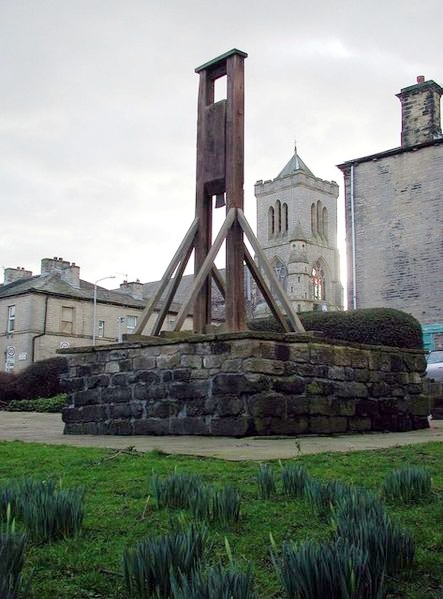
Photo: Paul Glazzard, CC BY-SA 2.0 via Wikimedia Commons
The Halifax Gibbet was an early guillotine used in the town of Halifax, West Yorkshire, England. Estimated to have been installed during the 16th century, it was used as an alternative to beheading by axe or sword. Halifax was once part of the Manor of Wakefield, where ancient custom and law gave the Lord of the manor the authority to execute summarily by decapitation any thief caught with stolen goods to the value of 131⁄2d or more, or who confessed to having stolen goods of at least that value. Decapitation was a fairly common method of execution in England, but Halifax was unusual in two respects: it employed a guillotine-like machine that appears to have been unique in the country, and it continued to decapitate petty criminals until the mid-17th century.
© OpenStreetMap contributors
Music, Comedy & Theatre in a historic building.
Bowling, Snooker, Pool & more
Traditional wool-trading centre of Halifax, dating from 1779, now housing three floors independent shops, bars & restaurants. The central feature is a large open square. There are several heritage displays throughout. Reopened in late 2017 after redevelopment.
Four floors of exhibits relating to social history, historic industries.
Construction of the chapel started in 1772 and it was visited by John Wesley. The building was converted in 1992 to a modern arts centre. The arts centre closed in 2025 and future plans for the grade II* listed building are uncertain in 2026.