//

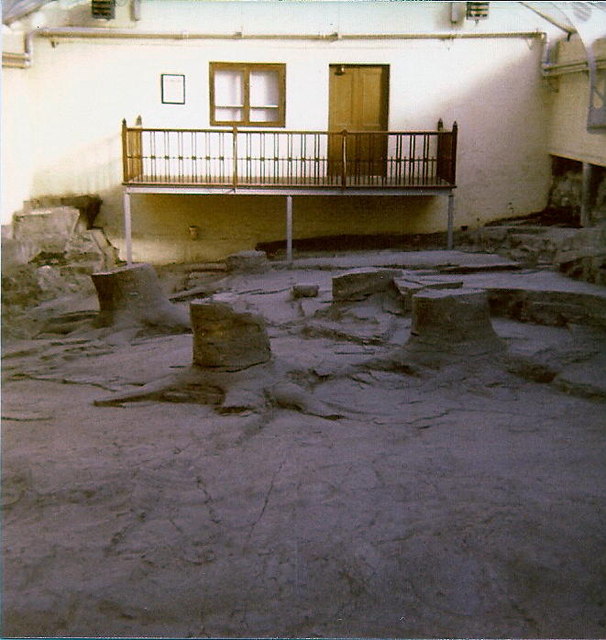
Photo: Elliott Simpson https://www.geograph.org.uk/profile/11965, CC BY-SA 2.0 via Wikimedia Commons
The remains of an ancient forest of Lepidodendron, extinct giant quillworts. About 330 million years ago this area flooded with mud, which killed the trees but made casts of their trunks. They were discovered during quarrying in 1887, and enclosed by a building for protection. This is open at weekends, while the rest of Victoria Park is always open.
The Fossil Grove is a group of plant fossils located within Victoria Park, Glasgow, Scotland. It was discovered in 1887 and contains the fossilised stumps and the stigmarian system of eleven extinct Lepidodendron lycopsids, which are sometimes described as "giant club mosses" but are more closely related to quillworts. The Fossil Grove is managed as a museum and has been a popular tourist attraction since it opened for public viewing in 1890.
© OpenStreetMap contributors
Govan became the city's main shipbuilding quarter once the Clyde channel was blasted open, and Fairfield was one of its leading companies. Built to impress in 1891, these were the august headquarters of a series of shipbuilders until the last vacated in 2001. It's now a heritage space and museum of Clyde shipbuilding.
Govan Old Church
The present church is from 1888, but there's been a church here since the 6th century, and from about 900 AD it looks to have been the ecclesiastic centre and royal burial ground of the Kingdom of Strathcylde. There's an impressive collection of 9th-11th century tombs and grave slabs, many of Norse "hogback" design, suggesting that Vikings and ancient Britons coexisted here whenever they weren't hacking each other to bits. Many stones were lost when Govan shipyards were demolished and they were mistaken for masonry rubble, and the survivors have been moved within the church for safekeeping.
Offers an excellent collection of vehicles and models telling the story of transport by land and sea, with a unique Glasgow flavour. Besides the usual rail locomotives, buses, trams, cars and planes, the museum also includes a recreated Subway station and a street scene of old Glasgow. The museum was designed by Zaha Hadid and completed in 2011.
Opened in 1921 in what had been a cab office and funeral parlour, this shows mostly mainstream films.
is across the street from Kelvingrove and mirrors its style. This was the city's main event and exhibition venue until SECC opened in 1985, see "Do". It's since been a bit of everything and nowadays is a study and research outpost of the Hunterian, a storage facility for Glasgow Museums, and has a climbing wall and soft play areas. The Moving Image Archive of the National Library of Scotland lets you watch archive films and videos - fill a wet afternoon by watching a 100 year old film.
"Zoology" over the door proclaims the intent, and it's a classical natural history museum where stuffed animals regard you with reproachful glass eyes.