//

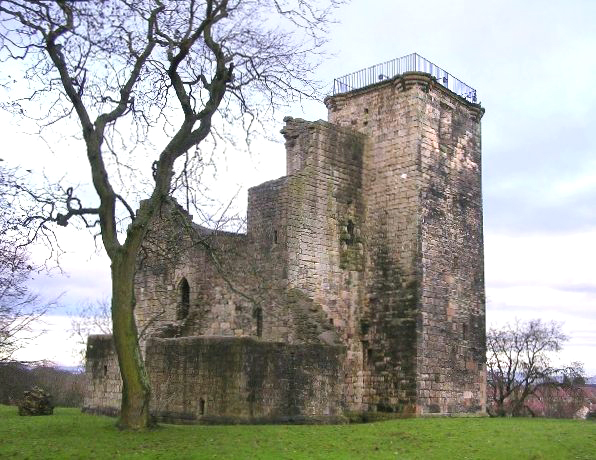
Photo: Chris Upson, CC BY-SA 2.0 via Wikimedia Commons
Ruin of a turret built in 1400 within a 12th-century earthwork, and repaired after a siege of 1544. It's perched on a hill over the Levern Water and has an unusual "X" design: a sturdy central keep within four corner towers; only the northeast of these survives.
Crookston Castle is a ruined medieval castle in the Pollok area of Glasgow, Scotland. It is located some five miles south-west of the city centre, on a hill overlooking the Levern Water, just before its confluence with the White Cart Water. Crookston Castle was built by the Stewarts of Darnley around 1400, and is set within earthworks constructed in the 12th century. Once the property of the earls and dukes of Lennox, the castle was extensively repaired following a siege in 1544, and it is the only surviving medieval castle in Glasgow.
© OpenStreetMap contributors
The park has a sports centre and an artificial ski slope. The park is often used for open-air concerts and similar events. Its biggest audience to date, of 250,000, was for the visit of Pope John Paul II in 1982. (Benedict XVI drew about a third of that in 2010.) The park used to extend all the way to Pollok Country Park, which you can reach (for the Burrell Collection) by walking along Drumbreck Road to pass under M77.
In 1901 a German design magazine ran a competition for a Haus eines Kunstfreundes, a house for an art lover. Charles Rennie Macintosh's entry was late and incomplete so it was disqualified, but awarded a special prize for its creative designs harmonising exterior and interior. From the 1980s there was a project to build to his original design, and this was completed in 1996. The building needed to pay its way, and wouldn't be viable just as a museum piece, so from the outset it was constructed as an event space not part of the original design for a residence. That means it's often closed, especially in wedding season. It is however a wonderful realisation of the Rennie Mackintosh style, which you will be so grateful you don't have to live in, with those bolt-upright chairs and where even the cutlery and bathroom fittings have to be exactly so.
Sir William Burrell (1861-1958) was a shipping magnate who amassed a huge art collection. He gifted it to the city with the condition that it should be displayed in a nearby yet rural setting, and this was difficult to satisfy until Pollok House was acquired in extensive parkland, and the purpose-built gallery was added. It was closed 2014-2022 for refurbishment and even now can only show a fraction of his 9000-strong collection. Other items appear in the various city museums such as Kelvingrove.
the Bears, the Gers
Rangers also play in the Premiership, where since returning they have finished runners-up to Celtic in all but one season. They play at Ibrox Stadium (capacity 50,800) in Govan and are Scotland's second-most successful club. In 2012, the business entity controlling the affairs of the football club entered liquidation, and the rest of Scottish football controversially voted for Rangers FC to start from the Scottish Third Division (now Scottish League 2) at the beginning of the 2012/13 season. They fought their way back up to re-enter the top tier in 2016, whereupon the 'Old Firm Derby' versus Celtic could resume its rightful place in the sporting calendar. Rangers women's team play in the Women's Premier League, their top tier; home games are held at Rangers training facility in Milngavie. See the club website for tickets, stadium and museum tours, and merchandise. In the summer of 2023 Rangers opened a new museum and events space called 'New Edmiston House'. The official Glasgow City Sightseeing tour bus will take you to Ibrox Stadium on the city tour where the stadium, museum and club shop can be visited.
Govan became the city's main shipbuilding quarter once the Clyde channel was blasted open, and Fairfield was one of its leading companies. Built to impress in 1891, these were the august headquarters of a series of shipbuilders until the last vacated in 2001. It's now a heritage space and museum of Clyde shipbuilding.
Govan Old Church
The present church is from 1888, but there's been a church here since the 6th century, and from about 900 AD it looks to have been the ecclesiastic centre and royal burial ground of the Kingdom of Strathcylde. There's an impressive collection of 9th-11th century tombs and grave slabs, many of Norse "hogback" design, suggesting that Vikings and ancient Britons coexisted here whenever they weren't hacking each other to bits. Many stones were lost when Govan shipyards were demolished and they were mistaken for masonry rubble, and the survivors have been moved within the church for safekeeping.