//

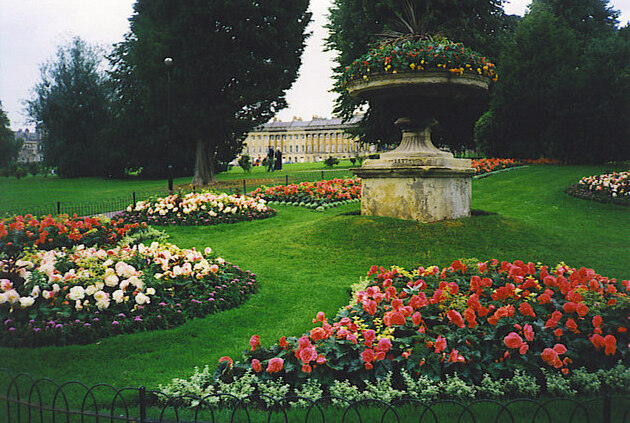
Photo: Colin Smith, CC BY-SA 2.0 via Wikimedia Commons
Bath's largest park in front of the Royal Crescent. Ideal for ball games or feeding the ducks. The Botanical Gardens in the north-western corner of the park make for a pleasant wander.
Royal Victoria Park is a public park in Bath, England. It was opened in 1830 by the 11-year-old Princess Victoria, seven years before her ascension to the throne, and was the first park to carry her name. It was privately run as part of the Victorian public park movement until 1921, when it was taken over by the Bath Corporation.
© OpenStreetMap contributors
A magnificent semi-elliptical crescent of houses designed by John Wood and completed in 1774. This was the first of Bath's eight crescents, and its shape remains unique. You can visit one of the houses which has been redecorated to resemble what it would have been like at the end of the 18th century. But you don't need to go in to admire the exterior and its view over Bath. There is also a large semi-circular lawn out the front owned by the Royal Crescent residents. It is separated from Victoria Park by a ha-ha (a recessed landscape design element that creates a vertical barrier while preserving an uninterrupted view of the landscape beyond).
Visitors can see this grand Georgian town house redecorated and furnished to show how it might have appeared in the late 18th century.
Dating back to 1761, this small garden has been through multiple transformations over the years. It has now been restored to a Georgian style (c. 1770–1836), with gravel, a stone path, and simple topiaries, and is open to the public. If you're near the Royal Crescent, the garden is worth a visit to step back into the Georgian era for a few minutes.
An excellent museum if you are interested in the history of science and astronomy music and culture at the time when Bath was at the height of fashion; it is also a perfectly restored Georgian townhouse of the type lived in by people of 'the middling sort' and the Georgian garden is delightful. William Herschel lived here with his sister Caroline, and it was here that he discovered the planet Uranus using what was then the world's most powerful telescope that he had made himself in his workshop. The museum has a gallery for temporary exhibitions.
The Circus is a striking circular arrangement of Georgian townhouses designed by John Wood the Elder and completed by his son in 1768. Inspired by classical Roman forms, its three curved terraces feature superimposed Doric, Ionic, and Corinthian columns, creating one of Bath’s most distinctive architectural set pieces.
A fascinating selection of ceramics, jades, bronzes, and other art from China, Japan, Korea and Southeast Asia.