//

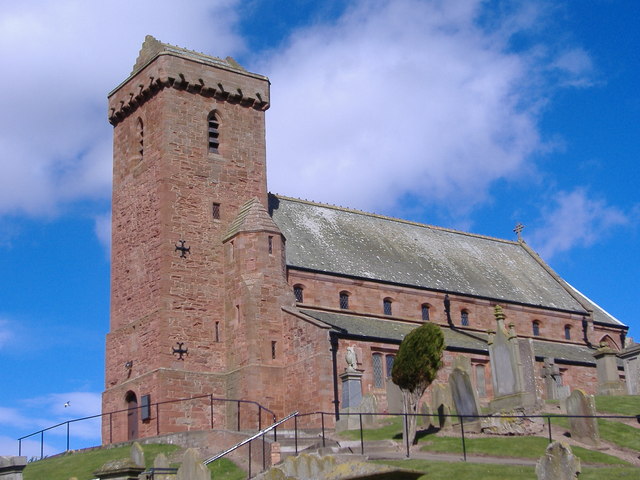
Photo: David Gray, CC BY-SA 2.0 via Wikimedia Commons
Approach from the east via St Vigean's Brae, a line of old sandstone cottages leading to a 17th-century bridge. It skirts the church, prominent atop a mound; this goes back to the 12th and 13th centuries but was over-restored in the 19th, so most ancient features were lost. An 18th-century legend had it that below lay an underground loch harbouring a kelpie, a shape-shifting evil spirit usually manifesting as a horse. It was, they said, harnessed to heave masonry up the mound to build the church, causing it to curse the church and its minister, who would be struck down or tumble to perdition in the loch. As an excuse not to go to church on Sunday, this was a beauty. The museum in the two cottages opposite the church displays 38 fine Pictish stones that formerly stood on the mound; the "Drosten Stone" is 9th century.
St Vigeans is a small village and parish in Angus, Scotland, immediately to the north of Arbroath. Originally rural, it is now more or less a suburb of the town of Arbroath.
© OpenStreetMap contributors
This was founded by King William I in 1178 for Benedictine monks, whose mother-house was Kelso. The king was buried here in 1214. It was here in 1320 that Scottish nobles signed the "Declaration of Arbroath" proclaiming Scotland's independence. The abbey fell into ruin after the 16th-century Reformation, and its roof-lead and masonry were pilfered. There remains an impressive shell of red sandstone (with the round "O", through which was shone a beacon to guide sailors), and the abbot's residence. The masonry of these is unsafe and they're closed, with ticket prices reduced.
The Bell Rock or Inchcape, 11 miles offshore, is only visible at low tide, with a long extension lurking just beneath the surface. By the 19th century it was wrecking half a dozen ships every winter. A 115-ft (35-m) lighthouse was built 1807-10 by Robert Stevenson, a daunting engineering challenge on such a small sea-washed foundation; and built so well that it has needed no alteration since. A shore station was built by Arbroath harbour: it housed the lighthouse keepers' families and the crew of the support vessel, and there was a tower for exchanging signals. In 1955 the support base was switched to Leith and the station endured a spell as Council housing, before being renovated as a museum; Bell Rock lighthouse was automated in 1988.