//

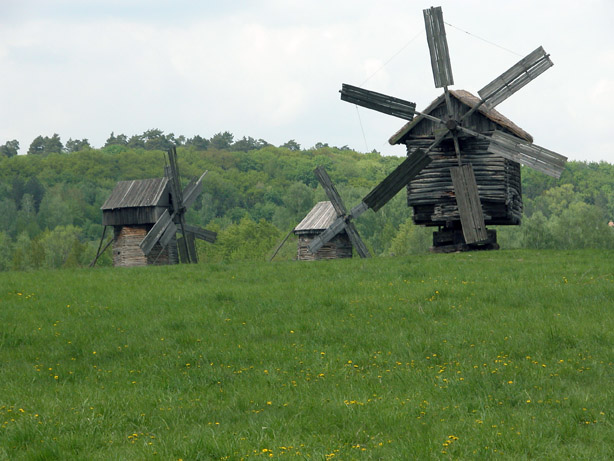
Photo: Kabinet at English Wikipedia, Public domain via Wikimedia Commons
Covering 160 ha, the area shows how people used to live in different parts of Ukraine. Six restored rural Ukrainian villages, with old huts, wooden mills and churches from all over Ukraine have been carefully restored and function as living museums. English-speaking (sort of) guides with expertise on the whole site are available and well worth-it. Ukrainians come on sunny days to relax in the grass.
The National Museum of Folk Architecture and Folkways of Ukraine, is a 133.5 hectare open-air museum located at 1 Akademika Tronka Street, in the Pyrohiv neighbourhood of Holosiivskyi District, Kyiv, Ukraine. An architectural and landscape complex representing the major historical and ethnographic regions of Ukraine, it is dedicated to the preservation and study of regional Ukrainian folkways.
© OpenStreetMap contributors
Національний ботанічний сад імені М. М. Гришка НАН України
The perfect place for a stroll in any season. There are unique floristic complexes on 130 hectares: "Forests of the plain part of Ukraine", "Ukrainian Carpathians", "Steppes of Ukraine", "Crimea", "Caucasus", "Central Asia", the "Altai and Western Siberia", "Far East".
Національний музей історії України у Другій світовій війні
A fairly large museum, starting with World War II, going through Nazi occupation until Ukraine's independence. The monument is 92 m tall, and for 200 ₴ ($6) you can take an elevator to the middle of it, and climb all the way to the top of the statue to enjoy the beautiful view of Kyiv from over there. The museum is at the base of the massive statue of Mother Ukraine. While the displays are mostly in Ukrainian. The museum has laminated cards in each room with varying languages including English, German and French. The museum also offers guided tours in several languages.
Київська фортеця
A 19th-century fortification building, that once belonged to the system of western Russian fortresses. Some of the buildings are restored and turned into a museum called the Kyiv Fortress, while others are in use by various military and commercial installations. It is semi-underground.
Indoor complex in the center of Kyiv. The hall hosts ice hockey, basketball and boxing competitions. Apart from sporting events, it's also the venue for Eurovision Song Contest and other concerts
Cave Monastery--Печерська лавра
One of the oldest and most important monasteries in Ukraine and in the territory of the former Soviet Union. Only the most important monasteries were designated as Lavras; there were only four, of which this Cave Monastery is the oldest. It was founded in 1077 by St Antoniy. The caves were dug out by priests who lived there as hermits. Nowadays, the caves are venerated by the faithful and tourists who visit the mummified monks, and pilgrims are still allowed access to the underground church there. There are two parts to the modern complex: the upper lavra, owned by the state and consisting of a number of museums (entry fee); and the lower lavra, owned by the Orthodox Church (Moscow Patriarch) and consisting of the caves (you'll need 1 грн to buy a candle to enter). Do not miss the display of micro-miniatures in the Upper Lavra. It sounds lame, but it is fascinating. You can enter the caves in the lower part if you dress correctly (women must cover their hair and wear skirts, no shorts. Expensive scarves are for sale there). Women can only just get away with pants in the winter. Start at the Lower Lavra, visiting the caves, before the crowds descend for the day. There are two cave complexes, each housing the mummified remains of monks, as well as religious icons and other relics. Both caves are accessed through churches, with the entrance to the shorter caves at the end of a boardwalk. While it is free to enter the caves, you must purchase a taper candle in order to light your way. The caves are not recommended for the claustrophobic or overly tall. Once you're in there, it's hard, even impossible to turn around and go back out - you have to keep going.
Дальні печери
Relics of 49 saints, accompanied by plates with names and icons. The total length of underground corridors is 293 m. There are three underground cave churches: Annunciation, Nativity and Reverend Theodosius.