//

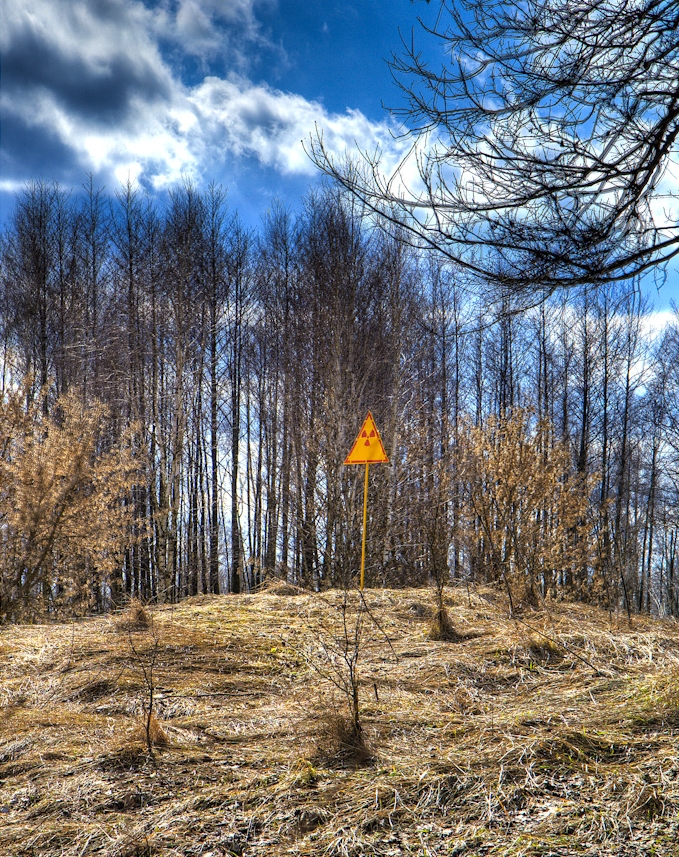
Photo: Timm Suess, CC BY-SA 2.0 via Wikimedia Commons
A strip of birch and pine forest that was contaminated with the worst fallout, killing off most of the vegetation because of the intense radiation and turning trees reddish brown — hence the name. Trees were felled and buried in trenches by liquidators, then covered over with soil and occasionally concrete slabs.
The Red Forest is still the most radioactive area in the Exclusion Zone, and marked with radiation warning signs but not fenced off in any way. As of 2019, radiation levels vary between 4 µSv/h (microsievert/hour) and 15 µSv/h, with local hot spots reaching 40 µSv/h. Spots where material is buried have considerably higher dose levels. It is recommended to stay no longer than 90 minutes around these hot spots (equivalent to a daily accumulated those of 60 µSv which is the threshold for radiation workers). As the most radioactive outdoor area in Europe, exploring the Red Forest is an experience on its own, but adequate safety measures must be taken. Wear protective wellies, carry an electronic dosimeter (PED) with warning threshold set no higher than 20 µSv/h, and do not touch anything. When leaving the Red Forest, protective wellies must be decontaminated (washed off).
If possible, take a geiger counter or similar radiation measurement device with you into the Red Forest to compare activity levels at different locations. Birch trees and lichen are particularly prone to absorbing radioactive Cesium (accounting to the majority of radiation after 32 years), and often read much higher radiation levels with peaks up to 3,000 counts per second not exceptional. Make sure the probe of the geiger counter does not touch any of the vegetation to avoid contaminating it!
The Red Forest is the ten-square-kilometre (4 sq mi) area surrounding the Chernobyl Nuclear Power Plant within the Exclusion Zone, located in Polesia. The name "Red Forest" comes from the ginger-brown colour of the pine trees after they died following the absorption of high levels of ionizing radiation as a consequence of the Chernobyl nuclear disaster on 26 April 1986. The site remains one of the most contaminated areas in the world today.
© OpenStreetMap contributors
Bridge between Pripyat and the Nuclear Power Plant. According to urban legends, on the night of the accident, people gathered on the bridge to watch the blue glow of ionizing air above the burning reactor, without knowing the dose rate was a deadly 500 R/h. The myth was propagated by journalists and stuck, whereas in reality the dose rate was much lower and no direct casualties were recorded among observers.
Гейферний ковш
A crane gripper used to remove radioactive debris in the aftermath of the accident. It remains measurably radioactive, and is often cited in popular culture as the most radioactive object in Pripyat city. Because of the natural decay of radioactive isotopes, the claw can nowadays be approached safely but should not be touched to avoid contaminating oneself.
A monument dedicated to the thousands of workers who put their lives and health at stake during the construction of the Sarcophagus.
NSC
A 100-m-tall arch designed to replace the iconic sarcophagus as confinement structure to keep radioactive materials contained. It can be seen from a distance of kilometres away. You'll not be able to get too close, but the nearest observation point is 200 m away. The only way to get closer is if you are a scientist or a film maker that has had months of preparation in advance. Although radiation levels here will be much higher than elsewhere in the region, you will not be able to pick up a significant dose during your stay.
The largest mural in the Exclusion Zone, depicting Przewalski horses living in harmony with the power of the atom in the hand of mankind.
A roadside concrete mixing plant with 4 hoppers and supporting facilities that transferred and produced the concrete that was used for the construction of the Sarcophagus. Some rubble with white tiles has been dumped on the site after the completion of the construction work, and is noticeably radioactive (~ 5 µSv/h).