//

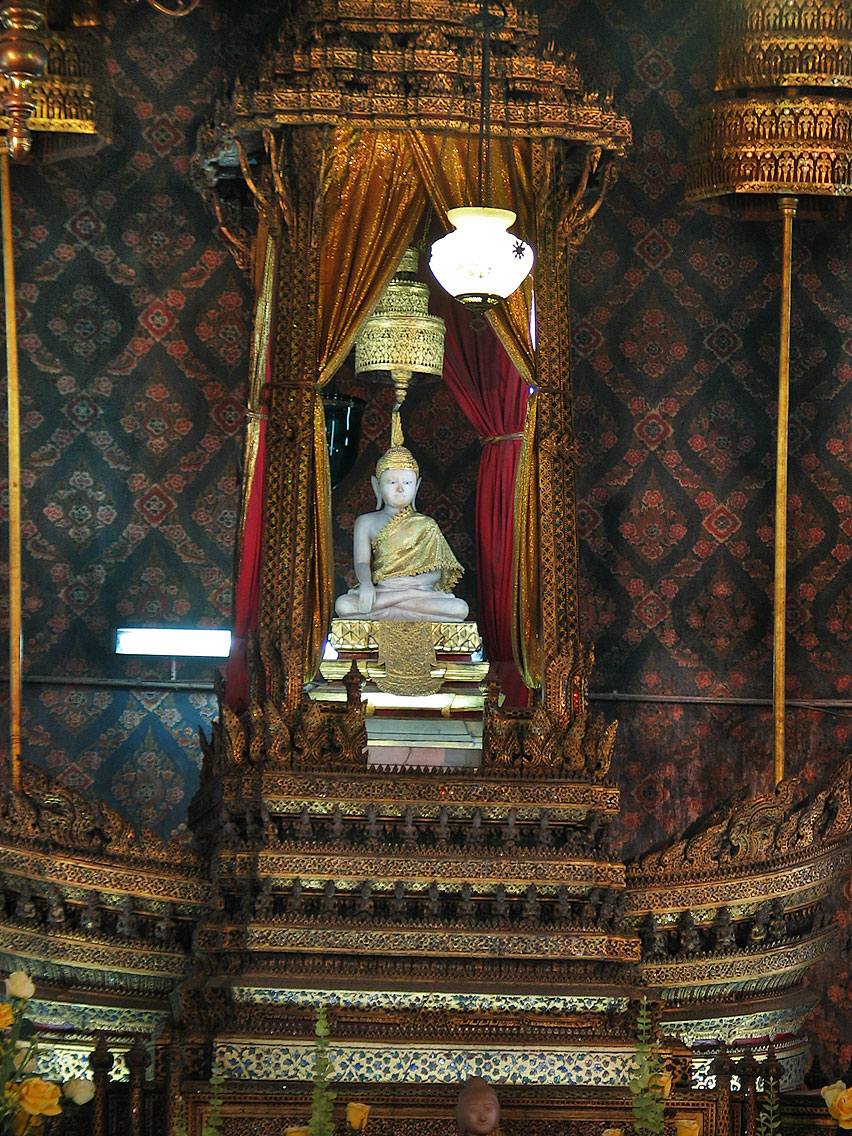
Photo: Heinrich Damm (User:Hdamm, Hdamm at de.wikipedia.org), CC BY 2.0 via Wikimedia Commons
The temple was built in 1836, during the reign of King Rama III. Like other temples from the third reign, it has a Thai layout, but is combined with a mixture of Chinese architectural styles. The gables are decorated with Chinese porcelain pieces and there are Chinese statues all over the complex. Unfortunately, the temple is in desperate need of renovation. Sunthon Phu, one of Thailand's greatest poets, resided in this temple during his monkhood in the early 1840s. The quarters where he spent three years of his life are preserved at the rear of the compound, and might be turned into a museum. In 1986, UNESCO declared Sunthon Phu one of the world's greatest poets.
© OpenStreetMap contributors
วัดราชนัดดาราม
Wat Ratchanaddaram is a temple compound built by order of King Rama III in 1846. Its main structure, Loh Prasat (โลหะปราสาท, Thai for metal castle), is easily spotted as its spires are of black iron, not the usual glittery gold. It is in a highly unusual style: the wat itself is a five-storied gleaming white structure with rows of Buddhas and nice views from up top, very elegant, calm and relaxing after the crowds at the big temples. A good view of Bangkok is afforded from the top tier. The 37 metal spires signify the 37 virtues towards Enlightenment. At night, the square around it is beautifully illuminated. Also check out the Buddhist market at the rear of the complex.
พระบรมราชานุสาวรีย์พระบาทสมเด็จพระนั่งเกล้าเจ้าอยู่หัว
This monument dedicated to King Rama III was built by the Fine Arts Department in 1990. The bronze statue, half larger than life size, is seated on a throne. The surrounding area has been turned into a beautiful square decorated with beautiful plants, the Royal Reception Pavilion and three minor pavilions known as Sala Rai, as well as a nice view on Wat Ratchanaddaram. At night this square is beautifully illuminated.
วัดสระเกศและภูเขาทอง
Wat Saket was built outside of the former city walls in the late 18th-century in the reign of King Rama I. It served as the capital's crematorium, and throughout the next century became the dumping ground of over 60,000 plague victims who were too poor to afford a funeral. Wat Saket's major feature is the Golden Mount, an artificial hill dating from the early 19th-century. A huge chedi was built on top of the hill in the reign of King Rama III, but it collapsed during the construction process as the soil was too soft to support it. King Rama IV used a 1,000 teak logs to secure the mound and started construction on a more modest chedi that still exists today. Later, King Rama V chose the chedi as the place to inter relics of the Buddha that had been discovered among the ruins of Piprāwā, India and presented to him by the British Government. A spiral staircase of 318 steps leads from the ground to a terrace and shrine-room — the Buddha's relics are housed in a gold-leaf-covered shrine at the centre of this area. In the first week of November, the mount is illuminated with coloured lanterns and the compound turns into a large fun fair.
ป้อมมหากาฬ
Mahakan Fort is one of only two remaining forts of Rattanakosin's outer city walls, the other being Phra Sumen Fort near Khao San Road. Mahakan Fort is on the banks of Rop Muang Canal, and a part of the former ring of forts that defended Rattanakosin Island from invasions from the east. It was built during the reign of King Rama I. What makes this fort unique compared to Phra Sumen Fort is that a part of the old city wall is still intact; it runs about 200 metres south along Maha Chai Road. An almost a century old community lives in shanties between the old city wall and the canal, but the Bangkok Metropolitan Administration has been trying to turn it into a public park for tourists (as was done around Phra Sumen Fort). After a 14-year legal dispute, it seems like a compromise has been reached where some houses of the old community will stay and be turned into museums.
หอศิลป์สมเด็จพระนางเจาสิริกิติ์ พระบรมราชินีนาถ
This privately funded gallery was established after the request of HM Queen Sirikit who wanted a permanent venue for the exhibition of Thai arts. The gallery has four floors of contemporary and modern arts, including paintings, sculptures, audiovisual arts and even furniture arts, most of them created by students. Many paintings use elements of traditional Thai life and religion and place them in a contemporary setting. Taking pictures without using the flash is allowed. There is also a reading room and a café.
วัดสุทัศน์และเสาชิงช้า
This wat is becoming more and more off the beaten path as it is quite hard to walk here from the Grand Palace. Wat Suthat is huge and actually one of the most important temples for the Thai people. It's large size was needed as it was constructed in the early 19th century to house the huge Phra Sri Sakyamuni Buddha image, brought all the way down from Sukhothai by boat. The outer wall of the cloister has more than 150 Buddha images lined up, and as they are being re-gilded, they are in various states of repair. Outside is an open courtyard with many Chinese statues. The Giant Swing (Sao Ching Cha) is a huge red frame on the plaza opposite the main entrance of Wat Suthat. The swing was used in an annual ceremony where teams of young men would try to swing high enough to retrieve a sack of gold that was tied to a pole about 25 metres high in the air. The ceremony has been banned since 1932, as many people got injured or died trying. The swing was fully renovated in 2007 and now looks as good as new.