//

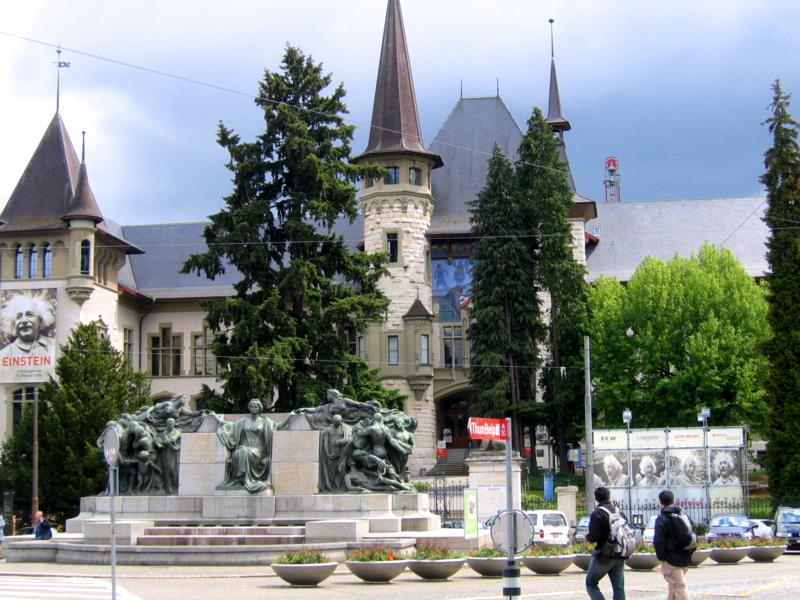
Photo: ZachT, Public domain via Wikimedia Commons
Large historic museum, combining under one roof one of the country's most important ethnographic collections together with the Bernese historical collections from prehistory to the present day.
The Bern Historical Museum is the second largest historical museum in Switzerland. It was designed by the Neuchâtel architect André Lambert and built in 1894. Since it was initially conceived as the Swiss National Museum, the architect took as his model various historic castles from the 15th and 16th centuries. An extension to the original museum building was completed in 2009.
© OpenStreetMap contributors
Alpines Museum
A museum describing all aspects of the Swiss mountains: geology & tectonics, glaciers, weather, wildlife, agriculture & settlement, and alpinism and winter sports. With a large collection of artwork, e.g. paintings by Ferdinand Hodler.
Federal Palace of Switzerland; Curia Confoederationis Helveticae
Inaugurated in 1902, the Swiss Parliament building is a great dome separating the two chambers: the National Council and the Council of States. Free guided tour when Parliament is not in session (German Tu-Sa, English only Sa 14:00, book online). In session, there are 25 spaces in the spectators' gallery, no advance booking. For either, you need your passport.
Suppose a Bern Tram passed you at the speed of light, with Einstein peering out the window. While your own watch ticked on, his would appear stationary, and the tram's mass and dimensions would distort. Most of us would just shrug at this and await the next tram. But Einstein realised that the same occurred if you were aboard the tram looking back at the tourist standing at the tram-stop. There could be no absolute reference point: all was relative. He also inferred an equivalence of acceleration and gravity, and of mass and energy, that totally rewrote the laws of what till then was a Newtonian universe.
Einstein rented this flat 1903-05 with his first wife Mileva, during his years working at the Swiss patent office. (The day job helped, as many inventors were exploring telecomms, and the problem of synchronising processes many miles apart.) Their son Hans Albert was born here in 1904; their illegitimate daughter Lieserl (b. 1902) was given up for adoption and her fate is unknown. But above all Einstein's special and general theories of relativity were born in this flat, which now displays photos and original documents from his life, work, and speeches. His writing desk overlooks the bustling street: trams rumble by, and the clock-tower tick-tocks, with a Swiss regularity that we now know to be deceptive. See Golden Age of Modern Physics for context.
It has been a guard tower, and a prison for women convicted of having sex with priests, but since the 15th century, it's been a clock tower with an elaborate astronomical clock. Hourly throughout the day, it puts on a great display of early animatronics. The show starts a few minutes before the hour with a little song and some drumming by a jester on top. On the hour, bears and an old bearded king get into the act. As well as the time, the clock shows the month, day, sign of the zodiac and phase of the moon. There are guided tours inside the tower that will let you have a look at the clockwork while the show is displayed outside. It can be booked at the tourist office and is definitely worth it if you love mechanics.
In July the Gurten hill is host to an open-air festival with many national and international music acts. During these four days you will find a party crowd of up to 25,000 people on the hill day and night.
Bärengraben & BärenPark
Run as an outstation of the city's Dählhölzli Zoo, the bear pit has a tunnel through to a bosky enclosure along the steep river bank, around which the bears can roam and swim. There are three: Finn (b 2006) is Daddy Bear, Björk (b 2000) is Mummy Bear, and Ursina (b 2009) is their daughter. Björk has been sterilised so there will be no more cubs: "More space for fewer animals" is the zoo's motto. These are Eurasian brown bears, Ursus arctos arctos, with a round head and yellow-brown fur; they remain common in the wild in Central & East Europe. A second smaller pit is bare of bears but describes the history of the pits. Next to this is the Old Tram Depot, see "Eat".