//

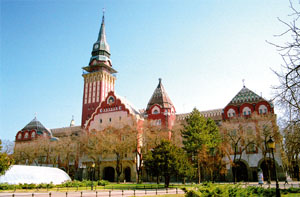
Photo: Саша Стефановић at Serbian Wikipedia, Public domain via Wikimedia Commons
The City Hall was built between 1908 and 1912. The decorative features of Art Nouveau are enriched with a romantic nuance of the Hungarian folklore, by floral elements made of ceramics and wrought ironwork forging. The Council Hall and its splendid stained glass windows are the heart of the building. Building’s 45 m high observatory provides an unforgettable sight of Subotica and its outskirts.
The Subotica City Hall is the administrative seat of the city of Subotica in the province of Vojvodina in northern Serbia. The building is one of city's most prominent landmarks. Constructed between 1908 and 1912 when Vojvodina was a part of Austro-Hungarian Transleithania, the building was designed by Hungarian architects Marcell Komor and Dezső Jakab in the Hungarian Secession style, a branch of Art Nouveau. Today, it serves both as the center of local government and as a major tourist attraction in northern Serbia.
© OpenStreetMap contributors
Liberty Square
Unlike many European towns, the City Hall in Subotica dominates the city centre instead of a church or a cathedral. The City Hall is a master peace of Hungarian version of Art Nouveau built in 1912. It is flanked by a park with a fountain and a vast square where many concerts and bazaars are organized throughout the year. It is surrounded by the building of People's Theatre that is undergoing a major reconstruction. It was built as a classic style building characterized by six Corinthian columns. On the eastern side of the square there is a neo-baroque building of The Public Library. The two Atlases carrying one of the nicest balconies in the city make this building charming. The Emperor Jovan Nenad Monument in the middle of the square represents a controversial historical figure. He styled himself emperor and pronounced Subotica his capital in 1527, but all lasted for a very short period of time. Not far from the monument there were two ceramic fountains. The Green Fountain (1985), and the Blue Fountain (2001). Both were made of Zsolnay tiles, likewise all decorative ceramics and roof tiles of the city’s Art Nouveau buildings. Unfortunately, the Green Fountain could not be easily renovated and was substituted by a generic one.
Example of the Munich Art Nouveau (Jugendstil) in Subotica is the building number 3 in the Korzo Street. The facade of the 19th century the Golden Lamb Hotel was adapted in 1904 by the local architect Titus Mačković. In the 1980s it was pulled down and built as it once looked like.
The architect, Pál Vadász although being the creator of the genuine geometric Viennese Secession in Subotica, designed this building in simple, almost modern concept in 1913. This was a tenement building and it was commissioned by the Council of Subotica.
This Church dedicated to St. Michael the Archangel was built in 1736, on the ruins of the medieval fortress from the 15th century. Attached to it is a friary with a chapel dedicated to the votive painting, the Black Madonna. The church, classified as a neo-Romanticism building, is part of the Franciscan monastery.
This building was designed by M. Komor and D. Jakab who, after completing one big commission (the Synagogue), were waiting for the new one (the City Hall). Designed also in Hungarian version of the style, it was built in 1908 for the Subotica Savings Bank. Because of its function, many corresponding symbols can be found on the facade. Squirrel – symbol of diligence, beehive - symbol of thrift, owl – symbol of wisdom.
EuroCinema has on its repertoire mostly European films including Serbian ones and the award-winning productions at prestigious European film festivals. Beside that some box-office films are occasionally shown in the cinema, too.