//


Historical region in Central Europe
Photo: Borja González Blázquez, CC BY 2.0 via Wikimedia Commons
Transylvania (German : Siebenbürgen) is the largest region of Romania and probably the best known one. When you visit Transylvania you dive into a mix of cultures, nature and history. Transylvania is a diverse region: it is worth trying to observe the differences that exist within the region, both culturally and naturally. This region is a place with abundant history and multicultural convergence. All over Transylvania the cohabitation of Romanians, Hungarians, Saxons and Roma is the leading theme. Transylvania is rich in myth and misty medieval sites: there about 100 castles and fortresses and about 70 fortified churches. Romania's greatest and best preserved castles and fortresses are to be found here. But for the more curious traveler, there are many small villages with old houses and fortified churches. As Transylvania is circled by the Carpathian mountains there are a lot of mountain forests and hiking or climbing possibilities. All over the Carpathians there are great national parks. In the center of Transylvania there are green hills and rivers. Most big cities are very western Europe like, and the infrastructure is generally good, making it easy for travelers.
This region, with Sibiu and Brașov, has a more pronounced Saxon (German) background. It is one of the most popular places for travelers due to its richness in fortresses (Rasnov, Bran, Rupea), old towns, fortified churches in picturesque villages (Biertan, Valea Vilor, Prejmer) and mountain forests (Piatra Craiului). It is also home to some of the most important ski resorts (Poiana Braşov).
The region around Sfântu Gheorghe, Miercurea Ciuc and Târgu-Mureş has strong Hungarian cultural influences. The counties Harghita (Miercurea Ciuc) and Covasna (Sfântu Gheorghe) are also known as the Szeklerland. Here you can buy fresh bread and Kürtőskalács from locals or see the Sfânta Ana lake.
Hunedoara (Deva) and Alba (Alba Iulia) are important historical sites for Romanian culture. Alba Iulia was the place where the unification of the Romanian regions was decided. In this region you can see the great Corvinești Castle, lakes, caves and other beautiful natural sites. The main access points to Retezat National Park are to be found here.
Cluj and Bistrița-Năsăud are harder to define in terms of a predominant culture. Cluj Napoca is a very important university and research city. It also has important historical and cultural landmarks. Around it there are picturesque villages (Romanian, Hungarian and German). Near Turda you can visit the imposing Turda Canyon. Bistrița-Năsăud is famous for its lakes, caves, health resorts, but also historical sites.
Transylvania is a must see destination for people travelling in this part of Europe.
Read in the guideChoose an airport to see hotels, stations, taxi ranks and car rental desks around it.
Cluj-Napoca · International · CLJ
Loading places around the airport…
an ancient city with a small, 14th-century citadel
home to a massive baroque fortification built in the 18th century, with a medieval Catholic cathedral

a modern industrial city with a well-preserved Old Town

the biggest city in Transylvania, also called "The heart of Transylvania"

a compact city with German flair, medieval charm, excellent views of the surrounding landscapes, great food, and stunning parkland

a small medieval fortified city, listed by UNESCO as a World Heritage Site
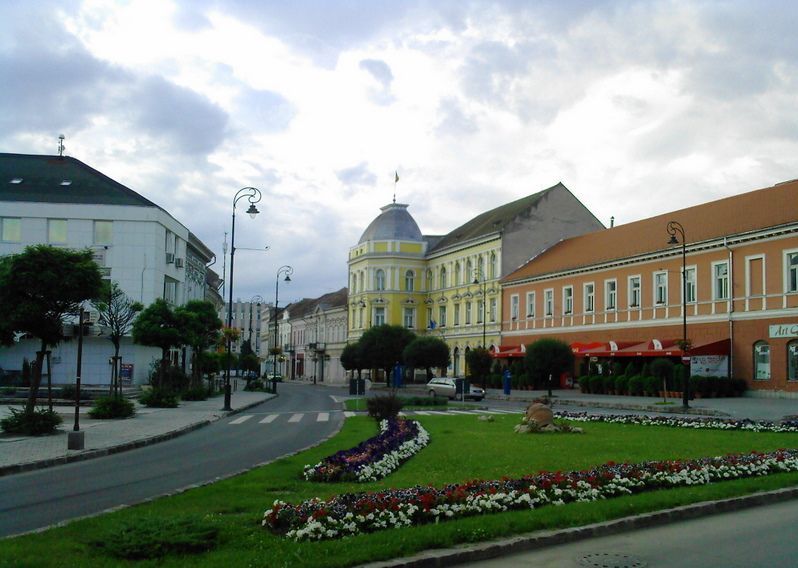
one of the oldest cities in Transylvania, it is a centre for the Hungarian-speaking people of the region

famous for its Art Nouveau buildings, Târgu Mureș is the cultural and economical centre of the Székely Land of the Hungarian minority

home to a restored Saxon fortress from the 14th century, and to many old Saxon houses
Huedin and surrounding villages, an agrotourism and ecotourism hotspot, as they offer wonderful scenery, secluded areas, great Romanian social and rural experiences
the highest mountain resort in Romania
one of the most beautiful parks in Romania
Târgu Secuiesc, Miercurea Ciuc, are home to the Szekler people, also known as Szekely, who are a Hungarian-speaking people of Transylvania

visit the former Salt mine, now a tourist attraction and amusement park
a remote mountain community, where you can experience farming, forestry and shepherding
Articles and travel topics about Transylvania and Romania.
 Itineraries
The Transylvania Triangle Train Tour is a 12-day "self-guided" train tour of the main attractions of Transylvania, Romania.
Wikivoyage
 Itineraries
The Braşov cultural itinerary is an itinerary of the city of Braşov (in Transylvania, Romania) from a cultural point of view.
Wikivoyage
 Culture & history
The Austro-Hungarian Empire (German: Österreichisch-Ungarische Monarchie, Hungarian: Osztrák–Magyar Monarchia) or Austria-Hungary was a constitutional dual monarchy that existed from 1867 to 1918.
Wikivoyage
 Travel tips
Dracula is without question the most famous vampire in fiction. Based on Bram Stoker's interpretation of Eastern European vampire myths and with a very tenuous relation to the 15th-century historic figure Vlad the…
Wikivoyage
Every section of the guide. Open one to read it in full.