//

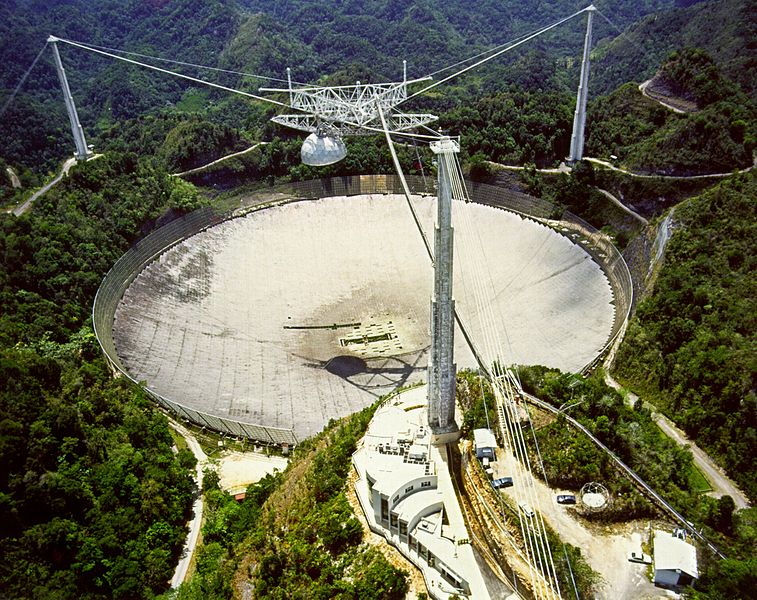
Photo: H. Schweiker/WIYN and NOAO/AURA/NSF, CC BY 4.0 via Wikimedia Commons
On a mountainous and somewhat isolated (but fairly well signposted) road, the Arecibo Observatory is home to what was for over 50 years the world's largest radio telescope, operated by SRI International, USRA and UMET, under a cooperative agreement with the National Science Foundation. The telescope collapsed in December 2020, but the observatory is open to visitors as of March 10, 2022.
The Arecibo Telescope was a 305 m (1,000 ft) spherical reflector radio telescope built into a natural sinkhole at the Arecibo Observatory located near Arecibo, Puerto Rico. A cable-mounted, steerable receiver and several radar transmitters for emitting signals were mounted 150 m (492 ft) above the dish. Completed in November 1963, the Arecibo Telescope was the world's largest single-aperture telescope for 53 years, until it was surpassed in July 2016 by the Five-hundred-meter Aperture Spherical Telescope (FAST) in Guizhou, China. Decommissioning the Arecibo Telescope was announced in November 2020, and the telescope collapsed in December 2020.
© OpenStreetMap contributors
downtown Arecibo
See the historic Roman Catholic church, Spanish-style recreational plaza, and the municipal buildings surrounded by streets and shops.
You can drive around the pueblo or park your car and walk around the square and into the plaza. The Spanish law, which regulated life in Puerto Rico in the early 19th century, stated the plaza's purpose was for celebrations and festivities.
Parts of the state forest are open to visitors for hiking, mountain biking, camping and bird-watching.