//

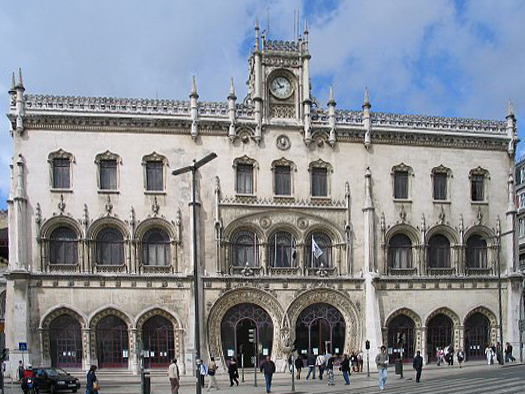
Photo: Osvaldo Gago, CC BY-SA 2.0 via Wikimedia Commons
Built in 1890 as the Estação Central (Central Station), it was the main railway hub until 1957. It provides a direct connection to Sintra in about 40 min. The trains access the station through a 2.6-km long tunnel. The main facade is an example of the Neo-Manueline style, a revival of Gothic style in Portugal during the mid-19th century.
The Rossio Railway Station is a railway station in Lisbon, Portugal, located in the Rossio square. The station was formerly known as Estação Central and that designation still appears in its façade. Trains gain access to the station, which is in the central urban area of Lisbon, through a tunnel which is over 2.9 km (1.8 mi) long.
© OpenStreetMap contributors
A palace constructed in the 18th and 19th centuries. Visits can be arranged in advance via email. Concerts (some of them free) are offered.
Excellent vertical view of the Baixa streets, next to Igreja do Carmo. The line can be quite long, you may want to consider walking up and riding it down instead.
Fado in Lisbon
A typical Portuguese Fado concert hall with daily evening shows. Run by a young Fado guitarist from Lisbon. The show lasts about one hour.
This magnificent plaza, facing the river, is the beginning of Lisboa's downtown. It is also known as 'Terreiro do Paço', meaning 'Grounds of the Palace', relating to its function before the Great Earthquake of 1755. The upper floors of the yellow buildings surrounding the square are mainly used as government offices, while the lower floors often contains cafés and restaurants. King Josef I, who ruled during the reconstruction of Lisbon, is seen as a mounted statue in the middle of the square, while the arch facing north is a tribute to the explorer Vasco da Gama.