//

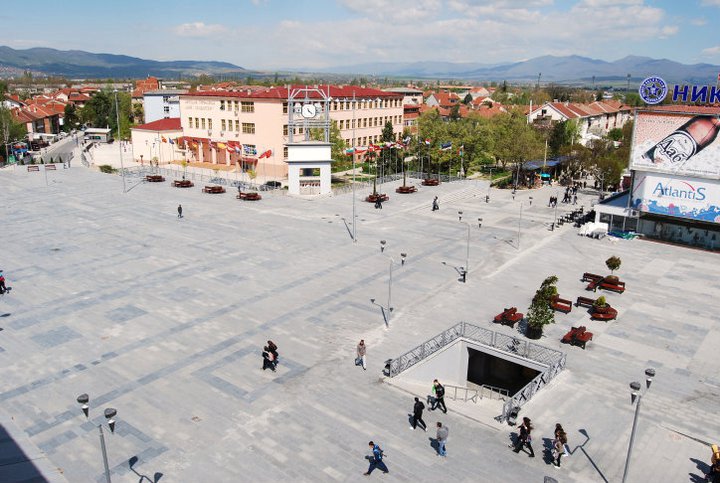
Town in Southeastern, North Macedonia
Photo: Тиверополник, CC BY-SA 3.0 via Wikimedia Commons
Strumica (Macedonian Cyrillic: Струмица) is a city in Eastern North Macedonia, situated near the tripoint with Bulgaria and Greece. Strumica is a well developed small city with about 40,000 residents and is the seat of its own municipality. It is a great place to stop by and, depending on your time, you have a lot of things to do. You can go shopping, take a walk through downtown and enjoy the cafés and restaurants, which are in quite a number, or you can surprise yourself with the historical and natural wealth that this area offers.
From the travel guide. Select a place for details, a map and what is nearby.
Плоштад Гоце Делчев
Strumica's central square lies above Maršal Tito Boulevard, just west of Leninova Boulevard. It was built in 1970, and was completely redesigned in 2010. The mostly concrete square now contains fountains, a modern clock tower, and shrubbery. Its centrepiece remains a large statue of revolutionary Goce Delčev, erected in 1973. Among the other monuments is the statue Strumica Under the Mask, commemorating the historic Strumica Carnival. The Anton Panov National Theatre fronts the square.
Градски парк Струмица
If you decide to take a casual walk through the city, then first rule is never miss the park. Strumica offers locals and tourists a common place, a greatly managed urban park that will let you enjoy the nature away from the traffic, but more importantly, walking through the park you will get to know the spirit of the locals. The park has a large area and is accessible from anywhere. If you are on the city square, just head down towards the café street (Blagoj Jankov Mučeto St). The park in Strumica has a good number of features: A few restaurants, playgrounds, but also the Amphitheatre and the football stadium are here. However, the number one place where everyone go to while at the park is the small artificial lake (ezero), in front of the stadium.
Strumica Fortress; Цареви кули; Струмичко Кале
Strumica's fortress dates from the 11th century. It sits just west of town, overlooking the city from its elevated position. It was used under the Byzantine, Bulgarian, and Serbian empires. It then fell under Ottoman rule and by the 17th century it was completely abandoned. The site, however, was used again during the Balkan Wars and the World Wars. A restoration effort of the fortress began in 2014.
Собрание на Општина Струмица
This building and several of the ones surrounding it were built in the late 1920s in the neoclassical style. The city hall has a prominent balcony over its main entrance. It is located at the intersection of Sando Masev and Gjorče Petrov streets.
Стара турска пошта
This 19th-century building served as a post office during Ottoman rule. The building is a good example of traditional Ottoman architecture. It was a private residence until 2005 when it was converted into a museum.
Струмички музеј
Established in 1952, the Strumica Museum showcases some of the history, ethnology, and archaeology of the area, including pieces from many of the significant sites listed in this travel guide. It is in a neoclassical building built in 1931, which it shares with the State Archives.
Хотел „Српски крал“
This historic building is also in the neoclassical style. Built in the 1920s, it functioned at Strumica's first brothel. For the next couple decades it remained a place frequented by the elite. During communism, the building was nationalised and served different purposes before falling into neglect after the 1980s. ProCredit Bank bought and renovated the building in 2010.
Спомен-костурница
Built atop a hill in 1979, this communist-era monument memorializes many of Strumica's fallen in the National Liberation War. In 1982, remains of many soldiers were placed in the sarcophagus of the memorial. The complex is made of white marble and sits in not-so-great condition, with graffiti painted in various areas.
Орта џамија
This building was built as a church during the Byzatine period, presumably in the 11th or 12th centuries. Some remnants of frescoes can be found in the foundations of the structure. Following the arrival of the Ottomans, the church was converted to a mosque. The square-based mosque has one minaret. Within the complex of the mosque are archaeological excavations. While it was in use by the city museum, the building has been closed for years because of fears that it can be damaged. Thus, it can only be viewed by visitors today from the outside.
Црква „Св. Петнаесет тивериополски маченици“
This complex of churches contains ruins from the original church dating from the 4th and 9th centuries, and from the present-day church built in 1972. The church complex is dedicated to the group of martyrs killed in Strumica (Tiveriopoulos) in the 4th century for not adhering to the pagan beliefs during the early Byzantine Empire. The group is considered the patron saints of Strumica and December 11, considered the day of their execution, is observed throughout the city.
Катедрална црква „Успение на Пресвета Богородица“
This is the cathedral church of the Macedonian Byzantine-Catholic Church, which is in full communion with the Holy See. Construction began on the church in 1925 and it was consecrated in 1931. It is a red-brick church with a taller central tower.
Црква „Св. Кирил и Методиј“
This church has an architectural style not commonly found in North Macedonia - it has a tall Russian/Gothic appearance and the funding of its construction in 1905 was provided by Russian missionaries on Mount Athos. The paintings on the iconostasis were completed in 1935. The church has a bell tower on the west side.
Вељушки манастир
Among the most important monasteries in North Macedonia is the Veljusa Monastery, built in 1080. Dedicated to the Holy Mother of God, it remains in very good condition inside and out. Byzantine Emperor Alexios I Komnenos visited the monastery several years after its construction and expressed a strong admiration for it. The church is cross-shaped with three multi-sided domes, including two above the church and one above the exonarthex. Its important frescoes were primarily painted in 1085, though the porch painting was done in 1164 and most of the nave was done in the 19th century. A cross in red brick on the southern wall of the church is an important symbol of the Macedonian Orthodox Church.
Водочки манастир
This monastery, the seat of the Strumica Diocese, consists of the main church dedicated to St Leontius as well as archaeological remains of early Christian basilicas. The earliest remains date from the 5th century and are visible around the complex. The Church of St Leontius, dedicated to the martyr from Tripoli, contains two prominent domes. The church was built in the 12th century but has had multiple revisions over time since its original construction.
Бања Банско
A thermo-mineral healing spa from Late Antiquity. It was uncovered in 1978 when digging began for the construction of the Tsar Samuel Hotel. The archaeological site covers an area of . The preserved walls range in height from 2 to 6.7 m (6.6 to 22 ft). There are a total of five thermo-mineral springs. The temperature of the water in the springs remains consistent throughout the year, ranging amongst the sources from 47 to 72 degrees. These waters have long been considered to have healing effects. During Ottoman rule, there were four hamams (Turkish baths) in Bansko, some ruins of which remain standing, due to the mineral springs and the waters still draw visitors to the present day.
Струмин гроб
This ancient or medieval tomb is made of limestone. The ruin sits 2.3 m (7.5 ft) tall and 4 m (13 ft) long in a pretty random spot near Strumica where it was uncovered in 1983. There are multiple theories as to who was buried in the tomb, including the sister of King Marko or a relative of Alexander the Great.
Габровски водопади
Above the village of Gabrovo on Belasica Mountain is a group of three small waterfalls located a kilometer apart. The falls range in height from 4 to 8 m (13 to 26 ft). The lowest waterfall is beside the parking lot above the village. The biggest one is the highest of the three up the mountain. A trail leads from the parking lot to the biggest waterfall. The Gabrovo Waterfalls are near the better known Smolare and Kolešino waterfalls in Novo Selo Municipality. The village of Gabrovo is also home to the 1874-built Church of St Elijah.
Стар амам и џамија во Баница
Banica once had a mixed population of Orthodox Macedonians and Muslim Turks. The latter community has disappeared from the village since the fall of the Ottoman Empire. Two major remnants of this community include its old mosque and the Mehmed Aga Hamam. The mosque, built in the 16th century, stands in rough shape with one minaret. The hamam is in ruins. It was built in the 17th century.
Манастирски комплекс (Ангелци)
An interesting complex of nine churches, established in 1991 by a villager who was inspired by a dream to build the churches. It is visited by people from around Strumica but it is not actually recognized by the Macedonian Orthodox Church.
Црква „Св. Петка“
The most significant church in Vasilevo Municipality, built in 1875. It contains historic frescoes.
Црква „Успение на Пресвета Богородица“
The main church of the municipal center of Vasilevo, built in 1840. It was built of stone and features a porch covering three of its sides.
Here are the waterfalls of Smolare (Смоларски водопад), 650 m a.s.l., 35 m high; and Kolesino (Колешински водопад), 630 m a.s.l, 20 m high, at the river Baba
Дом на Културата
Events, exhibits.
Strolling, relaxing
Водочко езеро
This artificial lake lies at the confluence of the Vodoča and Trkajana rivers. It covers an area of nearly 2 km2 (1.2 mi2) with a maximum depth of 42 m (137 ft). The lake is a recreational place for the Strumica area.
Стадион Младост; Blagoj Isatov Stadium
The city's main stadium has a capacity of about 8,000. It is the home ground of FK Belasica and FK Tiverija, but it sometimes hosts matches of the Macedonia National Football Team.
Спортска сала Парк
Opened in 1981, the sports hall seats 2,300. It is home to three basketball clubs, one handball club, and one ping-pong club.
Спортски центар „Пандев“
One of Macedonia's greatest soccer stars, Goran Pandev, opened this sports center in 2014 in his hometown of Strumica.
Relax at the natural healing waters of Bansko.
Hotel four-star spa & wellness, 7 apartments, 45 deluxe rooms, 56 double rooms, 5 triple rooms.
Трговски центар „Глобал“
The largest shopping center in the city, opened in 2008. The building sticks out easily with its almost entirely reflective glass facade and is opposite the city square. The shopping center has a multi-storey parking garage, its entrance is on the north side of the building. On the ground floor you will mostly find fresh food from the locals. There are boutiques, cafés and other shops on the upper floors.
Трговски Центар Југопромет
Choose an airport to see hotels, stations, taxi ranks and car rental desks around it.
Ilinden · International · SKP
Loading places around the airport…
Articles and travel topics about Strumica and North Macedonia.
 Inspiration
Discover 10 rewarding emerging travel destinations for 2027. Escape crowded tourist hubs and explore quiet spots with rich culture and great food.
8 min read


 Itineraries
The ancient road Via Egnatia led from Durrës (Albania) via Ohrid (North Macedonia) and Thessaloniki (Greece) to Istanbul (Turkey).
Wikivoyage
 Itineraries
The Brotherhood and Unity Highway (Croatian: Autocesta "Bratstvo i jedinstvo"; Macedonian: Автопат „Братство и единство“; Slovene: Cesta bratstva in enotnosti or Avtocesta bratstva in enotnosti, Serbian: Autoput…
Wikivoyage
 Culture & history
The Ottoman Empire, also known metonymically as the Sublime Porte, and especially in the 19th and 20th centuries as the Turkish Empire, was one of the great empires of the Old World, from the 14th to the early 20th…
Wikivoyage
Every section of the guide. Open one to read it in full.