//

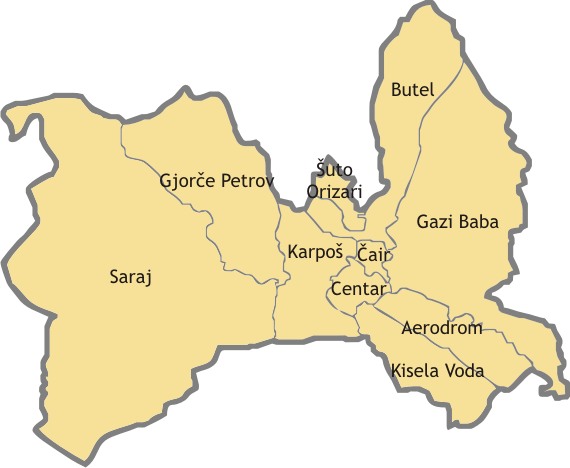
Skopje, North Macedonia
Photo: Пакко, CC BY-SA 3.0 via Wikimedia Commons
Outer Skopje consists of the territory of the City of Skopje outside of Centar, the Stara Čaršija (Old Town), and Karpoš. This large and diverse area of the city is generally less densely populated. It consists of both urban neighbourhoods and older villages now within the borders of the capital. Important archaeological sites and medieval churches can be found here. There is also a lot of nature to be explored, particularly at Matka Canyon.
From the travel guide. Select a place for details, a map and what is nearby.
Џевахир Скај Сити
The skyscrapers, which are topped out, are the tallest in North Macedonia. The four towers, each rising 142 m (466 ft), will be connected by a mixed-use building containing a shopping mall and sports facilities. The development is expected to be completed in 2021.
Скопски аквадукт
Located within the village of Vizbegovo, this is the only aqueduct archaeological site in North Macedonia and one of three in the former Yugoslavia. Its date of construction is not known; it may have been built as early as Roman times or as late as early Ottoman rule. The stone and brick structure was used as an aqueduct until the 18th century. Today, 386 meters (1,266 feet) consisting of 55 arches remain. It is on the Serava River and, presumably, carried water from a spring in the Skopska Crna Gora to the city centre.
Црква „Св. Никола“
This medieval church was built in 1337 by a donor by the name of Danica at the foot of the Skopska Crna Gora mountain range. Capped by a single cupola, the frescoes within the church date from its original construction. Due to the church's location in a now mostly Muslim village, it is often subject to theft. Ljuboten was a hotspot during the 2001 insurgency. From 2006 to 2017, the church was renovated.
Црква „Св. Ѓорѓи“
Formerly the main church of the village, Saint George is one of a pair of 16th-century churches in Radišani. Its frescoes were originally painted in 1631.
Црква „Св. Никола“
This smaller 16th-century church contains fragments of its original frescoes dating from 1631.
Црква „Св. Никола“
The predecessor church here was built around the time of the Yahya Pasha Mosque in the Old Bazaar with permission to build granted by Yahya Pasha. The current church was built in 1881 and its frescoes were done the same year by Dičo Zograf.
Љубански манастир
Reached via a narrow paved road above the village is this 19th century monastery. It was a home to monks before it became home to nuns in 1998. The monastery contains one church dedicated to Saint Nicholas, along with dormitories and a bell tower.
Турбе на кралската ќерка
This türbe (mausoleum) is dedicated to the Bosnian princess Catherine; Sultan Mehmed II ordered its construction after her death. It was destroyed in the 1963 earthquake and rebuilt in 2014.
Тумба
The most significant Neolithic settlement in the Skopje valley. It was first discovered in the 1960s and since then multiple important findings have been unearthed, in particular the sculpture of the Great Mother, now on display at the Museum of Macedonia. The site today features reconstructed Neolithic dwellings.
Црква „Св. 40 Маченици“
This church was built in 2013 in honor of the five victims of the Smilkovci Lake Killings, perpetrated by some ethnic Albanians attempting to destabilize the country.
Црква „Вознесение Христово“
The most significant church in this municipality, built in 1872. Its frescoes, painted by artists from Kruševo, are fully preserved. Its wooden iconostasis features roughly 40 important icons painted by Dičo Zograf in the 1850s.
Црква „Вознесение Христово“
Built in 1850, this church also features iconostasis work by Dičo Zograf. It was built of stone and has a detached bell tower.
Кучковски манастир
Containing one church dedicated to Saint George, this monastery was established in 1346 with its construction. It fell into disrepair over its history, ultimately renovated in the 20th century. Monks lived here until 2014.
Црква „Св. Спас“
The most significant church from this part of Skopje was built in 1849 and its frescoes were painted by Dičo Zograf in 1857. The nice courtyard contains a bell tower. Dračevo is a large village (now more of an urban neighborhood) with its own fully developed socio-economic life.
Хусеин Шах џамија
This 16th-century mosque was built by a prominent Ottoman figure. It was damaged multiple times in its history. The mosque has a main dome, a single minaret, and a porch. The courtyard contains numerous old graves.
Дона Дука
On the eastern slopes of Žeden Mountain is the country's fourth-largest cave. It is a complex system with multiple canals.
Gradište, Археолошки парк Бразда, Градиште
This archaeological site dates from the 5th-4th centuries BC. Around this time, the area was inhabited by the Agrian tribe of Paeonians, however ceramic findings at the site indicate it may have been an Athenian settlement. The walls of the tombs also bear a decorative technique thought to be a mark of the Athenians. It is situated on a hill just south of the village. Until 2012, the site was rather neglected but then underwent a major cleanup.
Кучевишки манастир
On the slopes of the Skopska Crna Gora mountain range is this monastery, established in the 14th century in the village of the same name. Its main church is dedicated to the archangels Michael and Gabriel. It was built between the Marička Battle of 1371 and the Battle of Kosovo of 1389. The interior was not painted until 1591 and the current iconostasis dates from the 19th century.
Црква „Св. Спас“
This medieval Orthodox church is actually dedicated to the Holy Mother of God but is called St Spas because it celebrates Spasovden (the Feast of the Ascension). Built in the Byzantine style, it was completed in the 14th century. The current frescoes were painted in 1874. In 1501, a secret chapel was built within the church but never discovered by the Ottomans during their entire rule.
Манастир Свети Никита
This medieval church was built around 1300 by Serbian King Milutin on the ruins of an older church. It is in a typical Byzantine style, made of stone and red brick. The frescoes inside the church date from around 1324, with the exception of those in the dome which date from the 19th century. The iconostasis was painted in 1847. Banjane is also home to the 16th-century Church of St George, significant for its frescoes.
Црква „Св. Архангели Михаил и Гаврил“ - Кучевиште
It was built towards the end of the 14th or maybe the beginning of the 15th century. The church is threeconhos with a dome, and elaborate ceramic decorations on the façades. There are two inscriptions dating the frescoes from 1631 and 1701. The figures are presented small in size, poor in colours but with bold drawing with an attempt to present landscape. Most famous is the large presentation Tree of Jesse.
Маркови Кули
Ruins of a fortress built in Late Antiquity under Serbian King Stefan Dušan. Today, the most prominent portion of the ruins is a tower that overlooks the modern A1 highway, and the Pčinja River.
Кожленски манастир
This medieval monastery was originally partially built into a cave, very near to Marko's Towers. The current church was built in 1918 but nonetheless worth the visit for an excuse to venture into the interesting terrain of the area.
Бадеријана
The birthplace of Byzantine Emperor Justin I, best-known for establishing the Justinian dynasty which included his eminent nephew Justinian I who was also a native of the Skopje area. Not much remains of the ancient city other than some structural foundations.
Црква „Св. Георги Победоносец“
This church found in thick forest northeast of Blace is rather simple on the exterior but it is considered significant for its frescoes and icons inside. Built in the 16th or 17th century, it was constructed on the remains of an older church. There may be some connection between this church and the nearby Baderiana archaeological site.
Црква „Св. Спас“
This small church was built in 1576 and its frescoes were painted shortly thereafter. It is apparent that the frescoes were done by two painters, one of which had greater talent than the other. Dobri Dol sits just under the Millennium Cross atop Mount Vodno.
Светла Пештера
About an hour hike south of the village, this cave is considered an ice cave, which makes it unique in Macedonia. Particularly in winter, interesting ice formations can be seen. Its opening is about 0.7 m (2.3 ft) tall.
Христијанова Пештера
Getting into this cave is not for the claustrophobic. Over the right bank of the Suva River near Jabolci, the cave opening is hardly noticeable. A person can only get in by lying down and crawling in. About a meter in, however, multiple people can stand upright. The cave contains a rich collection of ornaments such as stalactites and stalagmites.
Марков Манастир
Continuously active since its establishment in 1346, Marko's Monastery bears the name of Serbian Prince Marko who reigned at the time of its completion. It consists of one church dedicated to St Demetrius. The church was built of bricks and stones and its iconostasis is made of stone pillars. The monastery grounds also consist of lodgings, a belfry, a well, warehouses, a bakery, and a mill. Marko's Monastery did not suffer under the Ottoman-era, unlike many churches and monasteries, and in 1830 an Ottoman aristocrat even added an exonarthex to the church. The grounds today also contain a museum. It was founded by king Volkashin in 1345 and finished by his son King Marko in 1366, who is also the donor of the frescoes painted between 1366 and 1371. It is unknown why the monastery is built in the vicinity of Skopje instead of Prilep the capital of their medieval kingdom. It is presumed that the grave of king Marko (who died in Romania fighting the Turks) is here but it was destroyed by the Turks. The architecture of the church is a cross in square with a central dome and a blind dome in the narthex. The elegant exonarthex (open porch) was added in 1830 by Hamzi Pasha, who was a generous donor of the monastery throughout the 19th century. It is quite surprising a Turkish aristocrat to be a donor of a Christian monument. The frescoes are work of more artists with different skills and are well preserved. Visible is the tendency for adding dramatization and narrative painting of the scenes. There is a bus going to the village but just few times per day. From the village there is half hour walk to the monastery. Behind it there is a river and a small picnic area.
Црква „Св. Никола Николимуки“
Located just 300 m before Marko's Monastery is this small medieval church. Its date of construction is unknown but, based on the preserved portions of frescoes, it likely dates from the 13th or 14th centuries.
Тауресиум
This archaeological site is best-known as the birthplace of Byzantine Emperor Justinian I in 483, though King Theodahad of the Ostrogoths was also born here in 480. The ruins today mostly consist of building foundations and short walls. The present-day village of Taor takes its name from the ancient city.
Црква „Св. Ѓорѓи“
This medieval church dates from the 13th or 14th centuries, built of stone. Its age is very apparent and the building could use some renovation. The interior frescoes are somewhat faded. It likely once had cupolas prior to the Ottoman-era. Surrounding the church are very old graves.
The quay runs from Park Aerodom at ASNOM and Kiro Gligorov boulevards in the east down to Centar in the west. Portions east of Park Aerodrom are under construction. Along the quay are bike lanes, walking lanes, pull-up and push-up bars, parks, and cafes.
Катлановска Бања
One of Macedonia's most popular bath centers. Located above Katlanovo on the Pčinja River, the healing waters have been used since Roman times. A hotel was first placed at the site in 1934 and is now visited by 10,000 guests annually.
21.10-hectare area. The relief of the mountain massifs in the hunting area is characterized with heterogeneousness and significant differences in altitude of 2240 m, which enables zonal distribution of the game.
Скопска Црна Гора
Meaning "Black Mountain of Skopje". Even though Vodno is the most popular hiking option in Skopje, a fun and educational day trip from Skopje is visiting the villages, churches and monasteries on Skopska Crna Gora Mountain. Easiest way to do it is with a car, but also one can take a bus to one of the villages like Banjani or Kuceviste, and hike to the surrounding points of interest. St.Nikita monastery in Banjani village was built in by Serbian king Milutin in 1307-08 on a site of an earlier church. It is a single domed church of a written cross architectonical solution. The frescoes are work of the famous Ohrid painters Mihailo and Eftihie. Unfortunately they lack the energy and the technique of Bogorodica Perivlepta church in Ohrid. It is quite probable that by now they had a big group of students around them and they just controlled the work. If one looks carefully one can see where them two picked up the brush and corrected the work. Most significant fresco is the Pursuit of the Merchants from the temple where one can see the human elements characteristic for their work.
Great fresh wild meat, great wine, and great hunting lodge atmosphere. A tad more expensive than the average Skopje restaurant, but well worth it. 150 wines from all over the world.
Traditional Macedonian food, kids' playground, garden.
Serves breakfast, lunch, dinner, drinks and coffee
Great choice of different meals and quality wines.
Range of specialties such barbecue, seafood, game fish. Try the 'Dojran crap' (meaning 'carp'), as well as roast meat, frog legs etc.
On the Vardar River in Aerodrom, Hotel Russia opened in the early 2010s. A restaurant on top of the hotel provides panoramic views of the city. The hotel is situated next to the Jane Sandanski Sports Complex, the Park of Lakes, and also connects to the Vardar Quay.
This hotel is in the village of Vizbegovo in Butel Municipality. It is near the Skopje Aqueduct which is also within Vizbegovo.
A shopping center with very nice cafes, bar, and shops. It can be found in the Aerodrom municipality of Skopje. Many young people from the city come to spend their extra time here. Shops include mobile phones, electronics, clothes and banks. There is also a supermarket across the street.
East Gate Mall is the newest and biggest mall in Skopje. The mall offers products from 220 brands and has a parking with 2.000 parking slots.
By taxi
The bus system is efficient and cheap enough that an often overpriced taxi can be avoided. However, a taxi retrieved in central Skopje will drive anywhere to the outer parts of Skopje.
Choose an airport to see hotels, stations, taxi ranks and car rental desks around it.
Ilinden · International · SKP
Loading places around the airport…
Articles and travel topics about Outer Skopje and North Macedonia.
 Inspiration
Discover 10 rewarding emerging travel destinations for 2027. Escape crowded tourist hubs and explore quiet spots with rich culture and great food.
8 min read
 Itineraries
The ancient road Via Egnatia led from Durrës (Albania) via Ohrid (North Macedonia) and Thessaloniki (Greece) to Istanbul (Turkey).
Wikivoyage
 Itineraries
The Brotherhood and Unity Highway (Croatian: Autocesta "Bratstvo i jedinstvo"; Macedonian: Автопат „Братство и единство“; Slovene: Cesta bratstva in enotnosti or Avtocesta bratstva in enotnosti, Serbian: Autoput…
Wikivoyage
 Culture & history
The Ottoman Empire, also known metonymically as the Sublime Porte, and especially in the 19th and 20th centuries as the Turkish Empire, was one of the great empires of the Old World, from the 14th to the early 20th…
Wikivoyage
Every section of the guide. Open one to read it in full.