//

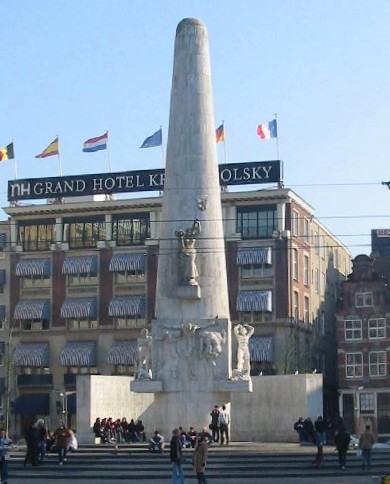
Photo: Ellywa, Public domain via Wikimedia Commons
A large spire that functions as a memorial for the victims of World War II. It was designed by architect J.J.P. Oud and revealed on 4 May 1956. Every 4 May, at the Remembrance of the Dead, a ceremony is held here to commemorate all civilians and members of the Dutch armed forces that died in World War II and later armed conflicts.
The National Monument on Dam Square is a 1956 cenotaph in Amsterdam, Netherlands. A national Remembrance of the Dead ceremony is held at the monument every year on 4 May to commemorate the casualties of World War II and subsequent armed conflicts.
© OpenStreetMap contributors
The well-known franchise of wax museums also has a branch in Amsterdam. It's a major tourist attraction so expect a steep entry fee and long queues. Unique to this branch are waxworks of famous Dutch people including Willem-Alexander, Beatrix, Tiësto, Rafael van der Vaart, Doutzen Kroes, Vincent van Gogh and Rembrandt.
Koninklijk Paleis
The Royal Palace is one of the three official palaces of the Netherlands. It is at the disposal of King Willem-Alexander by the Act of Parliament. It was built in 1651 as the city hall of Amsterdam, in a period known as the Dutch Golden Age. Many school children learn that because of the swampy soil, it was built on no less than 13,569 wooden poles. In 1795, the French Empire of Napoleon Bonaparte invaded the Netherlands, and his brother Louis Napoleon became the first King of Holland in 1806. He acquired the city hall in that year and turned it into a royal palace. It was restored to the original owners when Prince William VI returned to the Netherlands in 1812, but when he was crowned as King William I, he decided that Amsterdam should be the official capital and acquired the city hall once again as a royal palace. This is still a delicate subject among the locals, some of whom would like to see the palace returned to Amsterdam. It was completely renovated in 2009. It is mainly used for diplomatic receptions and to welcome visiting heads of state, not as a royal residence.
Used for royal coronations, including the crowning of King Willem-Alexander in 2013, and royal weddings, including his wedding to princess Máxima in 2002. The church is no longer used for services but is now a popular exhibition space. Admissions are limited: by tickets online to reserve a space.
Opened for over twenty years, the Hash Museum is dedicated to debunking the lies and demonization about one of our most useful plants, the hemp plant. Although small, busy and seriously overpriced, it is a well-done museum where people go to get informed.
Take a guided tour and check out the view from the top of the old stock exchange tower. It was built in 1903 (by Hendrik Petrus Berlage) and is considered the beginning of modern Dutch architecture. Costs €3.50, located on Beursplein near Dam Square.
A museum about the history of Amsterdam.