//

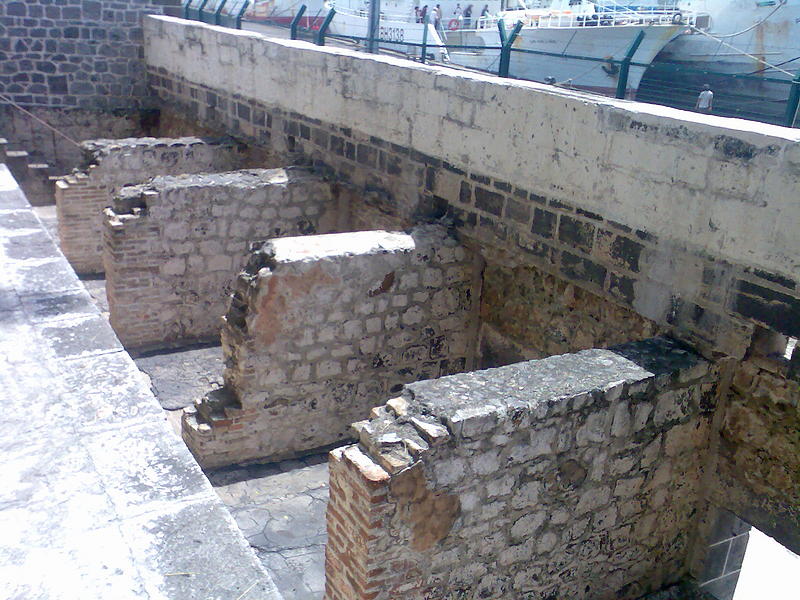
Photo: Avinash Meetoo, CC BY-SA 2.0 via Wikimedia Commons
When slavery was abolished in 1834, slaves that had been working on the island's sugar plantations were replaced by "free" indentured labourers from India. The complex whose present name translates to "immigration depot" in Hindi was first a French building but it was expanded over the years. From 1849 until 1923 more than half a million Indians arrived here, some to be shipped onwards to other parts of the British Empire, others to be settled on Mauritius. As ancestors of about 70% of the island's population has passed through here, it's a very important site for the history and identity of Mauritius. As the practice of systematically shipping Indians to the island ended, the complex was left to decay, used for other purposes and even partially demolished in the 1970s. In 1987 it was listed as a national monument and got its present name, and in 2006 it became a .
Aapravasi Ghat is a building complex located in Port Louis, Mauritius, the first British colony to receive indentured, or contracted, labour workforce from many countries. From 1849 to 1923, half a million Indian indentured labourers passed through the Immigration Depot, to be transported to plantations throughout the British Empire. The large-scale migration of the labourers left an indelible mark on the societies of many former British colonies, with Indians constituting a substantial proportion of their national populations. In Mauritius alone, 68 percent of the current total population is of Indian ancestry. The Immigration Depot has thus become an important reference point in the history and cultural identity of Mauritius.
© OpenStreetMap contributors
Showcasing the postal history of Mauritius.
The main mosque of the city was built in 1853, and enlarged during the following decades. It's a rare proof of the skills of Indian, mainly, Tamil craftsmen, who also built temples and churches. It has a madrasa (Islamic school), and in the middle of the courtyard stands an Indian almond tree, that was there already when construction began. The mosque a haven of peace in the middle of this busy capital.
Locals come to this square to sit down and take a break. It's surrounded by colonial French buildings, but also some high-rises. There are statues of important figures in the island nation's history like Queen Victoria, Sir Seewoosagur Ramgoolam, first prime minister of the island, Sir Veerasamy Ringadoo, first president of the island and Emmanuel Anquetil, second president of the Mauritius Labor Party. It's quite busy during daytime, also because of the traffic on adjacent streets but it's peaceful in the evening which therefore is the best time to visit.
A part of the old town is the Chinatown, where Chinese culture is alive. Here you can find shops selling products from traditional Chinese paintings, clothing and medicine to trinkets and second-hand goods as well as restaurants. Nevertheless the district gets surprisingly silent at night.
Parliament.
At the waterfront there's a small casino with roulette, poker, black jack and slot machines.