//

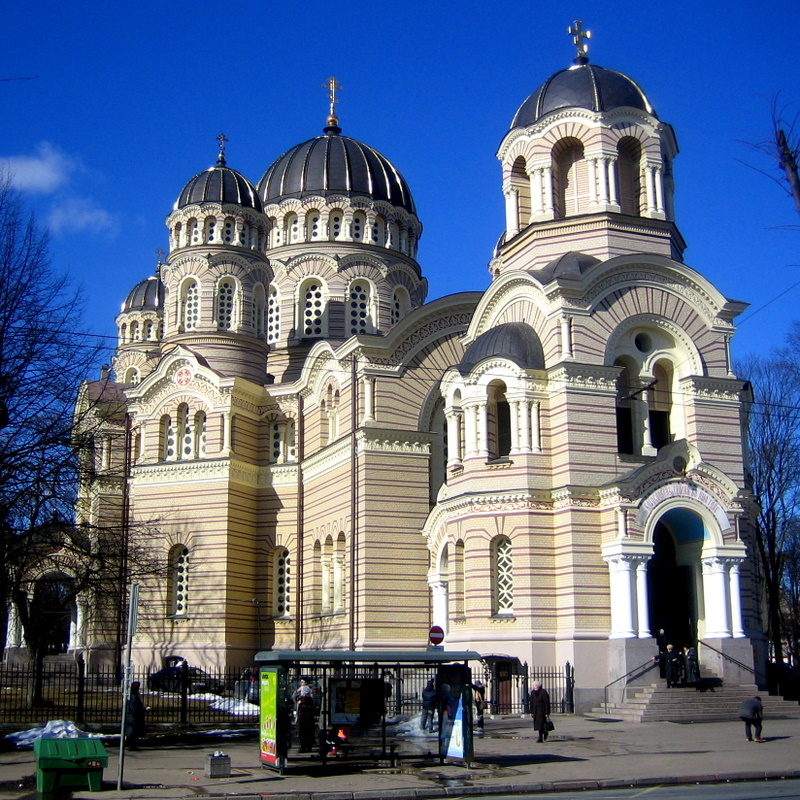
Photo: Smig at Russian Wikipedia, Public domain via Wikimedia Commons
The Orthodox Cathedral was erected during Russian rule for Russian residents. In contrast to its relatively plain exterior, it is spectacular on the inside, but be aware that shorts are not allowed.
The Nativity of Christ Cathedral, Riga, Latvia was built to a design by Nikolai Chagin and Robert Pflug in a Neo-Byzantine style between 1876 and 1883, with decorations made by the firm of August Volz, during the period when the country was part of the Russian Empire. It is the largest Orthodox cathedral in the Baltic provinces built with the blessing of the Russian Tsar Alexander II on the initiative of local governor-general Pyotr Bagration and bishop Veniamin Karelin. The Nativity of Christ Cathedral is renowned for its icons, some of which were painted by Vasili Vereshchagin. During the First World War German troops occupied Riga and turned its largest Russian Orthodox cathedral into a Lutheran church. In independent Latvia, the Nativity of Christ Cathedral once again became an Orthodox cathedral in 1921. Archbishop Jānis Pommers, a native Latvian, played a key part in the defence of the cathedral, including defence from the Latvian government which was extremely unfriendly to Orthodox Church in the first years of an independent Latvia. In the early 1960s, Soviet authorities closed down the cathedral and converted its building into a planetarium. The cathedral has been restored since Latvia regained independence from the Soviet Union in 1991.
© OpenStreetMap contributors
Designed by Georg Kuphaldt, who was expelled by Germany in 1915 as a spy because he had a telescope in his garden.
One of Latvia's national symbols. It was erected during the first independence and surprisingly never taken down by the Soviets (although laying flowers at its feet was forbidden). The statue of a woman holding three stars at the top of the monument represents Freedom embracing Latvia's regions.
Small museum dedicated to Jewish life in Latvia since the 16th century. Includes information on destruction of the synagogues by the Nazis, and the Latvians that saved Jews during the Holocaust. Exhibits are in English and Latvian.
Latvian National Museum of Art is the most significant depository in the nation for works of art. Houses many works by Latvian artists.
Donated by Riga's sister city Kobe in celebration of anniversary of restoration of independence.
Vecā Svētās Ģertrūdes baznīca
The brick neogothic church of St. Getrude, despite "old" in its name, is an entirely late 19th-century creation that replaced a series of stone and wooden churches that stood there (and were repeatedly destroyed due to being outside of the city walls) since the 15th century. The unusual veracity with which the 19th-century architects interpreted the principles of Gothic architecture may make the church pass for an authentic medieval creation, both inside and out.
St. Gertrude has long-standing links with Riga's German Lutheran community, and offers religious services in German. The Latvian Lutheran community which used to share the church with the German has moved to the "new" St. Getrude church further east down Brīvības Street.