//

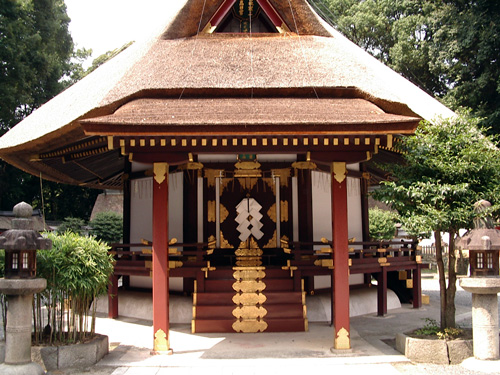
Photo: Mochi at Japanese Wikipedia, CC BY-SA 3.0 via Wikimedia Commons
Most famous as the site of the Setsubun Festival held in February, this small shrine was very highly revered during the Heian Period, and the court made offerings here.
Yoshida Shrine is a Shinto shrine located in Sakyō-ku in Kyoto, Japan. It was founded in 859 by the Fujiwara clan.
© OpenStreetMap contributors
平安神宮, Heian-jingū
Built in 1895 in commemoration of the 1100th anniversary of Kyoto, the shrine was designed as a scaled-down replica of the original Imperial Palace. The Shin'en Garden encircling the backside of the shrine is one of the city's most beautiful gardens and a popular place for hanami, particularly for those who prefer pink blossoms.
法然院
A quiet temple with some interesting raised sand designs. It was built in honor of Hōnen, the founder of the Jōdo sect.
安楽寺
A temple built to console the souls of Anraku and some concubines who were killed by order of the Imperial Court who did not approve of their Buddhist sect.
銀閣寺, or Jishoji 慈照寺
This temple, known as the Silver Pavilion and restored between 2008 and 2010, is at the northern end of the Philosopher's Walk. Much like its golden counterpart Kinkakuji, the Silver Pavilion is often choked with tourists, shuffling past a scrupulously-maintained dry landscape Zen garden and the surrounding moss garden, before posing for pictures in front of the Pavilion across a pond. Unlike its counterpart, however, the Silver Pavilion was never actually covered in silver; only the name had been applied before the plans fell apart. Be sure not to miss the display of Very Important Mosses!
光雲寺
A temple designed around the borrowed scenery of the surrounding mountains, it was once owned by Empress Go-mizunoo.
細見美術館 Hosomi Bijutsukan
A museum that showcases Japanese religious art from all periods of history. Exhibits change each season but typically feature famous artwork from local temples and shrines.