//

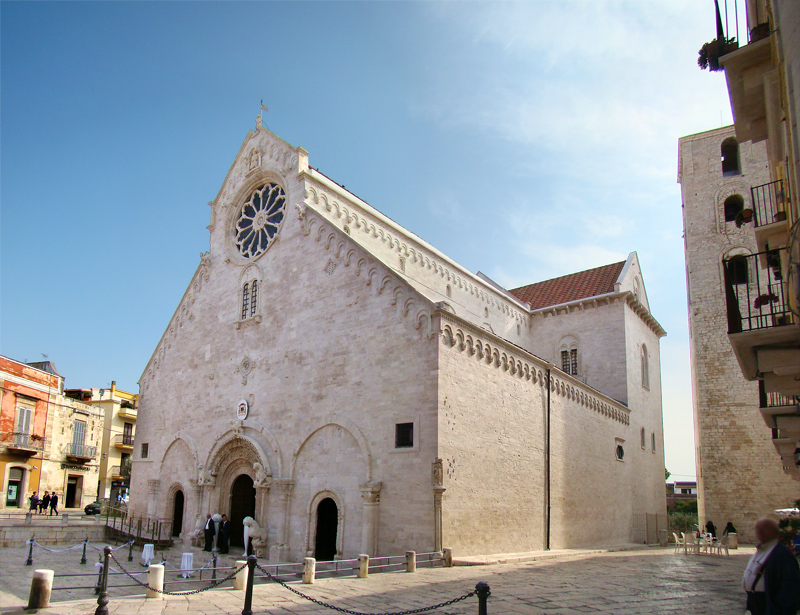
Comune in Apulia, Italy
Photo: Tango7174, CC BY-SA 4.0 via Wikimedia Commons
Ruvo di Puglia (Rìuve in ruvestine dialect) is a city in the Land of Bari, in Apulia, southern Italy, on the Murge plateau. It is one of the major cities of art in Apulia and one of the fundamental tourist stops in the region. It is part of the Alta Murgia national park, of which it houses an operational office.
From the travel guide. Select a place for details, a map and what is nearby.
Cattedrale di Santa Maria dell'Assunta
Built in the 12th century, it is an excellent example of Apulian Romanesque. Very similar to the nearby Cathedral of Trani and Bitono, its rose window is particular of that of Ruvo. Furthermore, there are many references to Arab-Byzantine art and Gothic experiments. In its centuries-old and ancient history, the Cathedral has had many modifications and alterations, leading to the exceptional result it is today.
Ipogeo della Cattedrale
It is an archaeological area below the Cathedral which houses the remains of Peucetian tombs and beautiful mosaics of Roman origin. There are remains of what must have been an ancient Roman Domus, in addition to the columns of the ancient cathedral which previously stood here.
Campanile della Cattedrale
Bell tower of extreme historical importance. 36.5 m (120.9 ft) tall, it is one of the distinctive symbols of the city's skyline. Much older than the cathedral, its construction dates back to the year 1000, and it was one of the main watchtowers of the medieval city.
Chiesa del Purgatorio
17th-century jewel in the historic centre. It doesn't have an interesting facade, but hides a breathtaking interior. To forget the reason is the beauty of the statue of the Pietà, which is also carried in procession on Holy Saturday.
Grotta di San Cleto
It is an archaeological area below the church of Purgatory. These are Greco-Roman ruins, where the so-called Cave of Saint Cleto is of exceptional value, or rather an ancient Roman cistern used by Saint Cleto (Saint Anacletus) the first bishop of Ruvo and third Pope in history, to take refuge from Christian persecutions.
Chiesa dei Santi Medici
Antica torre dell'Orologio
17th-century Civic Clock Tower, it is a panoramic point of the city. At its base there is an epigraph dating back to 239 AD dedicated to the Emperor Gordian III, and below it a second epigraph from 1793 with a description of the first above. It has an interesting clock set on top, and is equipped with two bells that ring every quarter hour.
Palazzo Caputi, Museo del Libro - Casa della Cultura
It is a 16th-century noble palace, which belonged to the Caputi family and was built during the Carafa era. The palace is of extreme artistic importance, especially its large frescoes and its chandeliers. The palace houses the Book Museum or Casa della Cultura, where important medieval and Renaissance volumes are kept. It is also used as a municipal library.
Arco del Bacio
It is known as the kissing arch for its amorous decorations, which create a more exceptional setting than it already is.
Palazzo Spada
It is the ancient municipality of Ruvo, its internal atrium is interesting, where a priceless bas-relief is kept.
Beautiful medieval arch. It does not present particular marvels on the side of Via Vittorio Veneto, but it presents a hidden marvel after passing it and turning the view back towards the arch. Between medieval decorations, ancient wooden windows and artistic compositions, you cannot miss it.
Chiesa del Carmine
It is a neoclassical jewel set in the historic centre. Breathtaking Baroque interiors, a large number of wooden statue compositions are kept, built by Neapolitan masters in the 1600s and carried in procession on Good Friday, such as the well-known "Procession of the Mysteries".
Torrione Aragonese di Via Fornello
Medieval tower which constitutes, together with its twin in Via Rosario, the remains of the ancient walls of Ruvo. Inside there is an infopoint of the Proloco.
Torrione Aragonese di Via Rosario
Medieval tower which constitutes, together with its twin in Via Fornello, the remains of the ancient walls of Ruvo.
Piazza Giacomo Matteotti
Large square built in the early 1900s and restored in 2016, it is today the largest square in the city, the beating heart of the commercial life of the Ruvestines, overlooked by various noble buildings, in addition to the church of the Holy Redeemer with its mighty bell tower, or Camerino Palace or Avitaja Palace, seat of the Town Hall.
Castello di Ruvo
Remains of the Norman medieval castle of Ruvo. Once considered a large and powerful castle, today only its quadrangular tower remains.
Palazzo Melodia
Noble palace of the Melodia family, dated to 17th century. Its entrance arch is accessible which leads into an atrium that leaves sensations right from the Middle Ages, with a beautiful interweaving of steps and stairways that lead up to the top.
Chiesa del Santissimo Redentore
It stands mightily on Giacomo Matteotti Square. Of relevance is its bell tower, tall and neoclassical, built only in the 1950s. It rises mightily from the church, and overlooks the entire square and is tall enough to now constitute a distinctive sign of the skyline of the City of Talos.
Chiesa di San Rocco
Built in the 16th century as a thank you to Saint Roch by the Ruvese population for having freed the city from the plague. Inside there is a huge statuary composition on a single base, the so-called "Otto Santi" from ruvestines, which is carried in procession on Holy Thursday at 02:30 in the night. It is the most evocative procession of Holy Week in Ruvo.
Palazzo Camerino
Noble palace built among the remains of the southern atrium of the Ruvo Castle. It does not have particular artistic details on the outside, but the interior is decorated with frescoes and paintings that make Palazzo Camerino look more like a royal palace than a noble one. Reservations are required for a visit inside, but generally visits are made upon reservation by the Ruvo's Proloco during events such as Holy Week, April 25th, May 1st, the Christmas period or mid-August, but also during the Cardoncello Festival or the Talos Festival.
Palazzo Avitaja, Comune di Ruvo di Puglia
Noble palace of the Avitaja family, one of the best preserved together with Spada, Caputi and Camerino Palaces in Ruvo. Its exterior is austere, and on the Via Alcide de Gasperi side it has an interesting family crest on the first floor. As of 2023, it is undergoing restoration, the Palace has been used as the Town Hall. At its base, moreover, there is an epigraph in memory of three great ruvestines partisan, who died in the Italian resistance.
Piazza Felice Cavallotti
It is a pretty little square built in the early 1900s and restored in 2016, together withGiacomo Matteotti Square. Inside stands the statue of Domenico Cotugno, a ruvestine scholar and doctor. Furthermore, there is a graceful classic 1930s clock, once present in Giacomo Matteotti Square and now moved to Felice Cavallotti Square. Around it there are several bars and shops, as well as the presence of Testini Palace, one of the noble palaces of Ruvo.
Piazza Giovanni Bovio
Square born as the first municipal park of Ruvo (before the construction of Dante Alighieri Square), Bovio Square has an interesting shape, a trapezoid, made up of paths surrounded by greenery. In the centre there is an open space where the Memorial to Great War Fallen stands. The Jatta National Archaeological Museum overlooks it, where thousands of archaeological finds from the Magna Graecia era of Ruvo are preserved, the Baroque church of St. Dominic, of which the Domenico Cantatore Municipal Art Gallery stands behind it. Furthermore, a centuries-old cedar also overlooks the square, one of the largest in the whole of the Apulia region. At Christmas it is decorated to create one of the largest Christmas trees in the region.
Chiesa di San Domenico
Built in the Renaissance as a small church outside the walls, it was rebuilt in the 18th century in the Baroque style. Inside are preserved important works, as well as breathtaking Baroque decorations. The wooden sculpture of the Risen Christ is also kept, which is carried in procession at Easter.
Museo Jatta o Palazzo Jatta
Inside it houses one of the largest collections in the world of Greek, classical and Hellenistic art. The museum is organized in just 5 rooms which contain more than 2000 archaeological finds, including Greek vases, furnishings, Greek armor, toys and Roman epigraphs. Inside is kept the most valuable piece of the collection, the Vase of Talos, famous for its artistic revolution which still imposes an unknown factor on Greek pottery art. The vase is often transferred to temporary views in New York museums or the British Museum.
Monumento ai Caduti della Grande Guerra
Built in 1921 in honor of the ruvestines fallen in World War I, the bronze statue of victory was later removed to be melted down for war production during World War II. In 2009, with donations from Ruvestines and others, the statue was re-built and placed where the original once stood.
Pinacoteca di Arte Contemporanea Domenico Cantatore
Dedicated to the expressionist and cubist ruvestine painter Domenico Cantatore, the Art Gallery contains works by the ruvestines artist, as well as others by local artists such as Michele Chieco, Raffaele van Westerhout, Silvio Dodaro, Cesare Marino and Filippo Alto. The convent, on the other hand, was built in the 18th century and used as a primary school, then as an agricultural start-up and finally as a middle school dedicated to Domenico Cotugno, until 1987.
Piazza Dante Alighieri
Also considered as one of the Municipal Park of the city, the square was built during the 1920s and 1930s on 3 lots. The square was built following the destruction of the old Episcope of the Cathedral, once larger and which enclosed the entire back of the Cathedral and its bell tower. Furthermore, the Baroque side chapels of the Cathedral also once stood, demolished during the 1920s. This therefore changed the urban aspect of the area, allowing for the construction of the municipal park. In ancient times however, a dirt clearing stood in its place, used for the angel fair and the animal market, the latter no longer active for 40 years.
Fontana dei Quattro Cavalli
It is a marble fountain built in the 1960s decorated with beautiful horses. At night it is illuminated with colored lights, and is immersed in the greenery of the villa with its centuries-old pine trees.
Statua del Gigante Talos
Under construction in 2023, the Statue of the Giant Talos will soon rise in Piazza Dante. It is a 3.5-m Carrara marble colossus on a 2-m pedestal. The work was built by local artist Max di Gioia.
Episcopio della Cattedrale
Building built in the 1930s following the demolition of the previous one, the Episcopio is extremely elegant, with its portico overlooking the square.
Il Corso o Stradone
Corso Cavour was built by the engineer Egidio Boccuzzi, and is one of the main city corso. It is the main entertainment artery of the Ruvestine nightlife, where most of the youth clubs are located. It is shaded by the presence of its large centuries-old Lime trees. Ruvestines usually call it "corso" or "stradone".
Il Corso
If Corso Cavour is the course of nightlife and entertainment, Corso Giovanni Jatta is the corso of shopping and commercial. It has the smallest sidewalks and trees, but on the other hand it has a very large number of shops and commercial activities, as well as obviously the presence of a well-known club and a well-known pastry shop.
It is characterized by being the only Corso in Ruvo to have maintained its original state of road pavement, with its volcanic stones. Dedicated to the great Antonio Gramsci, it was once dedicated to King Vittorio Emanuele III. A well-known restaurant and a well-known pastry shop-bar overlook it.
It is the old main Boulevard of the city. It has the largest sidewalks, and is overlooked by important noble and bourgeois palaces, such as Chieco Palace. In addition to the presence of a couple of bars, unlike Corso Cavour, this corso is characterized by the presence of trade unions and municipal offices, making it not very active in the evening. It is nonetheless a fascinating and important place for a walk.
Chiesa di San Giacomo al Corso
Very particular neoclassical church that overlooks Corso Ettore Carafa. It features a breathtaking Baroque interior, similar to that of St Dominic. It stands where the old church of St James once stood, a small medieval church that no longer exists.
It is characterized as the entry point from Via Corato. Various other noble and bourgeois palaces overlook the Corso, and various pastry shops and commercial establishments overlook it.
Scuola Bovio
Elementary school built by the engineer Egidio Boccuzzi in the 1910s, the school is one of the largest in the area. It has a huge mammoth staircase at the entrance, with large arches covering the large portico. Finally, on the top of the facade there is an interesting sundial.
Chiesa di San Michele Arcangelo
It is a beautiful example of a Baroque church. Inside there are paintings by Gaspar Hovic, a Dutch painter of the 16th century.
Ex Convento dei Frati Minori Osservanti
It is a convent built by the Franciscans in 1200 AD, following the passage of San Francesco d'Assisi from Ruvo. Inside there are important fresco cycles of the life of St. Francis. It has been used as a nursing home "M.M. Spada".
Hospital constructed in 1881, and expanded in the 20th century.
On the train
By car
From the north (Pescara and others): coming from the Highway Autostrada Adriatica A14, exit at the Molfetta tool booth, follow signs for Ruvo in the direction of Terlizzi.
By bus
The Provincial Transport Company (STP) runs the Molfetta-Terlizzi-Ruvo and Trani-Ruvo sections.
Choose an airport to see hotels, stations, taxi ranks and car rental desks around it.
Bari · International · BRI
Loading places around the airport…
Articles and travel topics about Ruvo di Puglia and Italy.
 Travel tips
Understand travel insurance for a Schengen visa in 2026. Learn mandatory €30,000 medical coverage, zero deductible rules, and embassy-approved policies.
7 min read


 Travel tips
Complete 2026 guide to global tourist taxes and access fees. Compare entry fees in Venice, Bali, Bhutan, Kyoto, and Edinburgh, and learn how to pay them.
8 min read

 Travel tips
Find out how much does a trip to Italy cost in 2026. Compare realistic daily budgets for hotels, food, trains, and museum entry across three travel styles.
8 min read
 Travel tips
Estimate your Europe trip cost for 2 weeks in 2026. Compare realistic budgets for lodging, Eurail trains, dining, and sightseeing across three styles.
8 min read
Every section of the guide. Open one to read it in full.