//

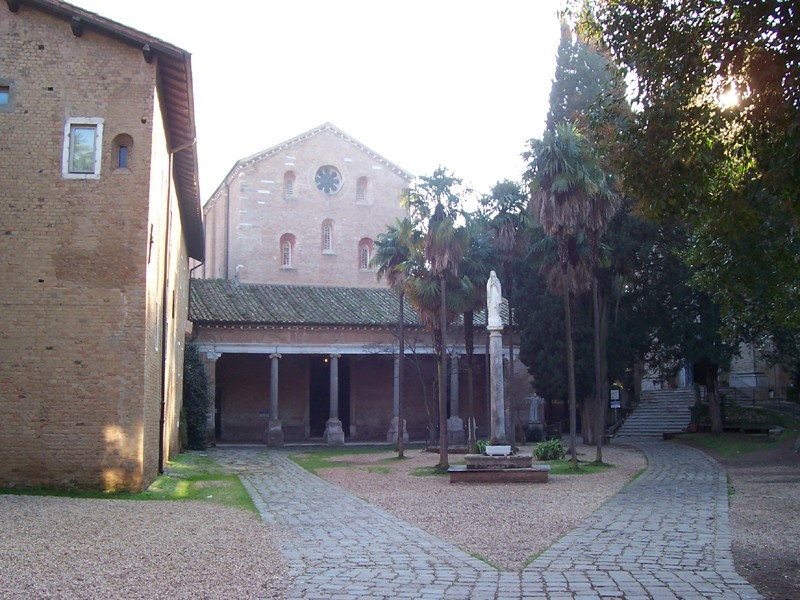
Photo: MarkusMark, CC BY-SA 3.0 via Wikimedia Commons
A truly quiet oasis close to the hustle and bustle of EUR. There are three churches in this complex and the doors are open all day, unlike city churches. The monks produce a range of products such as liqueurs, chocolate and honey, as well as a cure for the illnesses Romans suffer when the Scirocco wind blows in from the Sahara. These are on sale at a shop at the Abbey.
Tre Fontane Abbey, or the Abbey of Saints Vincent and Anastasius, is a Roman Catholic abbey in Rome, held by monks of the Cistercian Order of the Strict Observance, better known as Trappists. It is known for raising the lambs whose wool is used to weave the pallia of new metropolitan archbishops. The pope blesses the lambs on the feast of Saint Agnes on January 21. The wool is prepared, and he gives the pallia to the new archbishops on the Solemnity of Saints Peter and Paul, the Holy Apostles.
© OpenStreetMap contributors
Perhaps most famous for a large model of imperial Rome, but also has a large display of various aspects of ancient Rome, using plaster casts, models and reconstructions of works found in museums throughout the world.
Regular shows plus an excellent astronomical museum.
An ethnographic collection of around 60,000 pieces from European indigenous cultures. Documents evolution from the Palaeolithic age to the Iron Age.
Colosseo Quadrato, also known as Palazzo della Civiltà Italiana
Constructed around the 1940s as the centrepiece of the EUR, but unused for a long time. It was restored before 2015 when the luxury fashion label Fendi moved in.
Also known as St Paul Outside the Walls. This is on the outskirts of Rome in an otherwise drab modern neighborhood. The enormous basilica is a faithful reconstruction, finished in 1854, of the ancient basilica which burned down in 1823. Parts of the original interior were rescued from the fire and have been extensively restored. Visiting in the afternoon may avoid the tourist coaches. Don't miss the medieval cloister, which survived the fire.
The Catacombs of Domitilla are considered to be the best preserved of all Roman catacombs. They are the only ones still to contain bones. Domitilla also has a subterranean basilica, much of which was reconstructed in 1870.