//

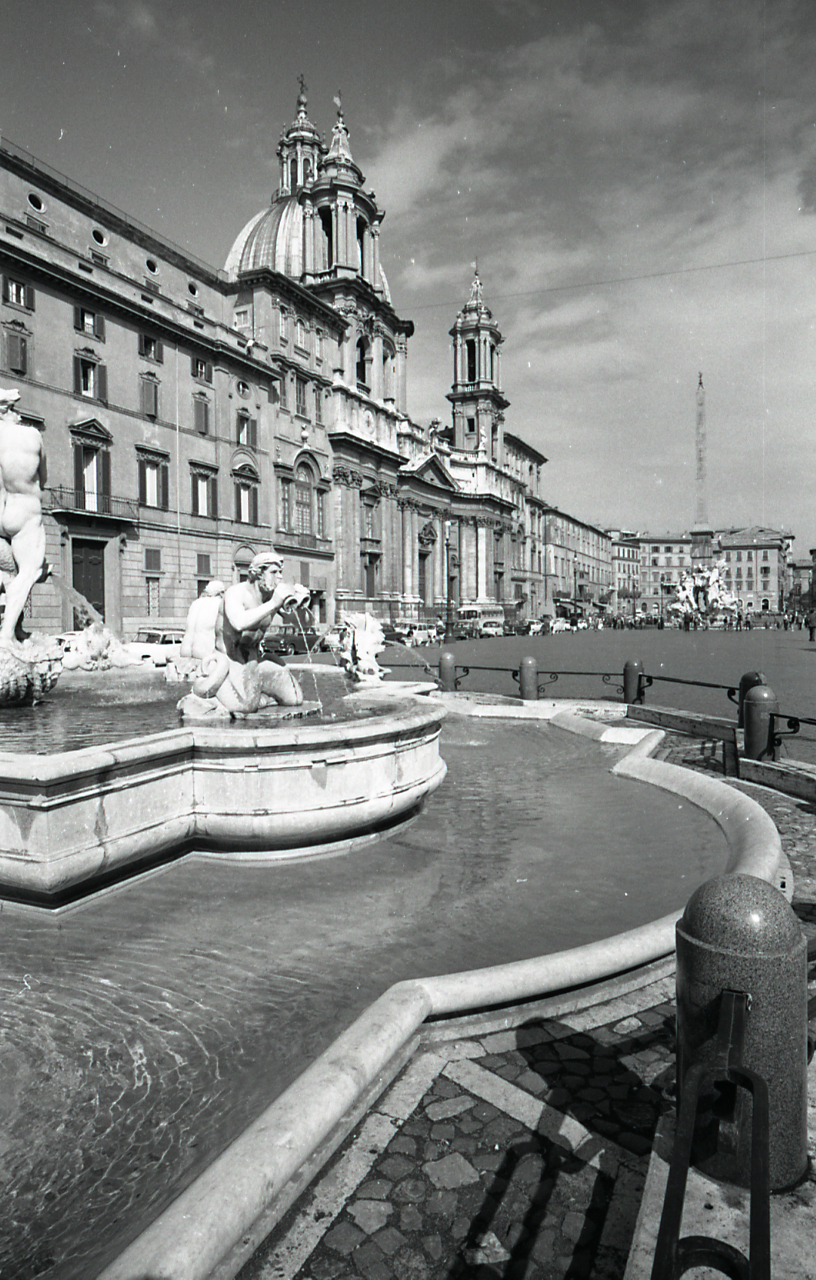
Photo: Paolo Monti, CC BY-SA 4.0 via Wikimedia Commons
The pride of Baroque Rome, was established towards the end of the 15th century, and preserves the shape of the ancient Stadium of Domitian. The buildings surrounding the square stand where the spectators once sat, watching the spectacle of the naumachiae (battles among ships). The square remains completely unspoilt by traffic and modern buildings. Today, the square is an immensely popular place to sip a cappuccino, shop, and watch street performers. Behind the piazza at the northern end, you can still see remains of the Roman athletic stadium well below the current ground level. Amongst the various monuments of the square, look especially for the two Baroque masterpieces by Bernini and Borromini.
Piazza Navona is a public open space in Rome, Italy. It is built on the site of the 1st century AD Stadium of Domitian and follows the form of the open space of the stadium in an elongated oval. The ancient Romans went there to watch the agones ("games"), and hence it was known as "Circus Agonalis".
© OpenStreetMap contributors
Fountain of the Four Rivers
By Bernini, in the very centre of Piazza Navona. Incorporates an Egyptian obelisk and symbolises four of the world's great rivers (the Ganges, the Nile, the Danube and the Plata), representing the four continents known at the time.
By Borromini, reputed to be on the spot where St. Agnes was martyred in the 4th century AD. This lovely basilica church is small with an almost circular interior. It is undergoing rehabilitation and the facade and dome are hidden in scaffolding. It seems to be open only until noon.
Fountain of the Moor
At the southern end of the Piazza, designed by Bernini but the main statue of the Moor was done by Giacomo della Porta and the other statues are 19th-century copies of the originals.
Fountain of Neptune
A 19th-century addition to the square, made to balance the Fontana del Moro.
This palace of the 16th century was erected by the famous Medici family. It was the residence of Cardinals Giovanni and Giuliano Medici, later Pope Leo X. and Clement VII. Catherine de Medici, Pope Clement VII's niece lived here until her marriage in 1553 with Prince Henry, the son of King Francis I of France. The palace is named after Madama Margerita of Austria, the illegitimate daughter of Emperor Charles V. Since 1871 it has been the seat of the Italian Senate.
Small piazza about 20 m (65 ft) from Piazza Navona, behind the Brazilian Embassy. There is a statue named "Pasquino", according to a legend named after a tailor who used to work nearby and had a reputation for complaining. The statue has been used for the past three centuries as a place to hang messages, complaints and other opinions which have to be shared with the neighborhood. The statue is probably an ancient Roman portrait of Hercules.