//

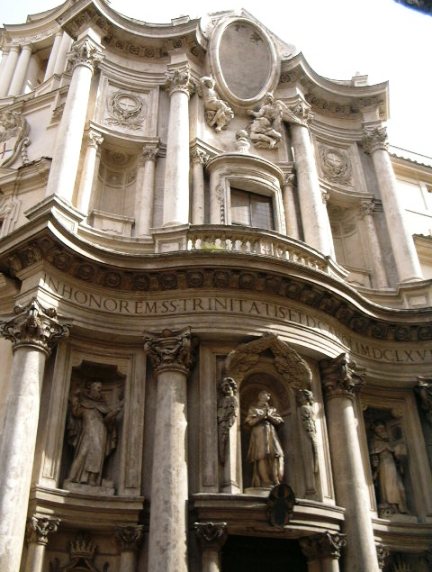
Photo: Erin Silversmith, GFDL via Wikimedia Commons
A very small and beautiful church, the first design commission of Francesco Borromini.
The church of San Carlo alle Quattro Fontane, also called San Carlino, is a Roman Catholic church in Rome, Italy. The church was designed by the architect Francesco Borromini and it was his first independent commission. It is an iconic masterpiece of Baroque architecture, built as part of a complex of monastic buildings on the Quirinal Hill for the Spanish Trinitarians, an order dedicated to the freeing of Christian slaves. He received the commission in 1634, under the patronage of Cardinal Francesco Barberini, whose palace was across the road. However, this financial backing did not last and subsequently the building project suffered various financial difficulties. It is one of at least three churches in Rome dedicated to Saint Charles Borromeo, including San Carlo ai Catinari and San Carlo al Corso.
© OpenStreetMap contributors
Four fountains from the time of Pope Sixtus V when much of Rome was redeveloped. A reclining deity is the theme of each sculpture. This is a busy intersection and if you don't look twice you may miss these exquisite examples of Roman mythology.
Galleria Nazionale d'Arte Antica
This remarkable building, designed partly by Bernini, houses the National Gallery of Ancient Art, and includes some famous paintings by Filippo Lippi and Caravaggio, as well as Raphael's "La Fornarina".
Rotating exhibitions, usually three at one time. Exhibition descriptions normally provided in both Italian and English. Avoid Sunday morning, when the Romans go, as queues to get in can be long.
With Bernini's famous Triton Fountain. Via Veneto starts here too.
More modern than most Roman churches: it was not started until 1873. This is Rome’s Episcopalian church. Some very interesting artwork, particularly the mosaics by Edward Burne-Jones of the Pre-Raphaelite school.
Built after 1631, the crypt of the church contains a macabre display - a series of chapels decorated with the bones of 3700 dead friars. The bones are glued to the walls and ceilings in bizarre and striking decorations.