//

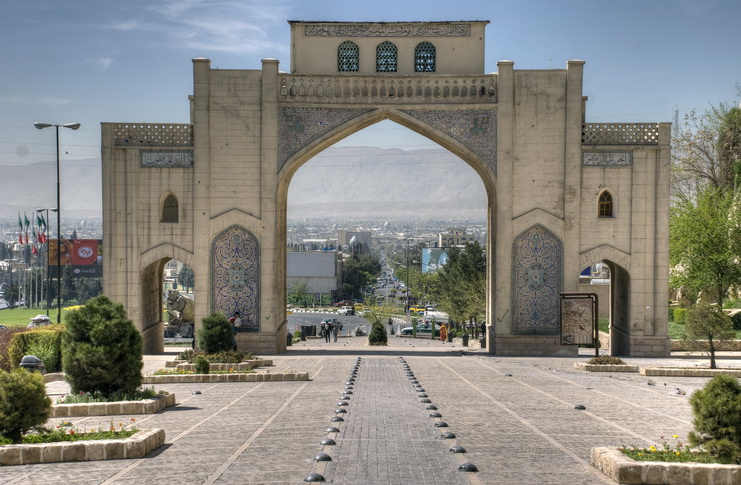
Photo: Amir Hussain Zolfaghary, CC BY-SA 3.0 via Wikimedia Commons
The city's main entrance. The original gate was built as an ornamental decoration by the Buwwayhids (Buwayhid dynasty) about 1000 years ago, but this was replaced 60 years ago by new gate, which is considered one of the finest architectural designs in Iran and has won numerous awards. From the gate walk up the stone stairways to enjoy picturesque and panoramic views of Shiraz. The tomb of Khajooyeh Kermanee, a famous poet, is also located here (entrance ticket 115,000 rials). Hidden in the alleys on the hill-side are numerous restaurants that serve the finest chelo kabob. It is an excellent place for picnics and taking photographs.
Qur'an Gate or Shiraz Gate is a historic gate in the north of Shiraz, Iran. It is located at the northeastern entrance of the city, on the way to Marvdasht and Isfahan, between Baba Kouhi and Chehel Maqam Mountains near Allahu Akbar gorge.
© OpenStreetMap contributors
People say this is the place where a guard tower was located in the old days, nowadays it has a stone replica of it. Besides, it's a fantastic observation point. Be prepared to climb up 800 steps to get there. Or be lucky that one of the guards at the gate will drive you up the hill. Even further up the road you'll end up at Mortaz Ali well, where you'll have an even more impressive overview of Shiraz (if there is no smog).
Tomb of Shah Shoja', the Mozafarid emir of Persia, and patron of Hafiz.
It's a mausoleum, where seven Sufi mystics are buried. Besides, there is a museum of stones that were collected from historical sites in Fars province.
Mausoleum of Hafez (1324–1391), the greatest master of Persian lyric poetry and the literary giant of the 14th century in the west and central Asia, was born in Shiraz, lived all his life here, sang its praises in unsurpassed verse and was buried in a garden known after him as the Hafezieh, in the northeast part of the city. The wide appeal of this poet among all Persian-speaking people make his tomb a cherished placed, visited by all. This mausoleum was rebuilt in the early 1950s. A flight of stone steps reaches to the tomb under a tiled cupola resembling a dervish’s hat. The tombstone is beautifully inscribed with two of Hafez’s poems or Ghazals. Visitors to the tomb can still, as they have done for centuries, take the omens, or faals, by picking a page at random from a volume of Hafez, kept for this purpose.
Built over the shrine of Emir Ali, a nephew of Shah Cheragh. The building itself is quite new as it had to be rebuilt after an earthquake. However, it can boast of the richly-ornamented interiors, parts of which are made of marble and mirror mosaics.