//

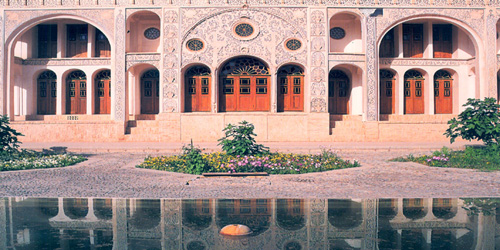
City in Isfahan province, Iran
Photo: Zereshk at English Wikipedia, Public domain via Wikimedia Commons
Kashan is a city in the Isfahan province of Iran. Kashan is the first of the large oases along the Qom-Kerman road which runs along the edge of the central deserts of Iran. Its charm is thus mainly due to the contrast between the parched immensities of the deserts and the greenery of the well-tended oasis. Archeological discoveries in the Sialk Hillocks which lie 4 km (2.5 miles) west of Kashan reveal that this region was one of the primary centers of civilization in pre-historic ages. Hence Kashan dates back to the Elamite period of Iran. The Sialk ziggurat still stands today in the suburbs of Kashan after 7000 years. After well-known Iranian historical cities such as Isfahan and Shiraz, Kashan is a common destination for foreign tourists because of its many historical sites.
From the travel guide. Select a place for details, a map and what is nearby.
This historical mosque was built in the late 18th century by master-mimar Ustad Haj Sa'ban-ali. The mosque is not in use any more, the theological school in its basement is, however, active. It was here where Ustad Ali Maryam as a pupil started his career as a brilliant architect.
One of the most beautiful historical gardens of the Middle East and the world. It contains Kashan's Fin Bath, where Amir-Kabir a famous vizier of Qajarid was murdered by the King Nasereddin Shah. It's the oldest garden in Iran, built in 1590, and covers 2.3 hectares with a main yard surrounded by ramparts with four circular towers. It is a Persian Paradise Garden, a type of garden that uses waterways to split the garden into four rectangles down the center. It's one of nine World Heritage Persian Gardens.
With its fantastic mudbrick architecture, it is one of the jewels of the city. Pay a small amount to one of the touts hanging around the bazaar and you will be led to the roof of the bazaar, where you can get an idea of the technical marvel of building such large structures from mudbricks and have a wonderful view over the old city.
Actually forming a part of the bazaar, this large structure was a caravanserai and has been renovated. Have a tea from the stand, take a break and look at the Iranian way of doing business here
Hammam-e-Khan
Old hammam beautifully transformed into a traditional coffee shop where you can take a rest, drink tea or smoke a shisha.
Beautifully restored bathhouse, with lighting installed to make the impression even more memorable. Don't forget to ask for the stairs to the roof.
The house of Boroujerdi, belonging to a trading family who migrated to Kashan, was built over a hundred years ago. The construction date can still be seen on the covered inscription of the building, completion of which took 18 years of work by tens of laborers, architects and master painters. Since exceptional attention has been paid to all minute architectural details demanded by the geographical and climatic conditions of the area, the house has attracted considerable attention of architects and recognition from Iranian and foreign scientific and technical teams.
A large house with several courtyards, which once belonged to a wealthy merchant. Experience how well the wind towers work. It consists of delightful wall paintings with elegant stained glass windows and includes other classic signatures of Traditional Persian residential architecture such as biruni and andaruni.
Imamzadeh-ye Sultan Mir Ahmad
خانه عامری
Traditional house built in the mid-19th century during the Qajar era, the house is one of several large spectacular old houses in the central district. Like the other houses around it, it was re-built after Kashan was ravaged by a series of massive earthquakes in the 18th century. The house is now a boutique hotel.
Claimed to be the world's oldest ziggurat, dating to the 3rd millennium BC.
خانه عباسیان
A large traditional historical house built during the late 18th century, the house is a beautiful example of Kashani residential architecture. It is said to have been the property of a famous cleric. It has six courtyards that would fit the needs of different families. One of the chambers has a ceiling designed with mirror pieces so as to give the impression of a starry sky under the nocturnal glitter of candlelight. The house is now a public museum.
Shrine of Abu-Lu'lu'ah (the assassin of Islam's second Caliph) was constructed in an eleventh century distinctive Persian-Khwarezmian dynastic architectural style, consisted of a courtyard, porch and conical dome decorated with turquoise coloured tiles, and painted ceilings.
If you are tired of historical houses, consider this cute museum showing some Iranian puppets and toys. Workshop included.
Walled fortress with grass field inside.
Labyrinth of tunnels consisting of three underground floors. It was dug as a shelter to hide from the summer heat, but later was used as a hiding place at times of enemy invasions. Only a couple of hundred meters are accessible for the public, out of the tunnel's total 4 km. A guide fluent in English is likely to give more information. Two different entrances exist. Entrance 1 has the shortest tunnel length. Therefore, entrance 2 is more interesting. These are signposted in the village.
Several square kilometres of sand dunes.
Salt lake close by to Maranjab desert. The salt lake is not that attractive unless it gets some water after the rain. Cannot be accessed with a normal car. You'll be stopped at the gate and will have to rent a 4x4 with driver.
Huge mosque with inner square and graves of the marters of the Iran-Irak war outside.
سفره خانه مظفری
Traditional restaurant serving Kebabs and other Iranian dishes. Nicely decorated with carpets and a pond under a very high ceiling.
This little restaurant is part of the Manouchehri boutique hotel. It overlooks the inner courtyard with the fountain and is tastefully decorated. The menu changes daily and contains Iranian dishes with culinary ambitions. It is a good place if you are tired of the standard Iranian fare. Expect better service and higher prices than elsewhere.
Traditional restaurant serving Kebabs and other Iranian dishes. Nicely decorated with carpets and a pond. Don't forget to admire the intricate woodwork of the ceiling. Some of the items on the menu don't carry prices, inquire or risk to be grossly overcharged.
Traditional house around a courtyard.
Double room quoted 1,600,000/1,300,000 rials with/without shower in the room, both including breakfast.
Extremely small rooms with concrete floor.
Kashan’s unique “Puppet Museum Hostel” is a charming accommodation, a unique site of cultural preservation and also an academic passion project. In addition to being a museum, it’s the former house of Qajar-era poet and cleric Jafar Allameh Feizi, who was the descendant of the famous mystic Faiz Kashani. The hostel consists of seven, traditionally-decorated rooms all leading into a lovely courtyard.
It's Kashan's first traditional house that was converted into a hotel, with a beautiful courtyard and free Wifi and breakfast. They have traditional rooms where you sleep on the floor, and rooms with bed. It is highly recommended to get a traditional room. Also ask one of the friendly staff to order traditional Iranian food (100,000-150,000 rial without rice). Be sure to book at least a day in advance as this place is very popular!
Traditional (or boutique) hotel with very nice and atmospheric interior located very close to the Bazaar. The inner courtyard with a water basin invites for relaxation in the afternoon. This house was renovated in a long process, pictures from the works are on display in the corridor. It is owned by an Iranian-Swiss lady who supposedly invested US$2 million into the hotel, and who ensures a European level of quality. It is popular and often booked out, reserve ahead.
Traditional house remodelled to be a premium hotel.
Kane Irani
Boutique hotel.
By train
Kashan is well-served by trains, as it's a stop on the main line between Tehran and Isfahan. There's up to 10 departures from per day in each direction.
By bus
Kashan is situated around 250 km south of Tehran. A bus ride from Tehran's South Terminal (Terminal-e-jonub) takes at least three hours.5 hours.
Most historical houses and the Agha Bozorg mosque can easily be reached on foot. A taxi to the Fin Garden should not cost more than 80,000 rials (Jan 2016). For sights further outside the city, consider hiring a taxi.
Read in the guideChoose an airport to see hotels, stations, taxi ranks and car rental desks around it.
Kashan · Regional · KKS
Loading places around the airport…
Articles and travel topics about Kashan and Iran.
 Travel tips
Woven carpets are traditionally crafted in North Africa and many parts of Asia, mainly along the Silk Road. They are sometimes called Oriental carpets, and are often associated with Islamic cultures, partly due to their…
Wikivoyage
 Culture & history
The ancient Persian Empire included areas far beyond modern Persia, now called Iran. At times the Persians controlled much of the Middle East — they were a main antagonist of Ancient Greece a few centuries BCE, and…
Wikivoyage
 Itineraries
The Trans-Iranian Railway (Persian: راهآهن سراسری ایران) is a railway connecting the Persian Gulf with the Caspian Sea through Iran. In 2021 it was added to the UNESCO World Heritage List.
Wikivoyage
 Itineraries
For modern-day trade in China, see Shopping in China The Silk Road (丝绸之路 sī chóu zhī lù), also known as the Silk Route, is not a single road, but a network of historical trade routes across Asia from China to Europe.
Wikivoyage
Every section of the guide. Open one to read it in full.