//

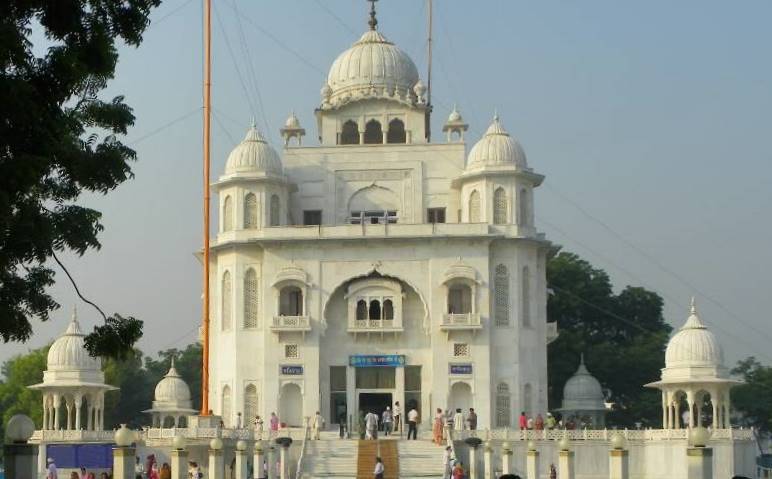
Photo: https://www.flickr.com/photos/vm2827/, CC BY-SA 2.0 via Wikimedia Commons
Built in 1783 near Raisina Hill, and it took 12 years to build.
The Gurdwara Rakab Ganj Sahib is a historic gurdwara near Parliament House in New Delhi. It was built in 1783, after Sikh military leader Baghel Singh (1730–1802) captured Delhi, on 11 March 1783, and his brief stay in Delhi led to the construction of several Sikh religious shrines in the city. This one marks the site of cremation of the ninth Sikh Guru, Guru Tegh Bahadur, after his martyrdom in November 1675 for helping Kashmiri Hindu Pandits, under orders of the Mughal Emperor Aurangzeb. The Gurudwara Sahib is built near old Raisina village near Raisina Hill, at present Pandit Pant Marg, took 12 years to build. Prior to that, a mosque had been built near the spot.
© OpenStreetMap contributors
Sachchā dī Kandhā, Sikh Genocide Memorial
A memorial dedicated to the Sikhs killed during the 1984 anti-Sikh riots. These include the Sikh soldiers killed during the riots and the three people from the Hindu and Muslim community who had been killed for shielding Sikhs during the riots.
An interactive museum describes the story of freedom struggle of India. It also has rare collection of gifts from foreign delegates to the Speaker of Lok Sabha.
Viceroy Church
The headquarters of the Church of North India, Delhi Diocese. Built by Henry Medd between 1927-1935, it is a fine example of the colonial architecture.
संविधान सदन Samvidhān Sadan
Literally the "Constitution House", the building served as the seat of the Parliament of India from 1950 to 2023. It has been the symbol of India's democracy for decades, with its grand design, spacious interiors and symbolic artworks that celebrate the country's unity and heritage. Designed by British architects Edwin Lutyens and Herbert Baker, the building was constructed between 1921 and 1927 as the seat of the Imperial Legislative Council of the British Raj. Based on the Ashoka Chakra, the circular building has 144 sandstone columns. The building is surrounded by large gardens and fenced off by sandstone railings modelled after the Great Stupa of Sanchi.
केंद्रीय सचिवालय Kendrīya Sachivālay
A complex of two blocks of symmetrical buildings (North Block and South Block) on opposite sides of the Kartavya Path. It was designed by British architect Herbert Baker in Indo-Saracenic Revival architecture, replacing the Old Secretariat in North Delhi. It once housed many important government ministries of India before the construction of the Kartavya Bhavan complex in the 2020s. The buildings are since closed for the development of a national museum inside.
A monumental column in front of the Rashtrapati Bhavan. After the transfer of the capital of India to New Delhi in 1911, the Maharaja of Jaipur offered to sponsor the construction of this column in 1912. However, the structure was completed nearly 18 years later. The column is very tall, around 44-45 m. There's an egg at the top surmounted by a bronze lotus flower and a six-pointed glass star.