//

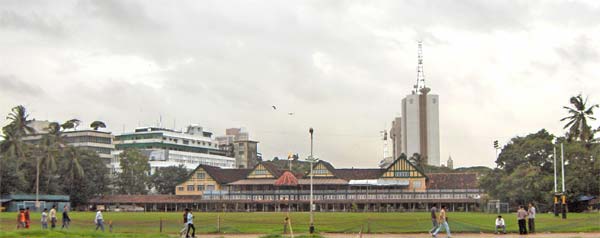
Photo: Nichalp, CC BY-SA 3.0 via Wikimedia Commons
One of the premiere gentlemen's clubs in the city. It was originally a British-only club, designed by architect Claude Batley. The Gymkhana's Grounds offers its members various sporting facilities like rugby, football, cricket, swimming, tennis, badminton and squash and also has a fitness centre.
The Bombay Gymkhana, established in 1875, is a premier private members' club in the city of Mumbai, India.
© OpenStreetMap contributors
आझाद मैदान Ājhād Maidān
A triangular urban open space in the heart of Mumbai. The Azad along with Cooperage Maidan, Cross Maidan and Oval Maidan once from the Esplanade, an open area that lay beyond the ramparts of the fort. After the demolition of the fort, several streets were constructed across the Esplanade, fragmenting it into several separate patches of green. Azad Maidan is known for its cricket pitches, protest meetings and political rallies.
A cinema built in 1879 by Kunvarji Paghtivala as a theatre. It was converted into a cinema by 1928.
The oldest Zoroastrian temple in Mumbai, built in 1709. It has a fortress-like structure.
The V-shaped building built in Victorian Gothic style houses the office of the Brihanmumbai Municipal Corporation (BMC), also known as the Municipal Corporation of Greater Mumbai (MCGM), the civic body that governs the city of Mumbai. The building was completed in 1893 and serves as the headquarters of BMC. It is classed as grade IIA heritage. The building is dominated by a 255 ft tall tower, which is crowned with a massive dome. The pediment of the building is crowned with a statue of a winged allegorical figure representing the urbs prima in Indis. The pediment also houses the coat of arms of Mumbai.
CSMT; छत्रपती शिवाजी महाराज टर्मिनस Chhatrapatī Shivājī Mahārāj Ṭarminas
One of the main disembarking stations for suburban and long-distance trains. The road goes further up to Ballard Estate where a lot of corporate offices and Mumbai Port are situated. The station building is designed in the High Victorian Gothic style of architecture. The building exhibits a fusion of influences from Victorian Italianate Gothic Revival architecture and traditional Indian architecture. The skyline, turrets, pointed arches, and eccentric ground plan is close to traditional Indian palace architecture.
Flora Fountain is an ornamental fountain dedicated to the Roman Goddess Flora. The walls of the Bombay Fort were demolished in 1862 and the gate leading to the church was replaced by the Flora Fountain in 1864. It was built at a cost of ₹64,000 or £9,000. The Flora Fountain is surrounded by several Victorian-era buildings. In 1960, the square was renamed "Hutatma Chowk" (Martyr's Square) in memory of the people who laid their lives during the birth of the state of Maharashtra. Next to the Flora Fountain stands a stone statue in memory of the martyrs. The statue consists of a pair of martyrs holding a torch.