//

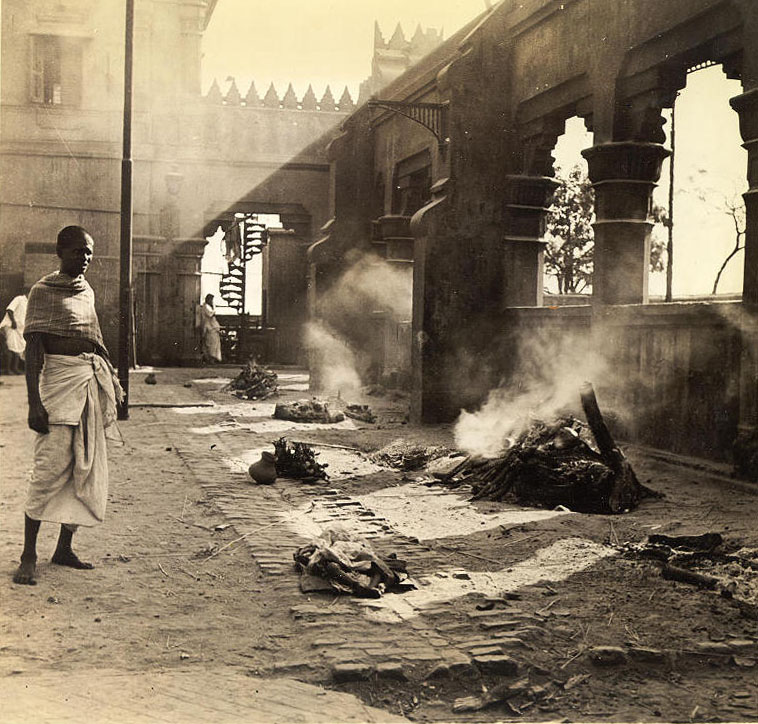
Photo: Clyde Waddell, Public domain via Wikimedia Commons
One of the largest crematoria in India, and one of the holiest for Hindus, similar to the Manikarnika Ghat in Varanasi. It is believed that the soul attains moksha (মোক্ষ mōkshyo) in this crematorium, which breaks the cycle of birth and death. So, people across the country come here for the cremation of their loved ones.
Nimtala Crematorium is located on Beadon Street, Kolkata, India. The crematorium has been historically known as Nimtala burning ghat, or simply Nimtala ghat. Located on the banks of the Hoogly (Ganga) just like the Manikarnika Ghat in Varanasi; it is considered to be one of the holiest burning ghats in the country where the soul is said to attain moksha, ie. breaking the cycle of birth and death. So people across the country comes here for the cremation of their loved ones. It is also one of the largest burning ghats in India.
© OpenStreetMap contributors
The original residence of the Tagore family, now in shambles. It is called "castle" mainly for its resemblance to a European castle compared to a traditional Indian building. Its auditorium once hosted Baṅga Nāṭyālaẏ (বঙ্গ নাট্যালয়) from 1859 to 1872, started by theatre enthusiasts Jatindra Mohan Tagore and his brother Shourendra Mohan Tagore.
ঘড়িওয়ালা মল্লিকবাড়ি Ghoṛiōyālā Mollikbāṛi
A large palace with an imposing clock (ঘড়ি ghoṛi). The ground floor hosts various shops, and the Mullick family once hosted a pharmacy there.
জোড়াসাঁকো রাজবাটী
হাওড়া ব্রিজ Hāōṛā Brij
Officially Rabindra Setu (রবীন্দ্র সেতু Robīndro Setu), the 705 m long Howrah Bridge is one of the iconic bridges of West Bengal. It is a cantilever bridge with a suspended span over the Hooghly River, and was built without any nut or bolts. The bridge was commissioned in 1943 by Braithwaite, Burn & Jessop Construction Company, replacing the older pontoon bridge. It took over six years to build, and the entire project cost ₹25 million.