//

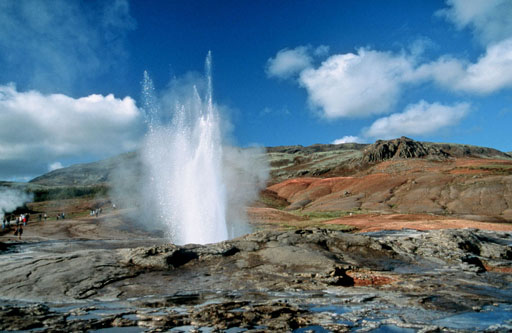
Photo: Dieter Schweizer (Obersulm, Germany), CC BY-SA 3.0 via Wikimedia Commons
The hot spring that is the namesake for all geysers in the world, is also one of the most popular stops in Iceland. First stories of the Geysir area can be found in documents from the year 1294 when earthquakes were frequent in the southern part of Iceland and caused the area to evolve to its current form. In the year 1630 the geysers in the area had so much power that the earth trembled when they spouted. As with many of the natural features in Iceland, many will be amazed at how close you can get to the geysers. Access is very unrestricted, you are not held behind guard rails and no officials warn you off. It is exhilarating to be able to be so close, and refreshing to be treated as an adult. Here's hoping trial lawyers never discover Iceland. As well as Geysir itself, which seldom erupts, there is the five-minutely Strokkur, other geysers, and various strikingly coloured hot pools. There is free parking, a gift shop and a good cafe.
Geysir, sometimes known as The Great Geysir, is a geyser in south-western Iceland that geological studies suggest started forming about 1150 CE. The English word geyser derives from Geysir. The name itself comes from the Icelandic verb geysa. Geysir lies in the Haukadalur valley on the slopes of Laugarfjall lava dome, which is also the home to Strokkur geyser about 50 metres (160 ft) to the south. The Strokkur geyser may be confused with it, and the geothermal field it is in is known usually as either Geysir or Haukadalur.
© OpenStreetMap contributors