//

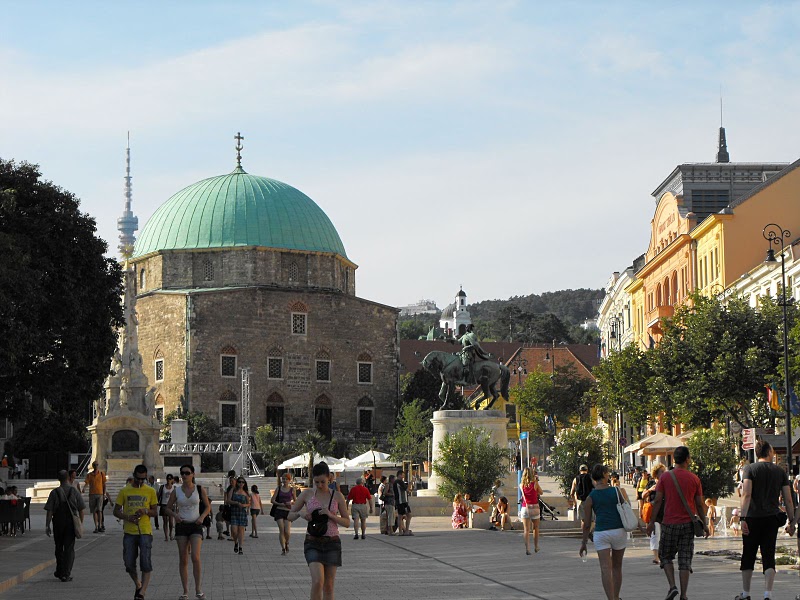
Photo: Jozsef TOTH, CC BY-SA 1.0 via Wikimedia Commons
Built on site and from the stones of Saint Berthold’s Gothic church by Pasha Qasim the Victorious, the Turkish character of the church was restored during the most recent, early 1940s renovations. Inside the building, which functions as a Catholic church, frescoes depicting quotes from the Qur’an from the 16th century are visible. The other mosque in the city, built by Yakovali Hassan, is in Kórház Square at the western terminus of the main pedestrian street, and is also open for visit when not in religious use by the city’s Muslim community.
The Downtown Candlemas Church of the Blessed Virgin Mary, formerly known as the Mosque of Pasha Qasim is a Catholic church in Pécs, Hungary, which was a mosque in the 16–17th century due to the Ottoman conquest. It is one of the symbols of the city, located in the downtown, on the main square. The current building, a hundred steps in length and in width, was built by Pasha Qasim the Victorious between 1543 and 1546. The mosque was converted into a church in 1702, after Habsburg-Hungarian troops reconquered the city. The minaret was destroyed by the Jesuits in 1766. One of the largest Ottoman constructions remaining in Hungary, the building still retains many Turkish architectural characteristics.
© OpenStreetMap contributors
Early Christian Mausoleum, Régészeti Kiállítás
The upper part of the two-storey building was a chapel while the lower part, decorated with murals depicting scenes from the Bible, functioned as a burial chamber. Museum shop. Guide available.
Klimo Collection, PTE University Library, University History Museum, Egyetemtörténeti Gyűjtemény
In the University Library. Here can be seen the valuable Klimo-collection
Mecseki Bányászati Múzeum
The Mining Museum of Pécs located in a part of the former wine cellar storage system with several levels below where they show eliminated coal and uranium mining relics of the region.
Vasarely Múzeum
Dedicated to the works of Victor Vasarely, founder of the op-art movement. Faux-threedimensional paintings, gobelins and "kinetic statues". One of the three collections of Vasarely's work besides Gordes (France) and Budapest.
Pécsi Nemzeti Színház
Csontváry Múzeum
This museum houses the largest collection of visionary painter Tivadar Kosztka Csontváry. A pharmacist by trade, Csontváry became a self-educated painter after receiving a vision at the age of 27 with a voice announcing “you will be the greatest sunway painter, greater than Raphael!” Gradually abandoning his civilian profession, he travelled the Mediterranean, North Africa and the Middle East as well as the Dual Monarchy for inspiration, and painted strange vistas of vivid colour in a unique style that has traces of post-impressionism and expressionism, but defies classification. Csontváry has been praised by Dalí as the second greatest painter of the century after himself. A must-see.