//

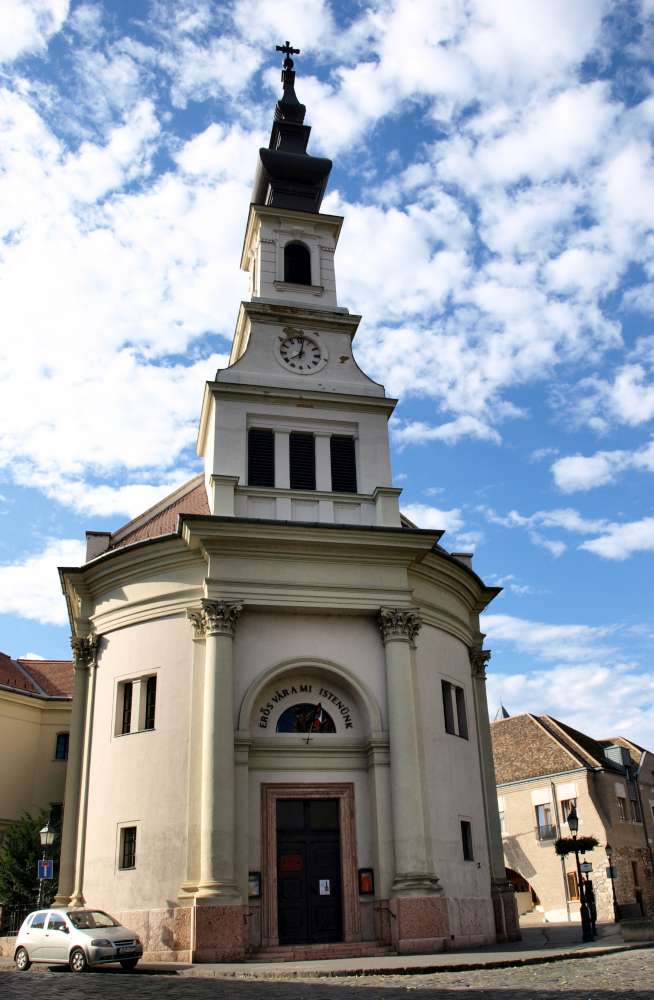
Photo: Misibacsi at Hungarian Wikipedia, CC BY-SA 3.0 via Wikimedia Commons
The oldest Lutheran church of Buda. It was built in 1895. Building was designed by Mór Kallina and it was consectrated in 1895. Exterior remained Neo-Baroque, but its interior became much more simple. There is a huge cross behind the wood altar table. There is a mosaic window over it which gives some light to the church. There is a red marble chalice at the altar.
Lutheran Church of Budavár is the oldest Lutheran church of Buda. It was built in 1895 at Vienna Gate Square in the 1st District of Budapest. The first church for the Lutherans of Buda was built by Maria Dorothea, third wife of Palatine Joseph, in 1846, at hu:Dísz tér. The site was taken over by the Ministry of Defence, so a new church was built near Vienna Gate.
© OpenStreetMap contributors
Kazinczy-kút
Well sculpture made by János Pásztor in 1936. A female figure is standing on it, holding a candle in her right hand. The front wall of the base features a portrait of Ferenc Kazinczy, who was a Hungarian author, poet, translator, neologist, the most indefatigable agent in the regeneration of the Hungarian language and literature at the turn of the 19th century.
Középkori Zsidó Imaház
Exhibition space of the Budapest History Museum. 14th-century Jewish graves, documents, drawings, and other finds. After the excavation in 1964, the prayer house was partially restored.
Budavár visszavételének emlékműve
Made by Béla Ohmann in 1936. The winged female figure raises an apostolic double cross in the air with her right hand, referring to the triumph of the weapons of the Christian world. On September 2, 1686, the Allied Army of various European countries gathered the Buda Castle from the Turkish forces.
Bécsi kapu
During the Middle Ages it was called Szombat-kapu (Saturday Gate), because markets were held in front of it every Saturday. It has been called Becs kapuszu by the Ottomans. Later it called also as Jewish Gate. One of its two side-gates were removed in the early 19th century, and in 1896, the whole gate was demolished. The current gate was restored in 1936, commemorating the 250th anniversary of Recapturing of Buda. The rebuilt gate, designed by Jenő Kismarty-Lechner, has a more symbolical, rather than functional value. Inscriptions, ornaments and reliefs, including a running angel was sculpted by Béla Ohmann. Two parts of Bastion Promenade are connected on the top of the gate.
Magyar Nemzeti Levéltár
A state public collection institute that preserves documents that are national treasures. The institution holds a total of 73 kilometers of records, more than 63.5 million microfilms and countless seals, maps, photographs, plans and diplomas. The building was built between 1913 and 1923 according to the plans of Samu Pecz in Romantic, historicizing style.
Európa liget
Small park opened in 1972 to commemorate the centenary of the capital and the congresses of 29 European capitals held on that occasion. At that time, the leaders of the capitals planted a tree with their own hands, which is typical of the flora of their own country and which also bears the climate of Hungary. The name of the donating city can be read on a limestone slab in front of the trees.