//

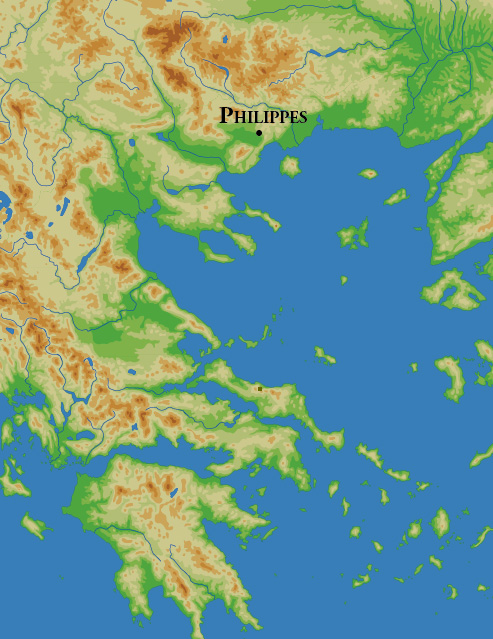
Photo: No machine-readable author provided. Marsyas assumed (based on copyright claims)., CC BY-SA 3.0 via Wikimedia Commons
In the double battle at Philippi, west of Philippi in October / November 42 BC the Roman triumvirates Marcus Antonius and Octavian (the later emperor Augustus) won about the followers of the republic, Marcus Iunius Brutus and Gaius Cassius Longinus, who had been among the leaders of the assassination attempt on Gaius Iulius Caesar. You can no longer see any of the battles in the fields. Only the 2 hills, each about 500 m from the mud bath, where part of the fortification of the army of Cassius are still visible today. On the larger, northern hill you can still see the remains of the fortifications and have a beautiful view of Philippi and the second hill and the former marshland. There is no path on the hill, so you have to go cross-country. The ascent is not exhausting and the view is worth the effort. In the immediate vicinity of the hills is the Lasponera mud bath, where you can park well and also find refreshment in the restaurant. It is a good starting point for visiting the northern hill. The southern hill has nothing to see and is not worth the climb.
The Battle of Philippi was the final battle in the Liberators' civil war between the forces of Mark Antony and Octavian and the leaders of Julius Caesar's assassination, Brutus and Cassius, in 42 BC, at Philippi in Macedonia. The Second Triumvirate declared the civil war ostensibly to avenge Julius Caesar's assassination in 44 BC, but the underlying cause was a long-brewing conflict between the Optimates and the Populares.
© OpenStreetMap contributors
It was probably built by King Philip II in the middle of the 4th century BC and extensively redesigned and completed by the Romans in the 2nd and 3rd centuries, so that the function of the theater could meet the needs of the performances of the time. It has been partially restored, and is used in summer for theatre and musical performances. The view from the ranks over the ruins and Pangaion Hills in the background is fantastic.
It was a large, three-aisled basilica (130 x 50 m) with transept aisle on the east side, a square atrium, and a gallery over the aisles and the narthex (narrow, single-storey lobby at the main entrance). Fragments of the luxurious pavement and part of the ambo (pulpit) are preserved in the middle aisle. Particularly impressive are the frescoes that imitate orthostates (dados) in the porch of a chapel. Dated to the end of the 5th century AD.
The Forum Romanum/Agora was the central place for political decisions, economic transactions, social interactions and religious ceremonies, making it the vibrant centre of public life. It was a complex of public buildings, arranged around a central open space. The most impressive buildings are the northeastern and the northwestern temples.
A three-aisled basilica with the remains of luxurious marble inlays on the floor. Dated as no later than the 6th century
Three-aisled basilica dates to about 550 AD. It has a narthex and appendages to the north and south (phiale, sacristy). The almost square aisle was covered by a vault supported by large pillars. A second vault covered the Holy Bema (closed space in Orthodox churches) .The basilica covers most of the previous Palaestra (No. 11), a humanistic Roman institution for physical and spiritual education. The Palaestra consisted of a central courtyard, rooms and a small amphitheatre.
Although it offers not really impressive objects such as Athens museums, it is still worth the visit. A small shop in the museum offers replicas of antique objects