//

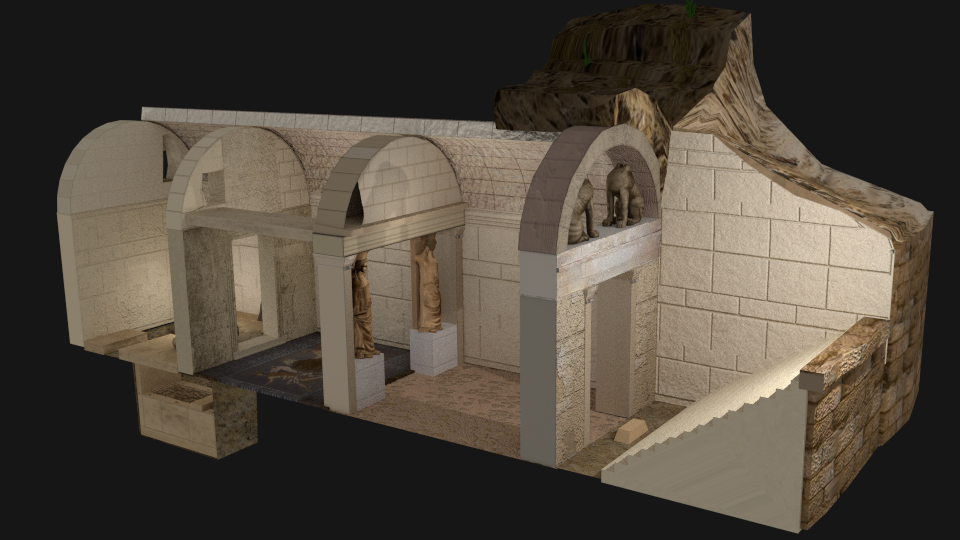
Photo: Magikos fakos http://greektoys.org/, CC BY-SA 4.0 via Wikimedia Commons
Kasta Hill is 2.5 km northeast of the Acropolis. It is the largest tomb that has been found in Greece so far. The complex is surrounded by a 497-m-long and 3-m-high wall made of marble from the island of Thassos. The burial mound is approx. 30 m high, 250,000 m³ of sand were needed to fill it up. The grave is said to be built in the late 4th century BC.
The Kasta Tomb, also known as the Amphipolis Tomb, is the largest ancient tumulus ever discovered in Greece, and by comparison dwarfs that of Philip II of Macedon, father of Alexander the Great, in Vergina.
© OpenStreetMap contributors
There is no information about the construction of the tower, but most likely it was built around the same time as the tower of Marmari, in the 14th century.
It was built in the 3rd century. Its construction suggests that it was a public building. The previously uncovered part of the villa was built around an atrium, which was covered with rectangular marble slabs. The walls of the rooms were plastered and painted with colored geometric patterns. The found mosaics (partly on display in the museum) are of particular interest.
The tower is not mentioned in Byzantine or other historical sources. It is known that a Proastion (settlement) existed in this area, which was granted to the Chilandar Monastery on Mount Athos by Emperor Andronicos II. Palaiologos in 1299. So this was most likely a monastery tower similar to the towers of Chlakidiki, the purpose of which was to protect and serve the various dependencies of the monasteries of Mount Athos. The type of construction and what little we know about the history of the area date the tower to around the mid-14th century.
The area was first settled by the Thracians in the mid-8th century BC. Around 655/654 BC, the inhabitants of Paros established a colony here to exploit the region's timber and ore deposits. This made it the first colony in the area. Around 500 BC, the city was presumably destroyed by the Persians under Darius I, but it was subsequently rebuilt. Following the establishment of Amphipolis in 437 BC, however, Argilos declined in importance.
In the Classical Period, as well as in the Roman and Byzantine periods, Amfipolis was the urban center of the region of the Strymon River Delta. During the Ottoman occupation, the city gradually lost its importance and business activity shifted to Marmario, while military control was concentrated in the modern village of Orfanio, where a small fortress was built. This small fortress to protect the delta was likely built in the 18th century or maybe earlier.
A few scattered remains of a Byzantine fortress on a low hill among vineyards. The castle is first mentioned by the sources in the 11th century. It seems that the castle never housed a settlement. It was probably just a haven for the population.