//

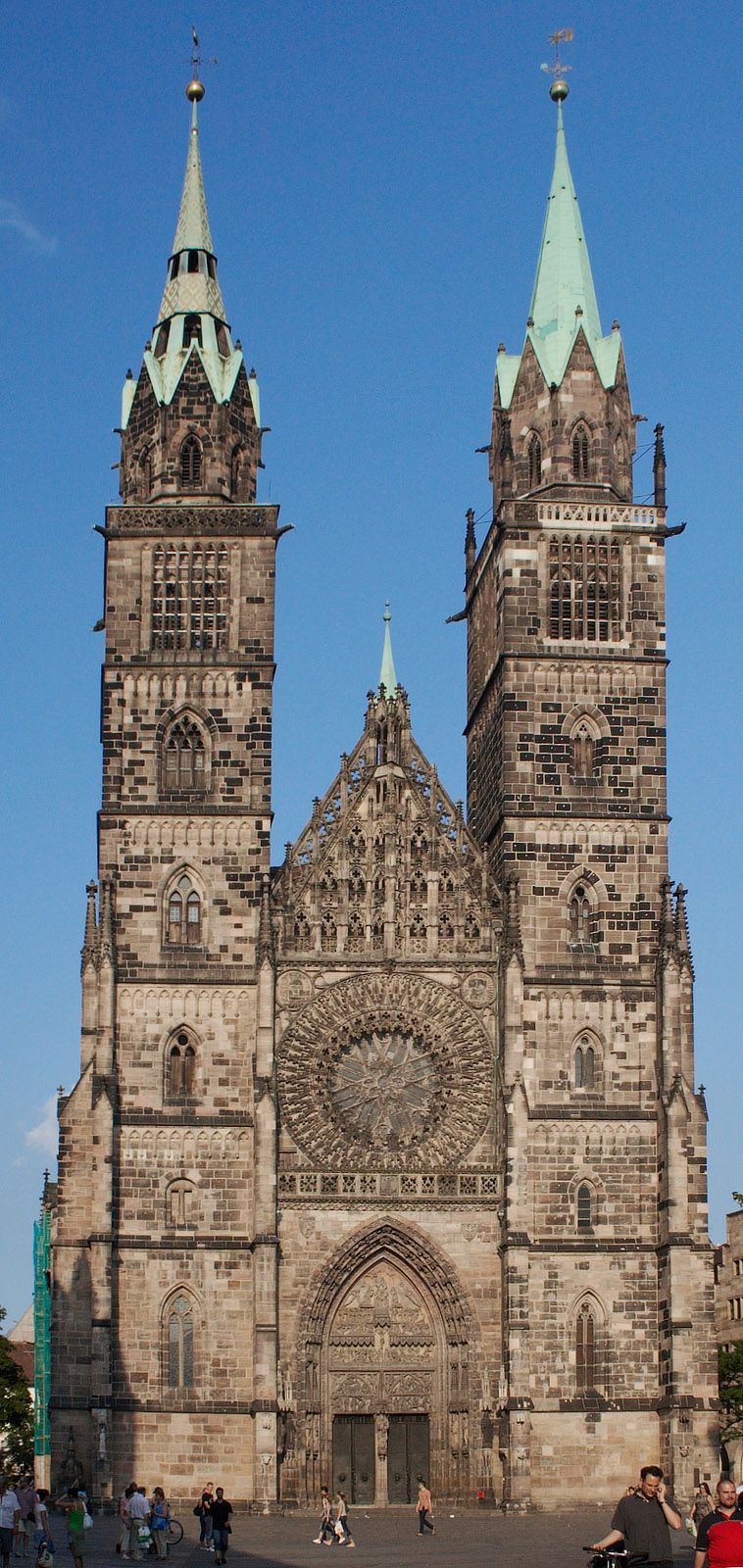
Photo: jailbird, CC BY-SA 2.0 de via Wikimedia Commons
Mostly built in the 15th century and now part of the Evangelical or Lutheran church of Germany, Lorenzkirche forms the focus of the south-side old town. It's dominated within by the 18m tall Tabernacle, a Gothic spire made circa 1493 by Adam Kraft, with himself as one of three figures holding it up. (Find more of his work across the river in St Sebaldus, in the Germanische Nationalmuseum, and in Ulm.) Note also the stained glass windows, and Veit Stoss' "Annunciation" (Engelsgruss) suspended high over the altar.
St. Lorenz is a medieval church of the former free imperial city of Nuremberg in southern Germany. It is dedicated to Saint Lawrence. The church was badly damaged during the Second World War and later restored. It is one of the most prominent churches of the Evangelical Lutheran Church in Bavaria.
© OpenStreetMap contributors
Tugendbrunnen
Six virtuous dames spout water from their breasts, guarded by the figure of Justice.
Often cited as the oldest residential building in the city, its Romanesque cellars date back to the 12th century, while the upper structure is a prime example of late Gothic architecture. This distinctive medieval tower-house is famous for its ornate oriel window and coats of arms. The building is privately owned and can only be viewed from the outside.
Hosts changing art exhibitions. Entry is free on Wednesdays, 18:00–20:00.
One of the largest museum of art and crafts in the German-speaking countries, with a collection ranging from pre-historic artefacts to 20th century art. Allow at least half a day.
Straße der Menschenrechte
A monumental outdoor sculpture, opened on 24 October 1993. It is sited on the street between the new and old buildings of the Germanisches Nationalmuseum, connecting Kornmarkt street and the medieval city wall.
Within Old Town but in a striking modern building, the museum shows art and design from 1945 to today.