//

Hamburg, Germany
Photo: Reinhard Kraasch, CC BY-SA 3.0 via Wikimedia Commons
Eastern Hamburg includes the dense, LGBT-friendly district St. Georg filled with cozy narrow streets between the dense, 19th-century tenements, with its cafe-filled main street of Lange Reihe, as well as a part of lake Aussenalster's shoreline with the venerable Hotel Atlantic. Further east, the density becomes more and more sparse, and the outer districts are mostly residential, with a few less known points of interest for the inquisitive tourist; indeed in the big southeastern district of Bergedorf you can experience some rural attractions.
From the travel guide. Select a place for details, a map and what is nearby.
Museum of Arts and Crafts
The museum is a leading centre for art, applied art, and design. Its collections of work from Europe and the Middle and the Far East are of the finest-quality and span all epochs from the Ancient World to the present day. They also have many activities and concerts (see the Classical Music section). The museum is housed in an 18th-century palace, which has the original roofs and ceilings.
Baroque church in Sankt Georg.
Since 1995, this neo-romanesque church is the cathedral of the youngest Roman Catholic archbishop of Germany. Though the church has not the splendor one might expect, next to it you may find the first statue world wide of the late pope, John-Paul II.
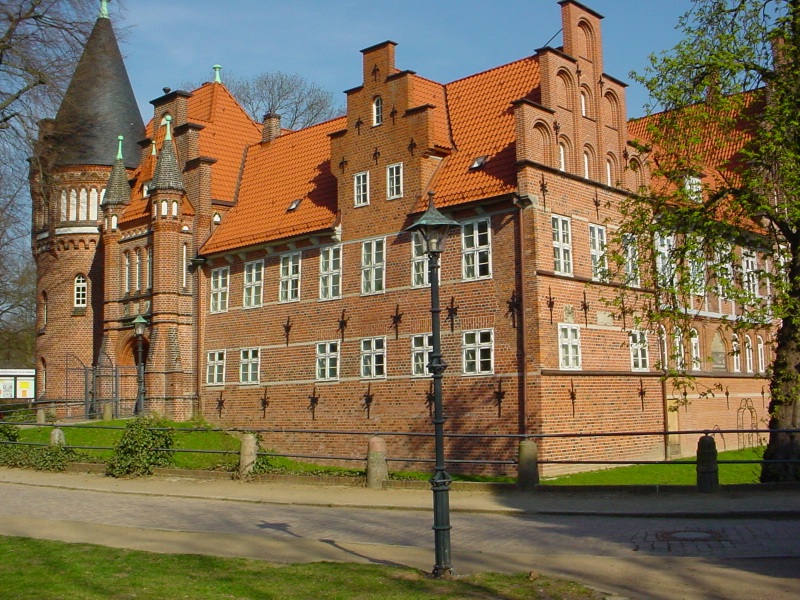
Schloss Bergedorf
This is the only preserved castle inside the city borders of Hamburg, and it has been mentioned in documents in the 14th century. Since 1953 it houses a museum of Bergedorf and the Vierlande region. The idyllic castle park has been protected since 1926.
Rathaus Bergedorf
This castle-like villa was built in 1898-99 and has hosted the city government of Bergedorf since 1927. It is also open to visitors, as is the 35 m high city hall tower (Rathausturm). There is a park (Rathauspark) behind the city hall with a scene, playground, stream and garden artworks.
The astrophysics faculty of the Universität Hamburg is spread over a big park with protected neobaroque buildings with historical equipment for astronomy science including different telescopes. There's a visitor center with a café and tours every Sunday or by appointment.
A Lutheran church, and together with the castle the most important historical building in Bergedorf. The first church was built here in 1162, the current one was opened in 1502.
Built in 1955 in the form of a white cube extended in the east by the altar room, in the north by the sacristy and in the west by the lobby. The church is in the middle of the old graveyard.
Katholische Kirche St. Marien
One of the newest churches in the region, this Lutheran church was inaugurated in 1993. The 40-m-high church tower is visible from far away.
A modern Catholic church building inaugurated in 1993. It is a round church with a flat roof rising up towards the altar.
Open-air museum showcasing the rural life in the Vierlanden before the industrial revolution. The premises was an active farm operated by the Rieck family up until WWII. There are still farm animals there, and several hands-on experiences for visitors such as milking cows.
Windmill built in 1828, though the first windmill at this place was already built in 1318. It has a shop and café, and in the nearby former warehouse there's an interesting shop with local art.
Farm open to visitors with a café, shop, and four cottages.
Built in 1870, this windmill is next to the Reitbrooker Mühlenbrücke ("mill bridge"). This is a so-called "Galerieholländer" windmill; a square two-story stone building with a wooden octagon building on the top. It was used until as a windmill 1938 or 1939, and became a protected building in 1942. It still functions as a mill, albeit not a wind powered one. When the fodder shop is open, you can also see the mill from the inside.
The biggest church in the Vierlande region. First built as a stone church in 1319, and thoroughly renovated in the late 18th century.
After an earlier church, presumably made of rocks, was destroyed by flooding, this timber-framed one was built in 1599-1603. It is an open church and as such can generally be visited anytime (during daytime).
First mentioned in documents from 1247, this is the oldest of the village churches in the Vierlande.
The oldest major church in Hamburg, mentioned in documents from 1261. It has been remodeled and expanded several times, though part of the walls are still from the 13th century. The wooden 26.2-m-high church tower was constructed in 1630.
This 17th-century church features carvings depicting scenes from the Old and New Testaments, and an organ by the famous organ builder Arp Schnitger.
The Museum für Kunst und Gewerbe Hamburg has many smaller concerts — something almost every day — and is much cheaper than the Laeiszhalle. The programs range from the curator of their early keyboard instrument collection playing them and giving a spiel on the music and the instruments (in German only!) to formal concerts of renditions of Schubert's Die Winterreise. Pick up a schedule at the desk of the museum (down the street from Hamburg Hauptbahnhof).
The biggest German speech theatre looks back on a famous tradition. Gustav Gründgens, Ivan Nagel, and Peter Zadek staged highlights in German theatre history here.
Menu changes frequently, fresh food, creativity.
McDonald's Drive-thru for boats
The only McDonald's that you can order your meal (on its app) and have it delivered to the shores while paddling along the canal. The meal is prepared fresh in the restaurant right next to the shoreline.
Excellent Italian and Pizzeria
Trendy restaurant with consistently good international cuisine, often local German dishes
Good Portuguese and German food.
Castle café on the inner yard of Bergedorf Castle.
Steak restaurant in a timber-framed house where there have been hospitality businesses for several decades.
Cafe and restaurant at the edge of Bergedorf Castle Park with lunch, breakfast buffet, home made cakes and a range of special coffees. In the evening the place becomes a cultural club with regular concerts, movie presentations and lectures.
Big restaurant with indoor and outdoor seating and a bar. They have many different menus to choose from; mainly Mediterranean and Northern German cuisine. The complex also includes a hotel and a spa.
Coffeehouse with wide range of delicious self-made cakes and pastries. Famous for its cake buffet, also a great place to have breakfast or lunch. Gay-owned. Customers mixed by straight and gay people of any age. May not be easy to catch a table during rush-hours. For sugar- and caffeine-addicts.
Outdated, worn and quite out of the way, with limited transit options. Pluses include breakfast and proximity to Elbpark for a walk or jog in the morning. Free soft drinks in minibar.
This is just like any other hotel in the Ibis chain — clean basic rooms with bathroom, TV and Wi-Fi. They have a bar and a restaurant too.
A large midscale hotel aimed at travellers staying for longer periods. Rooms have a small kitchenette and many come with extra sofa-beds. Unfortunately, the old Suite Novotel standards are far behind what more modern hotels offer. That said, the hotel is in a tall tower, so if you manage to get a room in one of the upper floors, you can enjoy a nice view of Hamburg.
The hotel's slightly offside location makes it accessible by car and quite cosy. The neighbourhood consists of late 20th century development over canals, which may not be the most interesting in Hamburg, but the Hammerbrook S-Bahn station is a short walk away. The hotel's highlight is the floating event space Kai 10, unfortunately as of 2015 only available for special events. The hotel is easily accessibly by car.
One of the best hotels overlooking the Alster lake. Each room is designed in the "Art & Tech" design. Restaurant with nice view over the lake and spa.
The grande dame of Hamburg has grown to be an internationally recognized paragon of luxury hospitality.
4-star hotel that provides various dining options, gym, business centre, parking and free Wi-Fi.
Most of St. Georg is within walking distance from the main railway station, otherwise there's a rail line for most parts of the east; U1, U3, S1 and S11 for the northeast and U2, U4, S2 and S21 for the southeast.
Read in the guideChoose an airport to see hotels, stations, taxi ranks and car rental desks around it.
Hamburg · International · HAM
Loading places around the airport…
Articles and travel topics about East and Germany.
 Travel tips
Understand travel insurance for a Schengen visa in 2026. Learn mandatory €30,000 medical coverage, zero deductible rules, and embassy-approved policies.
7 min read


 Travel tips
Estimate your Europe trip cost for 2 weeks in 2026. Compare realistic budgets for lodging, Eurail trains, dining, and sightseeing across three styles.
8 min read
 Travel tips
Plan your trip with our Oktoberfest 2027 guide. Learn how to reserve beer tent tables, understand Munich hotel booking windows, and budget daily costs.
8 min read
 Inspiration
Explore the best castle and gothic hotel stays in Europe. Discover historic fortresses, medieval estates, luxury châteaux, and Spanish parador hotels.
6 min read

Every section of the guide. Open one to read it in full.