//

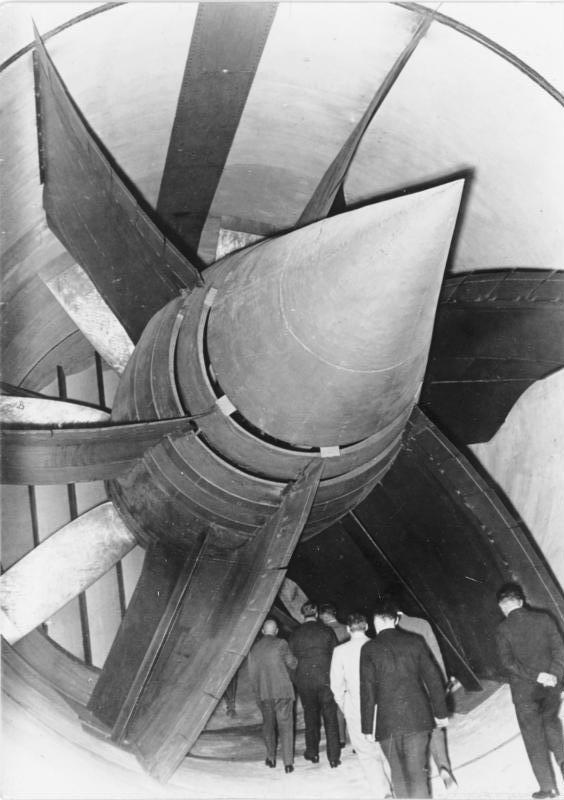
Photo: UnknownUnknown, CC BY-SA 3.0 de via Wikimedia Commons
This aeronautical experimental park on the grounds of Germany's first air field Johannisthal consists of a group of several individual technical monuments such as the walkable Großer Windkanal (High-speed wind channel, 1932–34), the Trudelturm (Fatty tower), a vertical wind tunnel for spinning tests (1934–36), the Schallgedämpfter Motorenprüfstand (Sound-insulated engine test bed, 1933–35) and the Isothermische Kugellabore (Adlershofer Busen, Isothermal spheric laboratories, 1959–1961), which are about 500 metres away from the other monuments.
The Aerodynamic Park of the Humboldt University in Berlin-Adlershof was once part of the German Johannisthal Air Field.
© OpenStreetMap contributors
The Schöneweide forced labor camp (GBI-Lager 75/76) on Britzer Straße is a complete ensemble, which makes it a rather unusual site in Berlin. Of the original thirteen housing barracks erected between 1943 and 1945, eleven are still standing today. Six barracks on the western part of the former camp grounds belong to the Documentation Center on Nazi Forced Labor.
An open-air event in the old town of Köpenick that takes place every year for a weekend once in spring (around end of April) and once in summer (around August). Wineries from (mostly) Germany bring their wine which you get to enjoy at a moderate price. There are also food stalls.
Wuhlheide Kindl Stage
The Kindl-Bühne Wuhlheide is a cultural heritage site and of Berlin's largest and most popular open-air stages for rock, pop and electronic concerts in the shape of an ancient amphitheater.
Pionierpalast Ernst Thälmann
While the former Palast der Republik in Berlin-Mitte has been demolished in favor of the reconstruction of the Berliner Schloss, its counterpart for kids, pupils and "young pioneers", the Pionierpalast Ernst Thälmann can still be seen at the Volkspark Wuhlheide. The large building complex which was built from 1976 to 1979 is a contemporary testimony for architecture in the socialist German Democratic Republic and of the 1970s. It included a cosmonaut training center, a large indoor swimming pool, a theater, restaurants, event locations, and a launch site for model rockets. Today it is called FEZ Berlin and the usage as a center for kids, the youth and families remains the same, with most of the original facilities such as the indoor swimming pool and the space flight training center still in place.