//

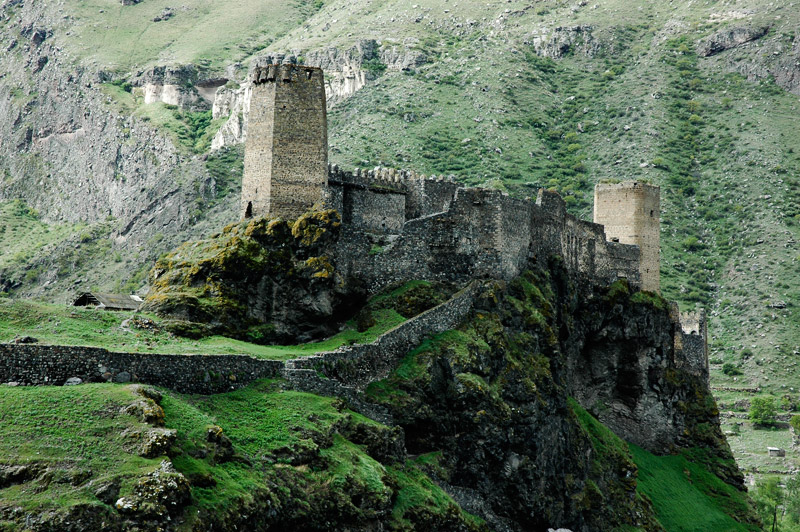
Photo: Laurynas M. from Vilnius, Lithuania, CC BY 2.0 via Wikimedia Commons
This castle looms over the village of Khertvisi at the confluence of the Paravani and the Mtkvari rivers and once guarded an important road between Byzantine Empire and the Caucasus. The outcrop has been used as a fortress from the second century BC, making it one of the oldest fortresses in Georgia. According to legend Alexander the Great passed through here during his Eastern campaign, with some sources claiming he destroyed it. The "modern" fortress, however, was built around the thirteenth-fourteenth centuries, and saw fighting during the Ottoman invasion (and subsequent occupation) in the 16th century.
One of the biggest fortresses in Georgia the elongated castle is more than 150 metres long and more than 30 metres wide. Inside the castle is a five-sided watchtower, a square keep, the 10th century St. George Church and the remains on the eastern wall side of two tunnels go down to the river; one was used for water delivery, the other – as a communication system.
The walls on the far side drop down a sheer cliff to the Mtkvari far below, so if you fancy a bout of vertigo, pull yourself up and look straight down.
Khertvisi is a village in Aspindza Municipality of Samtskhe-Javakheti region, the Republic of Georgia. Situated at the confluence of the rivers Mtkvari and Paravani, the village was set on a number of terraces.
© OpenStreetMap contributors
Zeda Vardzia
A church restored during Soviet times, 1975-1978. and in 1997, returned to use by a community of Christian nuns.
Virgin Mary Church
A late 12th-century church decorated by elaborate mural paintings. Among them are the portraits of Giorgi III and of queen Tamar, his daughter and successor, during whose reign the paintings were created. Other painting include scenes from the New Testament and images of saints. The church is cut deeply into the rocks and even has further interesting tunnels leading from behind the church rooms to the upper level. To enter the church, women must wear long skirts and a head covering, and men must wear long trousers.
This cave monastery contains six churches and very popular with people. Several hundred rock caves on 16 floors, used as shelter, vault, tomb and market. About an hour's walk or 5 km away from Vardzia on the road back to the highway.
The church (St. George) built here dates back to the 8th century. The caves where added between the 9th and 11th century. In 1089, a strong earthquake destroyed parts of the caves and the church. Reconstruction was carried out during the reign of Queen Tamar. In 1204, the old stone wall was rebuilt. Between 1204 and 1283, the site was owned by a feudal family named Mkhargrdzeli-Tmogveli. In 1265, the gate, a bell tower and the hall of the St. George church were built. However, in 1551 and 1576 the place was destroyed by the Persians and Ottomans, respectively. After this the place was not used as a monastery anymore.
A local businessman has built a shed with a large swimming pool inside, which is fed by hot (not so) sulphur water. It is indeed a nice refreshment, especially in winter. But also in summer it can be fun, especially in the evening. Bring some clean qater from the well next to the Vardzia car park to wash yourself after the bath. Otherwise, the water might leave a slight sulphur smell.
The owner is building another pool right where the road goes right to the Vardzia car park. So, reading this, you might already be lucky not to walk the 900 m. However, it will now probably be crowded.