//

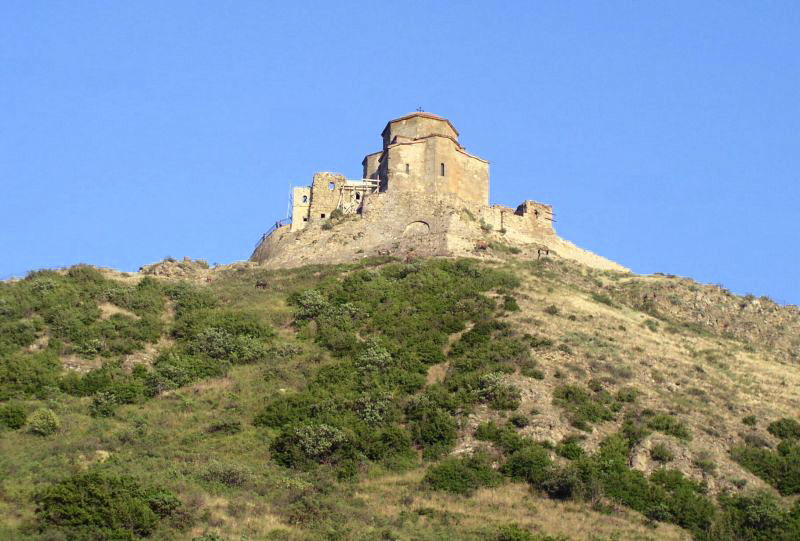
Photo: Holger Zacharias, Public domain via Wikimedia Commons
The 6th-century monastery is the culmination of a number of artistic and architectural aspirations in early Christian Georgian architecture. The view from above is great. Be sure you travel there when there's clear weather and before dusk. It's fairly far to walk.
Jvari Monastery is a sixth-century Georgian Orthodox monastery near Mtskheta, eastern Georgia. Jvari is a rare case of an Early Medieval Georgian church that has survived to the present day almost unchanged. The church became the founder of its type, the Jvari type of church architecture, prevalent in Georgia and Armenia. Built atop of Jvari Mount, the monastery is an example of harmonious connection with the natural environment, characteristic to medieval Georgian architecture. Along with other historic structures of Mtskheta, the monastery was listed as a World Heritage Site by UNESCO in 1994.
© OpenStreetMap contributors
The main fortress of the ancient town of Mtskheta was located at the high point above the river in strategically good position. The excavations of Armaztsikhe-Bagineti have been prepared for visitors and possess explanations in English. Archaeological investigations began in 1943 and three main cultures were identified: the oldest finds were dated to the 1st century BC to 2nd century AD, the central findings on the 3rd-5th centuries, and the latest to the 6th century. Consequently Armaztsikhe was destroyed by the Arabs in the 8th century. There are a royal sarcophagus, vestiges of the ramparts, a fortified tower and supporting pillars, foundation walls of the palace, a bath house, a wine cellar, a pre-Christian temple and a canal system.
The Life Giving Pillar Cathedral
Svetitskhoveli is one of the most sacred places in Georgia and, along with Jvari Monastery, the clear highlight of a trip to Mtskheta. It was founded in 1010, built on the site of Georgia's first church, and contains the graves of the ancient Georgian kings, including Sidonia, who was said to have been buried holding Christ's robe. There are many (unaggressive) beggars at the entrance gate.
Place of the Ruler
According to legend, St. Nino lived on this site and prayed within the smaller of its two extant churches. This small church dates from the 4th century. The larger church on this site was built in the 11th century and contains the graves of Mirian, the Georgian king who adopted Christianity, and his wife.
The Elder's Fortress
The ruins of Bebris Tsikhe are fun, if a bit dangerous, to climb on for views overlooking Mtskheta and the valley formed around the Mtkvari and Aragvi rivers.