//

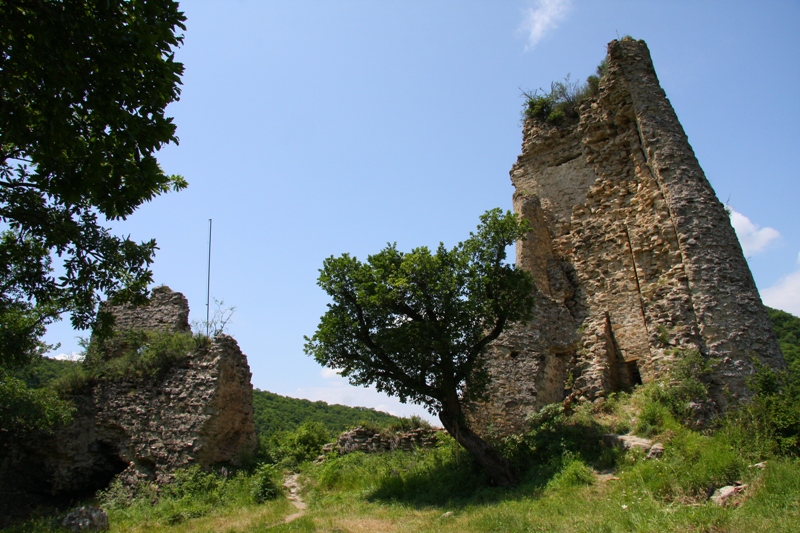
Photo: Nino Ozbetelashvili from Georgia, CC BY 2.0 via Wikimedia Commons
Ruins of a fortress near Sartichala, a former settlement of Germans from Baden Württemberg, who called it Marienfeld. The castle was built during the 3-4th century with the town below to safeguard the canyon of the Iori river against the Persians and Arabs. During the reign of Vakhtang I of Iberia, the castle was extended and used as his residency. In 914, Ujarma was conquered by the Arabs, and the castle was destroyed consequently. In 12th century the castle was rebuilt and renovated by Georgian King Giorgi III., but repeatedly destroyed in the following centuries.
Ujarma is a medieval fortress-town at the Outer Kakheti region, in the municipality of Sagarejo Municipality, Georgia. It is located on the right bank of the river Iori, on the Tbilisi — Telavi road, 4 km north of Ujarma village, near Gombori Pass through Tsiv-Gombori Range in the historical-geographical province Gare Kakheti.
© OpenStreetMap contributors
This complex contains Akhali and Dzveli Shuamta, which were renovated in 2008, including a paved road for access.
A former academy and now monastery, it was founded by Zenon Iqaltoeli on in the 2nd half of the 6th century. Zenon Iqaltoeli was a Christian religious founder and one of so called 13 Assyrian fathers, also buried inside of the monastery. In the 12th century, the theologian Arsen Iqaltoeli, which studied at Mangana in Constantinople and worked together with Johannes Petrizi, founded the academy on the orders of King David. For centuries the academy was the cultural centre of Georgia, teaching theology, philosophy, astronomy, rhetoric, law and mathematics. The monastery was also used as a winery and a smithy. In 1616 the academy was destroyed by Shah Abbas I.
In 1938 the grounds were examined, and the ruins of 59 buildings, several craft businesses and one pressing plant were found. Nowadays, the monastery contains three churches and the ruin of the academy. The main church, Chwtaeba (holy ghost), originates from the 8th century.
The wine harvest festival is happening all around Alaverdi Monastery every September. It takes place several days and reaches its peak on 28th September, the day of the holy Ioseb Alawerdeli (Joseph of Alaverdi). This festival has been a tradition and popular for centuries and even survived the Soviet Union.
Georgian: ალავერდი, ალავერდის მონასტერი, ალავერდის ტაძარი
Built in the 11th century by the order of King Kwirike III. (King of Kakheti), reaching 50 m into the sky, this is the second highest cathedral and third highest church in Georgia (after the Sameba cathedral and the Svetitskhoveli cathedral, respectively). Before it, another monastery was standing here, built during the 4th century by Ioseb Alaverdeli (Ioseb of Alaverdi).
The residential palace of the Chavchavadzes family. It has a charming garden of a medium size.