//

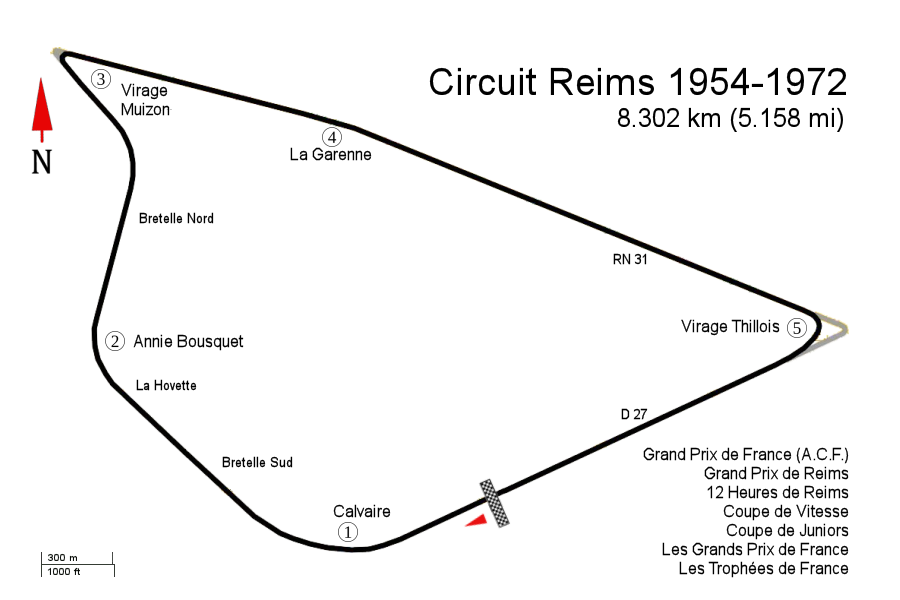
Photo: MotorOilStains, CC BY-SA 4.0 via Wikimedia Commons
The grandstands and other buildings for the former Reims-Gueux Grand Prix motor racing course still stand, some restored by volunteers, others fenced off for safety reasons but still impressive to view from the outside.
Reims-Gueux was a motor racing circuit made up of rural public roads, located in Gueux, 8 km (5.0 mi) west of Reims in the Champagne region of north-eastern France, established in 1926 as the second venue of the Grand Prix de la Marne. The triangular layout of public roads formed three sectors between the villages of Thillois and Gueux over the La Garenne / Gueux intersection of Route nationale 31. The circuit became known to be among the fastest of the era for its two long straights allowing maximum straight-line speed, resulting in many famous slipstream battles.
© OpenStreetMap contributors
A large late-Roman period triumphal arch.
Musée des Beaux-Arts
Dates from the 17th century. Behind it on the right is a fine art nouveau building originally for Mumm champagne, with mosaics showing the champagne making process.
A fine Renaissance mansion.
Notre-Dame de Reims
The French equivalent, somewhat, for England's Westminster Abbey, the cathedral at Reims was the church in which numerous French monarchs were officially crowned. Reims is one of the later Gothic cathedrals and renowned for its height. There is a fine interior west facade with carvings of Biblical scenes; some fine 13c stained glass in the high windows of the nave and choir; and windows by Marc Chagall (in the eastern chapel) and the two local artists Jacques and Brigitte Simon. The south transept window by Jacques Simon shows themes linked with champagne including a portrait of the monk who invented it, Dom Perignon.
Was the archbishop's palace and retains a 13c Palatine chapel.