//

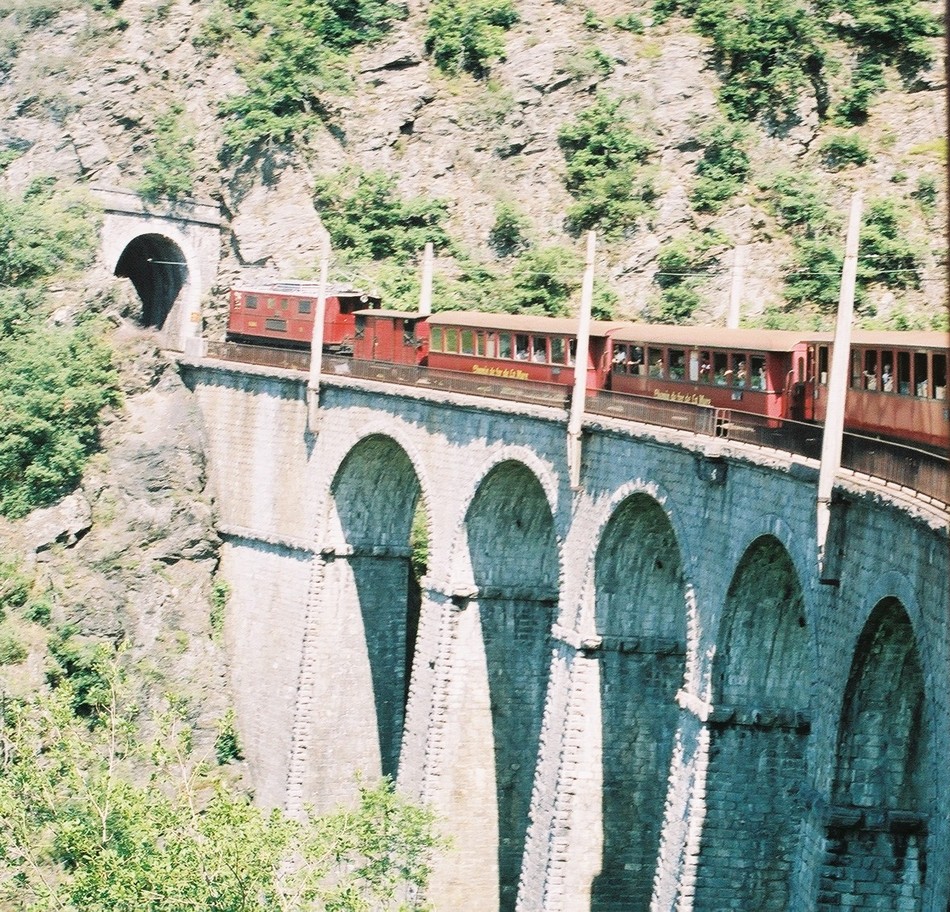
Photo: Fr.Latreille, Public domain via Wikimedia Commons
A train trip with 18 tunnels and a spectacular view on the river Drac and the dam of Monteynard. Saint-Georges-de-Commiers, 17 km from Grenoble. A major rockslide in late 2010 caused the closure of the line. Reopened in 2021.
The Chemin de Fer de La Mure is a former coal-carrying electrified railway in the Department of Isère near the city of Grenoble, France, which lost its regular public passenger service from 2 February 1950. It lost most of its freight traffic – apart from anthracite coal – in 1952, and even the anthracite ceased from 18 October 1988. However, the local tourist office had been chartering seasonal tourist passenger trains from 8 September 1968 and these developed steadily over the years, the line becoming one of the finest tourist railways in Europe with views over dams and lakes, and mountain scenery. Since 1 February 1998 the concession to operate the line and its tourist trains has been held by CFTA, now Veolia. The line can be reached easily by road from Grenoble, or by trains on the SNCF line towards Gap.
© OpenStreetMap contributors
A big park in the centre of the city. It includes a roller skating rink and people often play street hockey. The park also boasts extensive lawns and quiet tree-lined avenues. At the centre stands the tower Perret, built in 1925 for an international exposition about water-power. When illuminated at night with blue lights, it bears a considerable resemblance to both Dr. Who's sonic screwdriver and the Tower of Mordor. For at least 50 years, it has been impossible to go up due to safety problems. After renovations, the tower will reopen to the public in 2022.
Natural History Museum
Facilities for the disabled. The museum has some nice collections on the subject of mineralogy and Alpine wildlife, and also houses an aquarium.
History of the extremely active French resistance in the Alps during World War II. Information is in English, French and German. Entry is free.
Cattedrale di Grenoble
The current Grenoble Cathedral was mainly built in the 13th century and showcases a distinctive Gothic architectural style, notable for its use of brick and a five-sided apse with a vaulted ceiling. The cathedral is part of an exceptionally well-preserved episcopal complex, which includes the nearby Church of Saint-Hugues, a bishop’s residence, cloister, baptistery, and canons’ houses—offering a rare glimpse into medieval ecclesiastical life. Inside, visitors can admire a flamboyant Gothic ciborium from the 15th century, adding to the church’s artistic and historical value. Restoration efforts in the 19th century and archaeological discoveries, including remnants of a 4th-century baptistery found in 1989, have deepened the cathedral’s historical significance. A free tourist guide gives a potted history of the building and some of its works of art (in French, with an English translation written by a native speaker).
Admission is free. The museum is housed in the former bishop's palace on Place Notre Dame. It displays objects and pieces of art narrating the history of the Isère region and its people from Prehistoric times up to the present. Under the museum is an archaeological crypt; the remains of the city's Roman walls and a remarkable 4th-century baptistry, discovered during work on tram line B, are not to be missed. Ask for a free audioguide (French or English) at reception.
French: téléphérique
The cable car is the easiest way to see the town from above, and the trip in the plastic bubbles is impressive. At the summit (some 260 m above the town) is a 19th-century fortress, La Bastille. When you arrive at the top, you can explore the fortifications, have a meal or light refreshments, follow winding paths further up the mountainside or simply enjoy the view (on a clear day Mont Blanc is visible in the distance). If you take the path (GR9) to the rear of the Bastille, you can walk approx 20-30 min further up to Mont Jalla to get an even better view, where there is a memorial to the mountain troops who fought in World War II and a monument erected on the 60th anniversary of the liberation of Grenoble (1944). You can also walk up to the Bastille via one of several paths or go by car from the city of La Tronche. Paths start from the Fountain of lion on the East side, (this path is called Montée Chalemont) or a park on the West, near the large arch (called Jardin des Dauphins).