Money and payments
Cards and cash
There are ATMs in most towns, even smaller ones.
Tipping
In Ethiopia tipping is common in hotels, restaurants and bars.


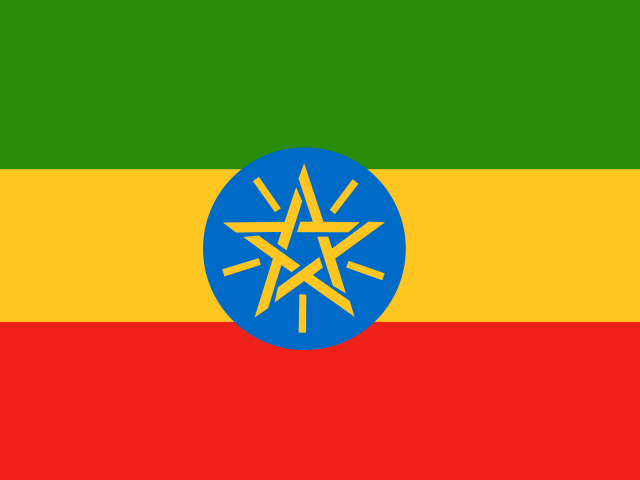 Africa · Eastern AfricaOutline guide
Country in East Africa
Photo: Buzzy, CC BY-SA 4.0 via Wikimedia Commons
Travelers to Ethiopia (Amharic: ኢትዮጵያ ʾĪtyōpyā) experience a country divided into two: in the north and east the focus is on cultural heritage, while in the south there are several national parks and lakes in the area of the East African Rift with their flora and fauna as well as the habitat of several indigenous peoples.
Answers to what travellers most often look up about Ethiopia.
Cards and cash
There are ATMs in most towns, even smaller ones.
Tipping
In Ethiopia tipping is common in hotels, restaurants and bars.
Amharic
Amharic is the first official language and lingua franca of Ethiopia. It is a Semitic language related to Hebrew and Arabic, and if you know either one you'll recognize some cognates.
As such it is highly recommended to get a local SIM card while in Ethiopia.
Mobile networks
Don't drink the tap water.
Don't drink the tap water. It's full of parasites, and hotels generally recommend guests not to drink it, nor to eat salads and uncooked foodstuffs that are usually washed in tap water.
Ethiopians are very proud of their culture, identity, and country. Avoid criticizing their cultural lifestyle, especially their brand of Christianity (Ethiopian Orthodox).
Attractions, food, stays and travel essentials, with ratings, reviews, opening hours and directions.

Addis Ababa (Amharic: አዲስ አበባ) is the capital and largest city of Ethiopia. With an estimated population of more than 6 million in 2026, it is growing very rapidly like many African cities.
Adama or Adaamaa, formerly known as Nazret, is a large city in central Ethiopia. It is a popular weekend destination for residents of Addis Ababa and hosts many governmental and non-governmental conferences.

Axum (አክሱም, also spelt Aksum) is a city of 56,000 in the Tigray region of Ethiopia, just south of Eritrea, with which it shares the language of Tigrinya. It was for nearly 800 years the administrative centre of one of the great empires of the old world along with those of Rome, Persia and China and remains the ecclesiastical capital of the Ethiopian church.

Bahir Dar, also spelt Bahar Dar, on the southern shore of Lake Tana, the biggest lake in Ethiopia, is the third largest city in the nation, after Addis Ababa and Dire Dawa, with a population of half a million. It's the capital of the Amhara region, dominated by the Amhara people, the Ethiopia's second largest grouping; the Ethiopian official language is Amharic.

Dire Dawa in eastern Ethiopia is the second-largest city in Ethiopia.

Gondar (also spelled Gonder) is a historic royal city of Ethiopia, in the northern Amhara region. It was the home of many emperors and princesses who ruled the country from the 12th century to the last decade of the 20th century, including Suseneos, Fasiledes, Empress Mentwab, Iyasu I, Tewodros II and Empress Taitu.

Harar (sometimes spelled Harrar or Harer) is an ancient city in eastern Ethiopia. Harar Jugol, the old walled city is a UNESCO World Heritage site.

Lalibela is a rural town of 15,000 people in a stunning setting at an elevation of 2,600 m (8,500 ft) in the midst of the Lasta mountains in the eastern highlands of Northern Ethiopia. Its unique and remarkable monolithic churches hewn from living rock, most built more than 900 years ago, are one of Ethiopia's leading attractions and were declared a UNESCO World Heritage site in 1978.
Abijatta-Shalla Lakes National Park is in the southern Oromia region of Ethiopia, about 200 km south of the capital of Addis Ababa.

Bale Mountains National Park is in Southern Ethiopia. In 2023 the park was listed as a UNESCO World Heritage Site.

Awash National Park is in Ethiopia. The Lower Valley of the Awash, a site where some of the earliest human remains have been found, was declared a UNESCO World Heritage site in 1980.
Mago National Park is in south-western Ethiopia, towards the border with South Sudan and Kenya. It is east of the Omo River, and stretches south towards the Chew Bahir basin.
Omo National Park is in south-western Ethiopia, towards the border with South Sudan and Kenya, and west of the Omo River.

Simien National Park, also known as Simien Mountains National Park], is in the Amhara region in northern Ethiopia. It was one of the first sites added to the UNESCO World Heritage List in 1978.
Sodere is a spa town (population 1,900) in Ethiopia that has natural hot springs. It is a weekend get-away place for people from Addis Ababa.

Konso is a small town in Southern Ethiopia. It was declared a UNESCO World Heritage site in 2011.
Places in Ethiopia on the World Heritage List.

Axum
Listed 1980

Omo River
Listed 1980

Simien Mountains National Park
Listed 1978

Fasil Ghebbi
Listed 1979

Bale Mountains National Park
Listed 2023

Monolithic churches in Lalibela
Listed 1978

Melka Kunture
Listed 2024

Tiya archaeological site
Listed 1980

The Gedeo Cultural Landscape
Listed 2023

Lower Valley of the Awash
Listed 1980

Konso Cultural Landscape
Listed 2011

Lalibela Cross
List from Wikidata (CC0). Photos from Wikimedia Commons.
The area traditionally known as Shewa, centred around the capital city of Addis Ababa
The historic heartland of the country, with highlands landscape and a cultural history very different from stereotypical Africa
Predominantly Muslim areas, including the holy city of Harar
The diverse regions of the Rift Valley, with more typical East African savannah, lakes, and minority groups
The least travelled area of the country, containing several ethnic groups
Public transport and paid services in Ethiopia.
By bus
Ethiopian buses fit into one of the following categories: the ubiquitous minibuses or matatus (typically Toyota Highace vans that room up to 14 people) that operate throughout the region; small to…
By train
Addis Ababa light railway has two routes in the central part of Addis.
By taxi
Here are some ride hailing apps that work in Ethiopia:
By car
A good way to tour Ethiopia is by car. You can take small aircraft to expedite your tour, but you will see more of the scenery if you travel by car.
Apps for booking a taxi or a ride in Ethiopia.
Finding apps for Ethiopia…
Other ways to travel:By bicycle
Operators checked against their official websites in October 2026; services that have stopped running are not listed. Logos and Wikipedia links: Wikidata (CC0)
Choose an airport to see hotels, stations, taxi ranks and car rental desks around it.
Addis Ababa · International · ADD
Loading places around the airport…
Calculated from climate averages: mild daytime highs and lower rainfall. It does not account for festivals, crowds or prices.
Average conditions in Addis Ababa
| Jan | Feb | Mar | Apr | May | Jun | Jul | Aug | Sep | Oct | Nov | Dec | |
|---|---|---|---|---|---|---|---|---|---|---|---|---|
| Avg. high | 24° | 25° | 25° | 24° | 25° | 24° | 20° | 20° | 20° | 21° | 22° | 22° |
| Avg. low | 7° | 9° | 10° | 11° | 12° | 12° | 11° | 11° | 11° | 7° | 6° | 6° |
| Rainfall (mm) | 12 | 27 | 56 | 90 | 89 | 116 | 239 | 246 | 145 | 34 | 16 | 13 |
| Humidity | 55% | 51% | 55% | 65% | 63% | 68% | 80% | 83% | 80% | 70% | 63% | 59% |
Choose your passport and destination to see whether you need a visa.
Budget
$40
Per person, per day
Mid-range
$100
Per person, per day
Luxury
$260
Per person, per day
| Budget | Mid-range | Luxury | |
|---|---|---|---|
| Accommodation | $20 | $55 | $155 |
| Food and drink | $10 | $20 | $45 |
| Local transport | $5 | $10 | $20 |
| Activities | $5 | $15 | $40 |
Estimate from World Bank price levels (2025). Actual costs vary by city and season. World Bank
—
We do not label countries as safe or unsafe. Below is the official advice from two governments, with the date it was last updated. Always read the full advice before you travel.
US Department of State
Level 3 of 4Reconsider travel
Reconsider travelto Ethiopia due to unrest, crime, kidnapping, terrorism, landmines, communications disruptions, and exit bans. Some areas have increased risk. Read the entire Travel Advisory. Unrest The security situation in Addis Ababa is stable. However, there is sporadic violent, armed conflict, and civil unrest outside of Addis Ababa. The security situation may worsen suddenly without warning. Communications disruptions Internet, cellular data, and phone services are often restricted or shut down before, during, and after unrest. These disruptions affect the U.S. embassy’s ability to communicate with Americans in Ethiopia and delay consular services. Limited consular services for U.S. citizens U.S. government employees working in Ethiopia need special authorization to travel to most locations outside of Addis Ababa due to safety risks. Due to travel restrictions, the U.S. embassy has limited access to U.S. citizens arrested or detained in Ethiopia. Routine consular services are only available at the embassy. Ethiopian law does not recognize dual citizenship. There are often delays in notifying the U.S. embassy of an arrest for dual U.S.-Ethiopia nationals. Exit bans that prevent departure You are subject to local laws. If you break Ethiopian laws – even by mistake – you could face deportation, fines, imprisonment, or an exit ban. Exit bans prevent travelers from leaving. As noted, Ethiopian law does not recognize dual citizenship. Research Ethiopian entry and exit requirements and immigration law if you travel. Dual citizens who have entered Ethiopia on their…
UK Foreign, Commonwealth & Development Office
Advises against all travel to parts of the country
Areas where FCDO advises against travel Border areas FCDO advises against all travel to within: 20km of the border with Sudan 10km of the border with South Sudan 100km of the Ethiopian border with Somalia and Kenya in Ethiopia’s Somali region, and within 30km of the Ethiopian border with Somalia in Fafan zone, except the border town and crossing at Wajale, and the principal road between Jijiga and Wajale 10km of the border with Kenya, except for principal roads and towns 20km of the border with Eritrea Tigray region FCDO advises against all travel to Tigray region. Amhara region FCDO advises against all travel to Amhara region. Afar region FCDO advises against all travel to within 20km of the border with Eritrea FCDO advises against all travel to within 50km of the boundary with Tigray region. FCDO advises against all but essential travel to the rest of Afar. Gambela region FCDO advises against all travel to Gambela region. Oromia region FCDO advises against all travel to: within 10km of the border with Kenya, except for principal roads and towns north of (but not including) the A4 road in West Shewa zone south and west of the A3 road in North Shewa zone, including the A3 road itself in North Shewa West Wollega zone (including the main Addis Ababa to Gambela road), East Wollega zone, Kellem Wollega and Horo Gudru Wollega FCDO advises against all but essential travel to: all of East Shewa zone except the Addis Ababa to Adama Expressway, 10km either side of the Addis Ababa to Adaba expressway between Addis Ababa and Bishoftu, and the A7 from junction with the…
Stories, itineraries and practical advice for travelling in Ethiopia.
 Culture & history
Ethiopia has some of the most historic churches in the world.
Wikivoyage
 Nature & adventure
Many of these parks are on the UNESCO World Heritage List. They can be visited for safaris, to see the African flora and fauna.
Wikivoyage
 Culture & history
Christianity is the world's most prolific religion, with more than 2.38 billion followers, and churches, cathedrals and chapels on every continent including Antarctica. Many of those are UNESCO World Heritage Sites.
Wikivoyage
 Nature & adventure
Volcanoes come in many shapes and sizes, and their eruptions vary hugely in both frequency and intensity. Many volcanoes are tourist attractions and are worth a visit provided you take due care, in particular keeping a…
Wikivoyage
 Food & drink
Coffee is one of the world's most popular drinks, with significant cultural variations. It is also the most consumed psychotropic substance (by number of regular or intermittent consumers) in the world and present…
Wikivoyage
ItinerariesThe Nile (Arabic: النيل, an-Nīl), is Africa's longest river, and by most definitions the longest in the world at 6,695 kilometers (4,132 miles) from its source White Nile in Burundi/Rwanda to its mouth at the Egyptian…
Wikivoyage
Every section of the guide. Open one to read it in full.


