//

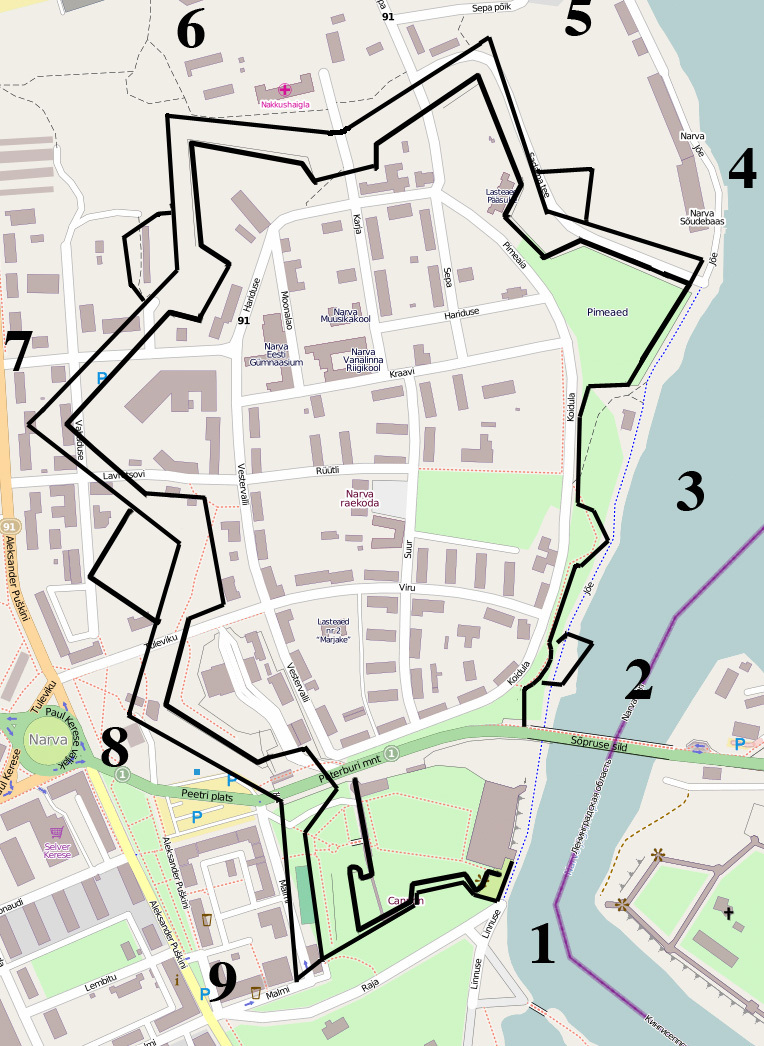
Photo: Macuser, CC BY-SA 3.0 via Wikimedia Commons
Seven bastions were built in the 17th century: Victoria, Honor, Gloria, Fama, Triumph, Fortuna, and Spes. Work has been started to dry and light the bastions. Victoria bastion is the largest and most impressive one of all bastions, with 2-storey casemates, and marked here.
Narva bastions are bastions around Narva, Estonia.
© OpenStreetMap contributors
This is Narva’s oldest part, an example of park architecture from the end of the 19th century. You might be surprised what that just means.
Narva kunstigalerii
The gallery is the art centre of East-Viry County. It is located in an 18th-century ammunition warehouse. In addition to the permanent collection, exhibitions of modern Estonian and Western European art are organized and a traditional art party takes place on the last Sunday in May.
Narva raekoda
Erected in 1668-1671, German, Swedish and Italian architectural influences are mixed in the building style of the Town Hall. The design stems from Georg Teuffel, a former architect from Lübeck. Approved in Stockholm, the design was amended by Dutch classicism elements. Nikolaes Millich built the Baroque entrance portal. Heavily damaged during World War II, restoration was carried out between 1956-1964.
Founded at the end of the 13th century by the Danes. In 1347, the Danish king sold Northern Estonia to the Livonian Order. After that the castle was turned into a convent with a massive tower named Hermann. During World War II the castle and the tower were severely damaged. After 30 years of restoration, the castle was reopened in 1986. The Castle tower overlooks the Ivangorod castle on the Russian side of the river and offers an eclectic display of Estonian and Narva history. The park around the Hermann Castle is for free and allows for good pictures.
Aleksandri Suurkiriku tornimuuseum
Built in 1881-84 by Otto Hippius, who also constructed the Sangaste Castle in South Estonia, the building represents historicism with elements of classicism. The building was financed by Ludwig Knopp, owner of the Krenholm Manufacture. In commemoration of the deceased Alexander II, his name was used. The Alexander Church was damaged during both world wars. The bell tower was destroyed in 1944 along with the Walcker organ that was located there. Between 1962 and 1990 the church was not active but used mainly as storehouse. Today the church's bell tower has been restored. You can visit the bell tower and the observation platform installed there, as well as a museum where artworks from the 14th to 21st century are displayed.
MPEÕK Narva Issanda Ülestõusmise Peakiriku Kogudus
It was built in 1890-1896 for the Orthodox Christian workers of Kreenholm Manufactory. The architectural style comes from Byzantine tradition. You can see three part iconostasis and 17th century’s crucifix of Christ. The bombing of the city in 1944 during the Second World War left only the church untouched.