//

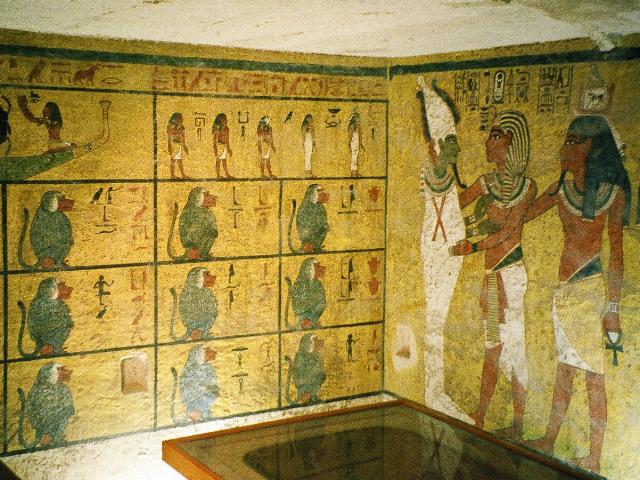
Photo: via Wikimedia Commons, CC BY-SA 3.0
KV62 may be the most famous of the tombs in the Valley, the scene of Howard Carter's 1922 discovery of the almost intact royal burial of the young king. Compared to most of the other royal tombs, however, the tomb of Tutankhamun is barely worth visiting, being much smaller and with limited decoration. Anyone interested in seeing evidence of the damage to the mummy done during attempts to remove it from the coffin will be disappointed as only the head and shoulders are visible. The fabulous riches of the tomb are no longer in it, but have been removed to the Egyptian Museum in Cairo. Visitors with limited time would be best to spend their time elsewhere.
The tomb of Tutankhamun, a pharaoh of the Eighteenth Dynasty of ancient Egypt, is located in the Valley of the Kings. The tomb, also known by its tomb number KV62, consists of four chambers and an entrance staircase and corridor. It is smaller and less extensively decorated than other Egyptian royal tombs of its time, and it probably originated as a tomb for a non-royal individual that was adapted for Tutankhamun's use after his premature death. Like other pharaohs, Tutankhamun was buried with a wide variety of funerary objects and personal possessions, such as coffins, furniture, clothing and jewelry, though in the unusually limited space these goods had to be densely packed. Robbers entered the tomb twice in the years immediately following the burial, but Tutankhamun's mummy and most of the burial goods remained intact. The tomb's low position, dug into the floor of the valley, allowed its entrance to be hidden by debris deposited by flooding and tomb construction. Thus, unlike other tombs in the valley, it was not stripped of its valuables during the Third Intermediate Period.
© OpenStreetMap contributors
The KV9 tomb was started by Ramesses V, but usurped after his death by his successor Ramesses VI, who enlarged the tomb and had his own image and cartouches carved in over his predecessor's. The tomb is one of the most interesting in the Valley, with one of the most complete and best preserved decorative schemes surviving.
KV8
The son of Ramesses the Great, Merneptah's tomb has suffered greatly from flash flooding of the Valley over the millennia. Those paintings and reliefs that have survived, however, are generally in good condition.
KV46
The tomb of Yuya and his wife Tjuyu, the parents of Queen Tiye, the wife of Amenhotep III, and King Ay. It was discovered in February 1905 by James E. Quibell. Until the discovery of Tutankhamun's tomb in 1922, this was the richest and best preserved tomb found in the valley, and the first to be found with major items in situ.
KV34
One of the most remote tombs in the Valley, at the far end of the Valley and up several flights of steps to gain entry. The climb is worth it though. The tomb is of the typical, early curved plan with a large oval burial chamber. The decoration is unique, being in a simple, pleasing style that resembles the cursive writing of the time.
KV43
High in the cliffs above the valley floor, it had been spared the extensive flood-water damage suffered by other tombs, and its wall decorations are consequently very well preserved. The pharaoh's outer stone sarcophagus is also still in place in the burial chamber.
KV57
The tomb of Tutankhamon's and Ay's successor, the last king of the 18th Dynasty.