//

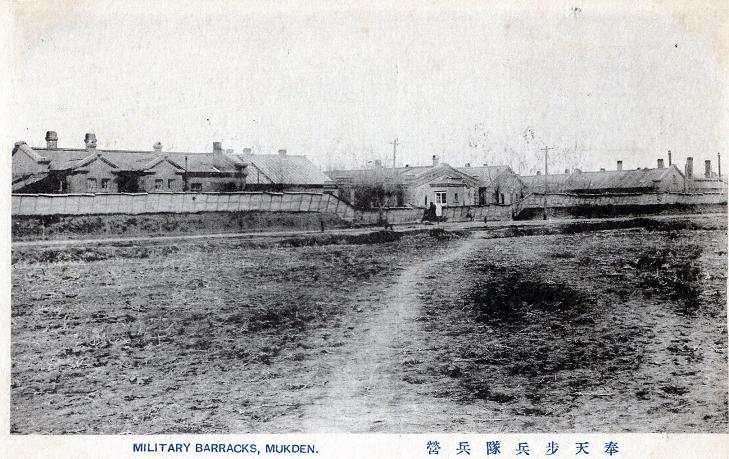
Photo: Unknown 不明, Public domain via Wikimedia Commons
From 1942 to 1945, around 1500 soldiers from six different countries were interned by the Japanese at this POW camp in Shenyang. The site is now a museum. Information is provided in both Chinese and English.
The Hoten Camp was a World War II prisoner of war camp in Manchuria. The camp was located near Mukden and was initially called Mukden POW Camp. Archival records indicate 1,420 Allied prisoners were held here, 1,193 of whom were liberated, and 224 of whom did not survive their captivity. Prisoners at the camp included soldiers from the United States, the United Kingdom, the Netherlands, Australia, and New Zealand.
© OpenStreetMap contributors
老龙口 laolongkou
A small museum beside the Laolongkou distillery tells the history of Baiju production on the site which dates to the early 17th century. The display includes old maps and photographs of the area. Equipment used in the wine production and a collection of old bottles, labels and trademarks used by the company.
抚近门
Marshal Zhang's Mansion 张氏篩府
This was the home of Zhang Zuolin and his son Zhang Xueliang during the end years of the Qing dynasty and the beginning of the Republic. Zhang became, with the fall of the Qing Emperor, the warlord in control of the northeast of China, and for a short time was proclaimed president of China.
故宫 Gugong
Former Imperial Palace - built in 1625 for Nurhachi, and inherited by his son Abahai (Huang Taiji), the Former Imperial Palace of Shenyang is one of two royal complexes extant in China today. The splendid and distinctly ethnic Manchu architectural style of the palace, which includes Dazheng (Grand Politics) Hall, the Ten Princes' Pavilion, Chongzhen (Golden Chimes), Phoenix Chamber and Qingning (Pure Tranquility) Pavilion, are still in perfect shape. On Saturday afternoons during the summer, the palace is the venue for a grand Imperial procession. This is listed as a UNESCO World Heritage Site alongside the palace in Beijing. It is also an AAAA-rated tourist site on the Chinese national scale. A guidebook is available in English at the ticket office, priced ¥25, which provides a detailed explanation of the exhibits. This fascinating palace contains finer details compared to the one in Beijing, such as the exquisitely handcrafted detailed carving and painting, which are still clear after four centuries. The throne room in Chongzheng Hall has incredibly detailed scrollwork -even the columns circled by the watchful dragons and on the throne. The palace also shows a significant influence from the nomadic heritage of its builders in the cold Manchuria.
“九•一八”历史博物馆, 9.18 History Museum
At 22:30 on 18 September 1931, a bomb exploded beside the Japanese-run railway line near Shenyang. Though instigated by the Japanese, the Chinese were blamed for the event giving the Japanese an excuse to invade and occupy the whole of the northeast of China. Shenyang was the epicenter of that invasion, so it is most appropriate that the museum for the Mukden Incident, known in China as the '9.18 Incident', is in Shenyang next to the spot where the explosion occurred. The museum, as one would expect, depicts the incident from a Chinese perspective. It is not for the faint of heart because it unflinchingly displays the atrocities of war. Only the main descriptions are available in English, but it's enough to follow the course of events. The pictures and exhibits speak for themselves, anyway.
太清宮
Taoist temple built in the Qing Dynasty .