//


Province in North China
Photo: Muzzleflash, CC0 via Wikimedia Commons
Hebei (河北; Héběi) is a province of about 75 million people that surrounds Beijing and Tianjin. Much of it lies on the flat North China Plain and is heavily industrial, so few international tourists visit. Those who do will find imperial palaces and tombs, long stretches of the Great Wall, beaches, grasslands and some of China's best skiing.
By train
High-speed trains from Beijing reach most of the province:
By bus
Some places have no high-speed rail, including the Eastern Qing Tombs and the grasslands of the far northwest. For these, take a long-distance bus from Beijing:
By plane
Many travelers fly into Beijing and continue by train. Beijing Daxing International Airport (PKX) sits on the Beijing–Hebei border and has a direct rail link to Xiong'an (see above).
Every prefecture in Hebei has a high-speed rail station; the only region without service is the sparsely populated grassland of the far northwest.
Read in the guideChoose an airport to see hotels, stations, taxi ranks and car rental desks around it.
Beijing · International · PKX
Loading places around the airport…

Provincial capital

Home to Hebei's best-known attraction, the Mountain Resort, a vast palace and garden complex where the Qing emperors spent their summers
Port city where the Great Wall meets the sea at Shanhaiguan

Hot springs, the Huailai Valley wine region, and some of China's best ski resorts at Chongli
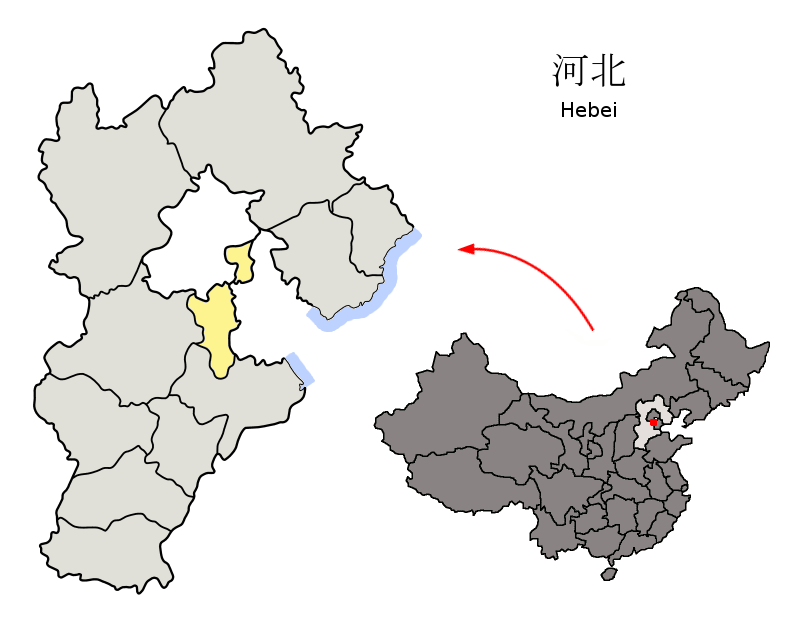
Between Beijing and Tianjin; also administers the exclave that includes Sanhe, a commuter suburb of Beijing

Steelmaking city that alone produces more steel than the United States

Historic provincial capital

Home of the Xiangtangshan Grottoes, Buddhist cave temples carved into limestone cliffs
Industrial city known for fine handicrafts, including glass-bodied painted enamel and inside-painted snuff bottles

Home of the famous 1,000-year-old Iron Lion statue
Oil town, headquarters of the Huabei Oilfield

The two great imperial burial grounds of the Qing Dynasty. The Eastern Tombs in Tangshan prefecture are the grander of the two, with the tombs of the Kangxi and Qianlong emperors and Empress Dowager Cixi. The quieter Western Tombs near Baoding hold the tombs of the Yongzheng Emperor and the Guangxu Emperor, the last imperial tomb built in China. China's last emperor, Puyi, is buried in a commercial cemetery next door, in a grave that differs little from a commoner's.
Qinhuangdao's main seaside resorts, packed in summer with domestic tourists from Beijing and the surrounding region. Beidaihe is the older and busier of the two, popular with families and budget travelers; Nandaihe is quieter and newer, with resort communities such as Aranya that have a cultural and artistic bent.
One of north China's most picturesque mountains
Walled city with over 1,000 years of history as an administrative and religious center, including towering pagodas

Walk across one of the world's longest glass-bottomed bridges
Articles and travel topics about Hebei and China.
 Travel tips
How to qualify for China's 144-hour visa-free transit, set up Alipay and WeChat Pay with foreign cards and navigate train travel as a foreigner.
6 min read
 Itineraries
How to link Beijing, Xi'an and Shanghai by high-speed bullet train, booking Great Wall hikes, Terracotta Warriors and modern urban towers.
6 min read
 Nature & adventure
How to explore Zhangjiajie's sandstone pillars, ride the Bailong Elevator and drift down the Li River through Guilin and Yangshuo karst peaks.
6 min read
 Itineraries
The Yellow River (Chinese: 黄河 Huáng Hé) is one of China's great rivers, the cradle of Chinese civilization and a historic transport route.
Wikivoyage
Every section of the guide. Open one to read it in full.