//

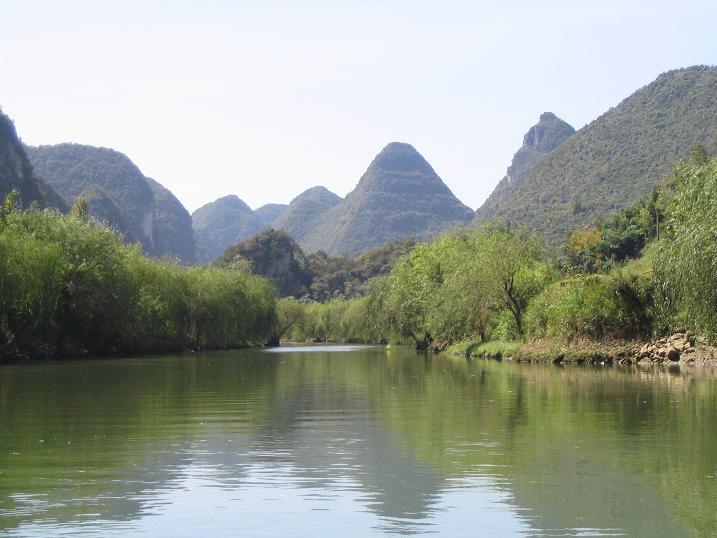
Prefecture-level city in Guizhou, People's Republic of China
Photo: (WT-en) Guiyang laoshi at English Wikivoyage, Public domain via Wikimedia Commons
Anshun (安顺; Ānshùn) is a city in Guizhou Province, southwestern China. The city is rather small, but the huge waterfalls and caves in the surrounding area make this city a popular stop in most trips to Guizhou.
From the travel guide. Select a place for details, a map and what is nearby.
The ancient temple now becomes an elegant tea-house.
A big reservoir.
黄果树大瀑布
黄果树瀑布
The sightseeing bus costs ¥50 per person and is valid for three days. The escalator costs ¥30 one way or ¥50 round trip.
龙宫洞
The vast cave network snakes through twenty hills just 17 miles (27 km) SW of Anshun and 100 km (62 miles) SW of Guiyang. Dragon Castle and Tianchi Lake, the Underground River Karst Cave is 15 km long and is the longest water Karst cave in China; Dragon Gate Flying Waterfall - is the biggest waterfall inside a Karst cave in China. This is a mountain lake that is about 90 meters above the river bed below. The large lake was formed when water from the above cave broke an opening at the bottom thus creating a lake below. You can actually see the water rushing in and making a deafening noise.;
Despite the elaborateness of the Longgong park site, it represents only a small portion of the ninety or more caves in this network. However, like the Huangguoshu Falls area nearby, this region continues to be aggressively developed for tourism – and signs regularly appear pointing the way to modest new ‘scenic sights’ within the Longgong area. Only six caves, all connected by an underground river covering 854 m (2,800 ft), are open to exploration, accessed by boat through the flooded entrance, Tian Chi (Heaven’s Pool), which is partially concealed by a 40-m (130-ft) high waterfall. Inside, the largest cavern is about 80-m (260-ft) high. The caves are filled with colorfully-lit stalactites and stalagmites, and numerous oddly-shaped rock formations. During the rainy season, the boat ride ends at Tiger Lair, a broad platform from where visitors hike out of the caves and walk back to the entrance through an attractive stone forest of weathered karst spikes. The cave is visited by taking a boat tour through the cave but on the far side you have the option to get off and walk to the dry Tiger Cave. The mountain lake runs down to the river below in an impressive waterfall.;
Most other sights here will be anticlimactic after the Dragon’s Cave and many people continue on to Huangguoshu Falls after finishing their boat tour. But if you want to linger, you can follow footpaths to some of the more modest caves or continue on to Guanyin Cave (观音洞), the second biggest attraction in the park, about 3km away.;
To visit, you have to take a guided (Chinese-only) tour on one of the small boats, which lasts about 40 minutes (though in summer the flood of Chinese tour groups causes a watery gridlock that can draw this out substantially). There are three jetties inside the caves, and you need to change boats inside the caves in order to complete the whole journey. Life jackets are provided but choose carefully as some can be a bit dirty and smelly.;
The guides give a little geological background on the caves, but mostly they just point out the various karst formations with their flashlights and let everyone play ‘What does it look like?’. The recorded music and coloured spotlights here can feel a bit over the top at times, but most travellers enjoy drifting through the caves anyway. When busy it can feel very rushed with little time to appreciate the beauty of the caves. It is like a tourist production line. The boat guide uses a green laser to point to interesting features within the cave for half a second and spits out its name but you couldn't see anything because it is all too fast.;
Walking into another cave is quite challenging for older visitors as it is dark and wet in some places, and it is necessary to walk 6 floors down and 6 floors up steps along narrow limestone walls, but mostly the steps are low riser-types and there are sturdy handrails. Taking a lift to avoid climbing a staircase 10 stories high costs ¥25 one way. There is also a flying fox option for younger more adventurous visitors.;
At the end of the walk, there is the choice of taking a tourist bus for ¥20 or walking another 7 km to get back to the starting point or entry. Entrance fee for seniors is only ¥5. Hiring a tourist guide for a group is ¥150;
There are a few small restaurants serving farmers’ or villagers’ meals but at distinctly tourist prices.
Not far away from the exit of the caves, there is a piece of grassland with a large Chinese character "dragon" and there you can take beautiful photo shots.
Over 600 years old, this little Bouyei hamlet is packed with small stone houses, cobbled lanes in a lovely setting is not far from Huangguoshu Falls. Everyone here who is not involved in farming seems to somehow be involved in batik production, and you may be invited into a villager’s home to watch the process. This is becoming a popular stop for Chinese tourists and you can see efforts are being made to spruce the place up for travellers; some of the village equipment has bilingual signs explaining its use and the ponds across the street from the village have been landscaped and are dotted with a couple of small waterwheels. Definitely the Dali and Lijiang influence is strong here.;
An hour or two would be more than enough to see it all, and a stop here is a pleasant diversion either on your way to or back from Huangguoshu Falls. However, the karststudded landscape surrounding Shitouzhai is lovely and some travellers may consider hanging around to explore some of the villages spotting the nearby hills or to do some of the lovely walks that would be possible in the area.;
Sleeping & eating;
There is only one guesthouse open year-round ;
Shítouzhai Jingqu Zhaodaisuo (石头寨景区招 待所; Tel: 1376-536 4841) Just a few metres inside the village gates and run by a lovely family, this place has simple beds in dark wood rooms. The wooden floors are disturbingly creaky but the shared bathrooms and showers are clean and modern. A single room with a Ming-style ‘antique’ bed costs ¥150. Others are under construction and should be accepting guests by the time you read this.;
There are a couple of small restaurants here too, but they are only open in high season months (roughly April to September).;
Getting there & away;
To get here, take a Huangguoshu-bound bus from Anshun and tell the driver you are going to Shitouzhai (¥5-8, 30 to 40 minutes). You will be let off at a road forking away from the main highway. Follow the road for about 2 km until you reach Shitouzhai. You’ll know when you have arrived by the landscaping: there will be a pond with a waterwheel on the right, and, just afterwards, a clutch of stone houses on your left where you will find the village entrance. To leave, walk back to the fork in the road. If you are continuing on to Huangguoshu, most buses heading west will pass the falls; if you are going to Anshun, flag down any bus heading eastward.
Lying about 15 km (9 miles) east of Anshun, Yunshan is yet another fortified village, founded by Ming-dynasty troops. It is not hard to see why there were so many rebellions and uprisings in this area followed by large scale bloody massacres. This one contains a scattering of old structures, including the elegant Qiyan Qiao, a seven arch bridge. Tiantai Shan, 25 km northeast of town, is a 400-m (1,300-ft) hill with a cluster of thickly forested crags, whose summit is crowned by a Buddhist temple dating from 1616. Another 25 km southwest of Anshun, Zhenning County has a concentration of traditional Bouyi villages. The houses are built of skillfully laid drystone walls, with roofs tiled in hand-cut slates, overlapping like fish scales. The village of Shishao, built almost entirely in stone, is known for its Ground Opera, a regional variation of traditional Han opera, brought here by soldiers from Nanjing during the Ming era.
Anshun too, just like Beijing and Sichuan has its very own version of the art: ground opera. Called dixi in Chinese, ground, or ‘open-air’ opera, as it’s sometimes also known, dates back to the Ming dynasty. As part of the performance, actors wrap black see-through cloth over their foreheads and don traditional masks made from bamboo shoots. Up to 50 masks may be used in one opera. The colours of the masks are very symbolic: black denotes righteousness, red symbolises loyalty and bravery, while white indicates evil. Blue and green masks are reserved for monsters or particularly nasty bandits. Banners are also worn on the actors’ backs to denote rank, as in the Běijīng Opera. The operas originally served to drive out evil spirits but have merged with local religious dramas and Han classics such as the Romance of Three Kingdoms and History of the Sui and Tang Dynasties. The plots are livened up by gongs, drums, stilts, flags and displays of martial arts to keep the audience’s mind from wandering during the slow bits.
Around 6000 people live around this ex-army family quarters that dates back to the Ming Dynasty. The local architecture reflects their expertise in stone masonry skill. The houses here use stones instead of tiles to cover the house as there is no mud around. there are numerous examples of ancient housing, though some of this is in serious disrepair and undergoing renovations. Ladies garments normally comprise of colourful long, loose gowns with Chinese embroidery and laces. Ladies wear long scarfs also covering their heads. ;
Here once lived in exile the richest man in the world called Mr Shum. His wealth caused the Emperor to wish to kill him. Mr Shum gave all his wealth to the Emperor in exchange for an exile here. Tourists can see the house of his son where Mr Shum lived for a few years.;
The village is easily reachable, about 25 km or half an hour from Anshun. The village is popular for its ginger infused tea served by local women is indeed refreshing. There is a Ground Opera performance at 11:00 that is worth watching if you get there at the right time. Bathrooms are at the entrance, so go before you go.;
Visitors can hire a minibus in the Anshun minibus area near the railway station for ¥200 for a trip that takes about 30 minutes. You can then hire a guide at the entrance for ¥80 for 2 hours, which might be a good idea as the route winds through the village.
Yunfeng Bazhai is a scattering of traditional villages about 20 km northeast of Anshun. Introduced by the mildly interesting Tunpu Culture Museum (屯堡文化博物 馆 through ticket ¥50; 08:00-18:00), which serves as the point of entry, the village of Yunshan (云山), at the top of a steep set of steps from the road a 15-minute walk from the museum, is a gem. Hung with bright yellow dried corncobs and red lanterns, protected by a wall and a main gate and overlooked by the Yunjiu Shan (Cloud Vulture Mountain), the settlement is a charming and unruffled portrait of rural Guizhou. At the heart of the almost deserted village stands the rickety Money God Temple (Caishen Miao), opposite an ancient pavilion.;
These eight villages are close to each other, and mostly are preserved very well. Most houses are made of stones, even with stone slabs to make roofs for the house. As expected, villagers are the descendants of the soldiers from 600 years ago. They still keep on their traditional costumes, hairstyle, language. With so many army descendants everywhere, it is surprising that there are any minorities left.;
From Yunshan it is a 15-minute walk along the road to the village of Benzhai (本寨), also at the foot of Yunjiu Shan. With its old pinched alleyways, high walls, carved wood lintels, stone lions and ancient courtyard residences, Benzhai is brim-full of history and is also stone and slate and undergoing restoration. There are a lot of old women in local dress who are very happy to be photographed. It is great whether you are a photographer or not. The village has lovely stone houses with slate roofs. The slate is laid out to form a diamond pattern, which is visually interesting and good for photos. ;
Do not miss the chance to walk up to Yunjiu Temple (云鹫寺) at the top of Yunjiu Shan for some of the most extraordinary views in Guizhou. You can walk virtually all around the top of the temple for a sublime and unparalleled panorama of fields and peaks ranging off into the distance. In spring, flowering bright yellow rapeseed plants (youcaihua) add vibrant splashes of colour.;
To reach Yunfeng Bazhai, take a bus (¥5, 40 minutes, every 25 minutes, 07:00-18:00) from Anshun’s east bus station. The last bus from Yunfeng Bazhai to Anshun leaves at 18:20, passing through Benzhai. Coming from Tianlong, hop on a bus from the main road to Qiyanqiao (七眼桥; ¥5, 20 minutes) and then take a motorbike (¥10) for the 10-minute journey to the museum and the villages.
油菜花
From Anshun East Bus Terminal buy a ticket to Le Ping (乐平) which can trace its origins back to the Ming Dynasty (1368-1644) and has been fortified by stone constructions. The women's costumes and accessories are especially beautiful. Knee-length robes with wider sleeves are typical of Tan Bao women's dressing styles. The robe's neckline, cuffs and front are embroidered with colourful designs. They are very good in their embroidery. Ten minutes’ walk upwards from the main entrance of Yunfeng Eight Village is a beautiful golden sea of canola fields. This is a good option in case you miss the rapeseed blossoms at nearby Luoping in Yunnan. The last bus from Le Ping to Anshun is at 18:00.
A very well-organized indoor museum with displays of beautiful stones and wood carvings. The number of items on display was huge and the items are of very high quality and wide variety and are the private collections of a rich Chinese local. Not quite as authentic as the stone and carving wholesale market in Guilin but interesting all the same.
府文庙
The temple is a charming Confucian temple in the north of town with some stunningly intricate cloud-scrolling carvings on the twin stone pillars before the main hall. The building itself is slightly crumbly and dilapidated and the grounds overgrown, but that just adds to its charm.
虹山水库 (Hongshan Shuǐku)
Hongshan Reservoir is popular with locals for paddle boating in summer and polar bear swims in winter. Southeast of the Confucian Temple, Buddhist Donglin Temple was built in AD 1405 (during the Ming dynasty) and restored in 1668. Located down a lane off Zhonghua Donglu, the resident Buddhist monks welcome visitors warmly to this temple. Longwang Miao is another working Buddhist Temple, just off Zhonghua Beilu.
安顺城墙遗址 (Anshun chengqiang yizhi)
A modest chunk of the former Anshun city walls (安顺城墙遗址;) stands opposite the Fènghuángshān Dàjiǔdiàn on Tashan Donglu, where a revealing photo on the wall depicts Anshun during Republican days, before the advent of concrete, road widening and socialist aesthetics.
关岭化石群国家地质公园
Centered around a geological formation known as the Guanling Formation, which is notable for its Triassic fossils. A number of these fossils are displayed at an on-site museum. The museum includes three excavation pits where you can see fossils in situ. There is even a site where visitors are permitted to dig for fossils on their own (though whether you would be allowed to keep them and take them out of the country is another matter).
As of 2025, the world's highest bridge at 625 m. The bridge features a glass sightseeing walkway, specialty coffeehouse with panoramic views and has facilities for extreme sports (e.g. bungee jumping) integrated.
小舒冰粉
Xiaoshu Bing Fen sells a specialty food in southwestern China - Bing Fen. The specialty food of Xiaoshu Bing Fen is Bing Jiang, which is made from fresh fruits, milk, and ice cubes.
黔人百味 • 贵州菜
布依八大碗•多彩黔韵餐厅
贵枫味
黄果树银河假日酒店
清源客栈
By train
The original Anshun Railway Station on Zhonghua Road and was built in 1960. Sleepers from here used to take ten hours to Kunming and 12 hours up to Chongqing.
Bus Number 1 zips around town from the train station and up Tashan Donglu, and on past the Hongshan Binguan. Bus 2 travels between the train station and the north bus station.
Read in the guideChoose an airport to see hotels, stations, taxi ranks and car rental desks around it.
Anshun (Xixiu) · Regional · AVA
Loading places around the airport…
Articles and travel topics about Anshun and China.
 Travel tips
Who can visit China visa-free in 2026: the 30-day list (now including the UK and Canada), the 240-hour transit rule, and how to set up mobile payments.
7 min read
 Travel tips
Find out how much does a trip to China cost in 2026. Compare realistic daily budgets for bullet trains, hotels, dining, mobile payments, and top sights.
9 min read
 Inspiration
Celebrate Chinese New Year 2027 with festival dates, temple blessings, lantern displays, and top party spots across Singapore, Penang, and Taipei.
7 min read


 Travel tips
Compare travel eSIMs for international trips in 2026. Review Airalo, Ubigi, Nomad, and Holafly for coverage in Europe, Japan, and China.
7 min read


Every section of the guide. Open one to read it in full.