//

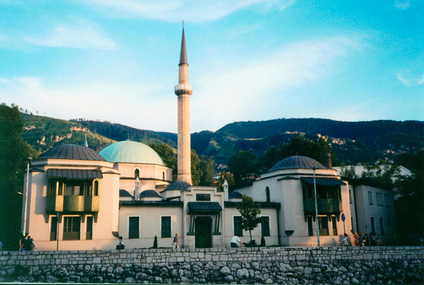
Photo: The original uploader was Asim Led at English Wikipedia., CC BY-SA 3.0 via Wikimedia Commons
This is the oldest mosque in Sarajevo, the first one to be built in 1457 after the Ottomans occupied the city. It is the largest single-subdome mosque in the country, constructed under supervision of Isaković-Hranušić who dedicated it to sultan Mehmed the Conqueror. It was destroyed at the end of the 15th century but rebuilt in 1565 and dedicated this time to Suleyman the Magnificent. The mosque was damaged again in the Second World War and during the 1992-95 Civil War, and restoration work on the painted decorations and interior are still pending. The adjacent cemetery hosts the graves of many former city viziers, mullahs, muftis, sheikhs and other prominent historical figures of Sarajevo. There is also a café inside the walls. The mosque is open to Muslims and non-Muslims, but a visiting woman must cover her hair and wear long skirt or dress within the mosque.
The Emperor's Mosque is a mosque in Sarajevo, Bosnia and Herzegovina. Completed in 1457 CE, it was the first mosque built after the Ottoman conquest of Bosnia. Built in the classical Ottoman style, it is the largest single-subdome mosque in the country.
© OpenStreetMap contributors
Renovated hamam in the Isa-begov Hotel with traditional Ottoman steam room, water pool and massage facilities.
Rezidencija "Konak"
The Konak was built as an Ottoman governors’ residence in 1868 in Late Baroque style during the rule of Topal Osman Pasha, an Ottoman vizier. It was built on a site of a former konak (an official residence in the Ottoman Empire). From 1878 to 1918 during the Austro-Hungarian occupation the Konak was the residence of the Habsburg family, and the Austro-Hungarian Emperor Franz Josef resided in Konak during his visit in May, 1910. During the Yugoslav Republic (1918 to 1941) Konak hosted generals, governors, district-prefects and many politicians from around the world. Today, it is a state residence used by the members of the Presidency of Bosnia and Herzegovina.
Latinska ćuprija
Archduke of the Austro-Hungarian empire, Franz Ferdinand, was assassinated on this bridge on 28 June 1914, sparking the beginning of World War I. A plaque commemorates the event. On the bridge was a memorial to the assassin Gavrilo Princip, but it was removed during the 1992-1995 War.
Small museum in a 1551 Ottoman silk shop, tracing Sarajevo's development from prehistory through Roman, Ottoman, Austro-Hungarian and modern times. Its centrepiece is a model of the Old Town on the ground floor, made by Husein Karišik on the first floor there is a famous blue garment with golden threads and fine yataghan (short Turkish sword).
Muzej Sarajevo 1878–1918
A small museum dedicated to the Austro-Hungarian occupation of Sarajevo, which started with the Berlin Congress in 1878 and ended with World War I in 1918. The exhibition portrays life in the Austro-Hungarian era from different perspectives and themes. The time line ends with the assassination of Archduke Franz Ferdinand and his wife Sophie in front of the building. The few artifacts and photographs include wax figures of the Archduke and his wife, and what are claimed to be the clothes and gun of the assassin. Tasteless photo opportunity with a replica of the car in which the Archduke was assisinated outside costs 1 KM. The location itself is far more notable.
Franjevačka crkva svetog Ante Padovanskog
Roman Catholic church in Gothic Revival style, built 1912-14 on the site of previous versions. The current interior dates from 1960s, with works by leading 20th C artists including Meštrović. The church serves the adjacent monastery.