//

City and municipality in Bolivia
Photo: via Wikimedia Commons, CC BY-SA 3.0
Cochabamba, or simply Cocha, is the fourth largest city in central Bolivia, in a valley with the same name, in the Andes mountain range. Its name is from a compound of the Quechua words q'ucha, meaning "lake", and pampa, "open plain". It is known as the "City of Eternal Spring" and "The Garden City" because of its spring-like temperatures all year round. It is also known as La Llajta, which means "town" in Quechua.
From the travel guide. Select a place for details, a map and what is nearby.
Ciudad Jardín typically feature more modern cars, and have placards inside of the vehicle with the driver's name and ID number. They have an app for mobile devices to request services.
Renacer operates primarily out of the Muyurina area.
Jacarandá operates primarily out of the Cala Cala neighborhood.
The statue is just a bit higher and larger than the one in Rio de Janeiro, making it the world's largest statue of Jesus until 2010, when a larger one was completed in Poland. It offers a great view of the city. Walk Calle Colombia until its eastern end, then a swift right: This park/playground is where the cable car goes from, Bs. 6.50 each way. You can also walk. The stairs are safe during the day. After sunset it is better to go in a group of 4 or more. However, the warning displayed at the cable car station, not to use the stairs, is obviously just there to make more money. The cable car is often under maintenance. There is no good way to know before heading out to the station, but the local newspaper is pretty good about updating any changes.
Display of native and non-native flora.
The main hospital in Cochabamba, Hospital Viedma, has a cute little medical museum attached, with some amazing old x-ray machines. The museum is near the corner of Venezuela and Oquendo.
Awesome archeological museum with mummies, deformed skulls, amazing pottery and other artifacts. Well worth a visit.
1760 convent that is restored for viewing.
Dancing fountain light show at night. Occurs from around 20:00-22:00 and small entrance fee.
Cochabamba's other popular square, next to city hall, and a little greener than Plaza de Armas, 14 de Septiembre.
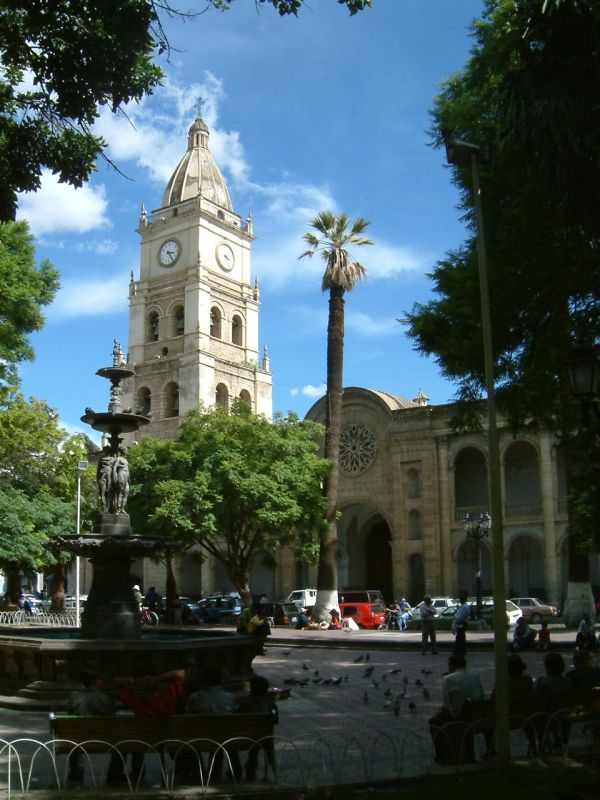
City center, site of commemoration of Bolivia's independence, where you can feed the pigeons and look at the Metropolitan Catedral of Saint Sebastian.
If you are interested in seeing different flags of the world on display, this might be of interest. But it makes for a pleasant stop if walking along the prado, and sometimes there are arts and crafts on display.
Centro Pedagógico y Cultural Simón I. Patiño
Includes the Palacio Portales mansion, gardens (Jardines), and an art museum (Centro de Arte Contemporáneo). The mansion was built by Patiño, a tin magnate who controlled over half of the nation's output in the 1930s.
Cable Car
Cable car to the top of Cristo de la Concordia peak.
The biggest cinema in town features a handful of showrooms mostly flashing the latest Hollywood fare, and a food court.
A great arts and performance center based in an old slaughterhouse. They have rotating art exhibits, music performances, and other interesting stuff.
Small park with amusement rides, concrete caricatures, and aquarium. May be of particular interest to kids but a bit neglected and dirty at times.
Andes Extremo is an excellent choice for paragliding and also offers other outdoor activities including rock climbing. You can book a tandem flight with a fantastic view on the Cochabamba valley for about Bs. 350. One of their rock climbing options is in Quarry Angostura, which will cost you US$45 per person for 1 day (half day) with a minimum of 2 people. The difficulty level is 5a-6c.
Height: 5035 m. This mountain can be done without a guide, but you need to take care and be aware of water, sun and altitude. It is a 4-hr climb one-way, so you need to start early. First you go to Quillacollo, where you transfer by taxi or other transport towards the mountain and its trailhead. Best ask your hostel or hotel which are the exact buses and destinations. The hotel might also recommend a local guide if you want.
Great with a paddleboat that you can rent, or a jetski, or be pulled by one. There is a jetski and boat rental station on the lake. Alternatively, you can just enjoy the lake and the view of the hills around or go for a delicious grilled fish in one of the villages around the lake, such as Achamoco. There are nice views of the sunset along Ruta 7 (Lat ).
An excellent social justice organization which offers volunteers the ability to train and facilitate with required social issues affecting many underrepresented Bolivians. They offer a homestay with safe, respectable families as well as a social network to keep you in the loops of cultural events whilst staying safe.
Sustainable Bolivia is an umbrella NGO that matches volunteers with local projects in Cochabamba. They typically have 15-25 volunteers working between the 25-30 local projects at any given time. They rent three houses that volunteers will live in, and also offer homestays. Most volunteers will confirm their projects several weeks before starting, and will commit to at least a month in Cochabamba. That means that their houses are sometimes full, and they cannot provide housing to walk-ins, particularly those who cannot commit to at least a month of time. Grants to organizations are administered by the volunteers themselves, so they know how the money is being used.
A Brazilian churasco style restaurant where the waiters comes to your table with a good selection of freshly grilled meats. Delicious. Note that there is only the choice of a buffet style dinner in the evenings, priced very reasonable.
One of the upscale restaurants in Recoleta. Large plates of food (even the half-plate was too much) and good pique macho and other local dishes. Price range is Bs. 37-50. Probably one of the best restaurants in town. Highly recommended.
Bolivia's favorite family restaurant. The main joint on Heroinas is always packed, with four dining floors and enough dancers in animal suits to keep the entire juvenile population of Cochabamba entertained.
Very neat and clean.
Not near the city center at all, but it has the reputation of best charque joint in town. Some people say that you can't leave Cochabamba without trying the charque, though it does really just taste like fried beef jerky. Charque is llama meat which is dried, then baked in the oven, then fried for the ultimate crispiness. The half-plate at Jacaranda comes with at least a pound of dried llama jerky, 2 boiled eggs, and the tastiest choclo (oooh the cheese slab was so thick and crumbly).
Upscale and pleasant Argentinian steak place. Portions aren't of the legendary Cochabamba size, but rather of the normal steak-portion size. Word is that the salad bar is amazing. You can get those skinny skinny chip-like potato fry crisps here.
North American style dishes and internationalized Bolivian classics. Yummy hot wings. The restaurant has the air of a place for the "see and be seens" in Cochabamba. Recommended. Avenida Ramon Rivero, on the corner of Lanza. Open in the evenings.
Small but filling menu, -somewhat spicy. The Plaza branch, with live piano music on Sundays, is a great place for brunch. Try the hearty menudito.
The food here isn't authentic Asian. It's slightly pricey, with sushi (mostly trucha-salmon) imported from La Paz.
Good icecream, many coffee-drinks, some cakes and burgers.
Hot and cold buffet lunch Bs. 10-20, the homemade jugs of juice are delicious. Ordering off the menu is possible in the evening, but not as good. Beautiful open courtyard to sit in. This is the same courtyard as that of the Hostel Naupa House.
Vegetarian and vegan options. American cuisine.
Parisian style café with both filling and sweet crepes as well as a good coffee. Very reliable WiFi available too.
After school hangout for 18-25s. Star Wars decor. Rock music. Cheap dinners. Probably the most colourful range of shots in the country. Bottoms up!
Full dance floor, mostly classics, i.e. reggaeton.
Starts out as a bar, turns into a club. Mostly Latin music.
Nice warm up venue. Tables, bar, play dice.
Hostal Buenos Aires
Excellent location. Very thin walls. In-house restaurant.
Fairly quiet, some long-termers, popular among Brazilians. You might share water pressure with you neighbours and the rooms smell strongly of cleaning fluid everyday. Small breakfast consisting of bread and tea included. Safe parking. And, yes, there is a garden here. If you stay for 10 days in a row, you can get a discount to Bs. 25 per day for a single with shared bath.
Decent budget hotel in a passable location, a solid 3-4 dark blocks from many of the restaurants and bars on Calle España. Singles Bs. 70, doubles Bs. 120, with bath and breakfast. It competes with the Hotel Las Vegas (similar prices and standard) across the street for the cheesiest norteamericano decor.
Newer hostel, with a great location along c/ España. Pricier than most other options you'll find in town at Bs. 75-90 per night for dorms, but it seems to be much cleaner and better maintained than typical in Cochabamba.
Small, but neat rooms, around a cozy courtyard. Expensive internet.
Has clean doubles for Bs. 60 (Bs. 20 more for a TV), though a not too friendly staff.
Not such a good location, can be very dangerous at night and is recommended to take a taxi to and from hostel, laundry service, helpful staff.
The Apart Hotel Regina, offers both rooms and apartments with kitchens. It is close to El Prado and many popular night spots. However, noise isn't a problem while sleeping. Staff at the reception desk speak English, and are friendly. The room decor is outdated and the carpets need to be replaced. There is hot water and good water pressure. All the rooms have free Wi-Fi. On-site parking is available. The buffet breakfast is 07:00-10:00.
A range of options in terms of pricing from mid-range to high-end. A large convention center makes this hotel well-suited for business travel.
Free parking and daily breakfast provided. Caters to American tourists while also providing conference space. There is a restaurant, Los Espejos, at the hotel.
El Hotel de las Estrellas
Stylistically modern hotel with a cafe and restaurant and a range of room options.
Hotel Boutique
This hotel in northern Cochabamba is designed in the traditional, colonial style with a nice courtyard and restaurant.
One of the city's biggest attractions, the city market on the south side of town and the largest open-air market in South America. Clothing, food, souvenirs, or books, the Cancha has it all. The best day to visit the market is on Saturday, on other days not all the shops are open. Pickpockets are fairly common in this area.
Stylistically modern commercial center, food court, and art gallery.
Offers offers a wide range of trekking, camping equipment and gear.
By plane
A taxi to the center of town from the airport ranges between Bs. 25-35 (approx.00) depending on the distance.
By taxi
Most cars honking at you are cabs. Ask and negotiate the fare before entering a cab.
Choose an airport to see hotels, stations, taxi ranks and car rental desks around it.
Cochabamba · International · CBB
Loading places around the airport…
Articles and travel topics about Cochabamba and Bolivia.
 Itineraries
The Jesuit Missions of the Chiquitos are a UNESCO World Heritage Site in the Chiquitania region of Bolivia's department of Santa Cruz.
Wikivoyage
 Itineraries
If you find yourself in Buenos Aires and want to do some overland travel in South America, why not make your way north, through northern Argentina and Bolivia all the way to the ancient city of Machu Picchu.
Wikivoyage
 Travel tips
The main air hubs of South America are Sao Paulo, Buenos Aires, Bogota, Santiago, and Lima, so many flights to other parts of South America will connect in one of these hubs.
Wikivoyage
 Nature & adventure
Bolivia has spectacular natural scenery and astounding biodiversity, both of which are protected in its national parks, monuments, sanctuaries and biosphere reserves.
Wikivoyage
Every section of the guide. Open one to read it in full.