//

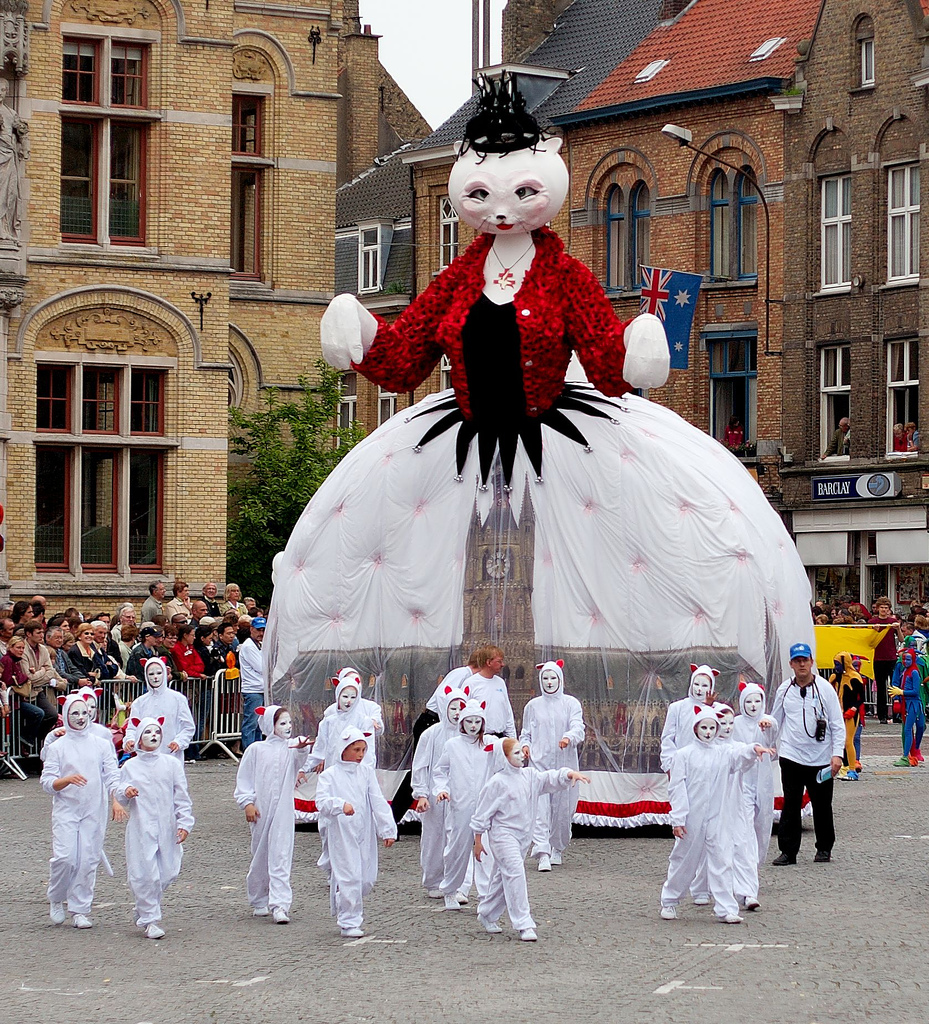
Photo: User cirdub at flickr.com, CC BY-SA 2.0 via Wikimedia Commons
A parade in Ypres devoted to the cat. It is held every third year on the second Sunday of May. This "Festival of the Cats" commemorates an Ypres tradition from the Middle Ages in which cats were thrown from the belfry tower of the Cloth Hall to the town square below. Symbolically reviving this practice for the parade festivities, a jester tosses stuffed toy cats from the Cloth Hall belfry down to the crowd, which awaits with outstretched arms to catch one. The throwing of the cats from the belfry is followed by a mock witch burning.
The Kattenstoet is a parade in Ypres, Belgium, devoted to the cat. It has been running regularly since 1955 and is usually held triennially on the second Sunday of May. The parade commemorates an Ypres tradition from the Middle Ages in which cats were allegedly thrown from the belfry tower of the Cloth Hall to the town square below.
Menenpoort
Dedicated on 24 July 1927 as a memorial to the missing British and Commonwealth soldiers who fell in Belgium during World War One. Has a Last Post Ceremony each night at 20:00 as a way for the Ypres citizens to express their gratitude towards those who died for Belgium's freedom.
This museum gives an excellent overview of World War I. It is more like an experience that takes you right into daily life during the war. The experience is very moving, and it's a must-see for everyone coming to Ypres, young and old. Allow at least 2 hr for a full museum visit. When the weather is good enough, the belfry tower is also available for visiting for an additional cost, giving you a great overview of the front region.
Military cemetery in the town of Ypres with 198 Commonwealth soldiers buried next to the Lille Gate (Rijselpoort).
Museum in a beautiful setting, telling the story of the Great War in chronological order. Lots of information on the different battles and a large selection of authentic artifacts on display. The big bonus of the museum is a reconstructed dug-out which lets you experience what life under Flanders Fields must have been at the time.
The largest Commonwealth War Graves Commission cemetery in the world, situated to the south of the village of Passchendaele. There's a massive wall at the back of the cemetery, containing names of many missing soldiers. The battle of Passchendaele is known for its big loss of human lives, for a minimal gain in worthless territory. There are also many more smaller Commonwealth cemeteries dotted around the region as well.
One of the most important German cemeteries from the First World War lies in the village of Vladslo, north of Ypres and close to the city of Diksmuide. In one of the few oak-tree woods in the area lie hundreds of square black stones with the names of the buried soldiers. The Peace Treaty of Versailles denied the losers of the war the use of white stone. The stones lie in rigid lines in the grass under the trees. No flowers decorate the burial grounds. Includes a statue by Käthe Kollwitz called "The Grieving Parents".